
Perelman Performing Arts Center
40.7126° N · 74.0123° W · Opera House
Photo: Zachbarbo · CC BY-SA 4.0 · Wikimedia Commons
Perelman Performing Arts Center is a performing arts center at the World Trade Center in New York City. Designed by New York architecture firm REX, led by Joshua Ramus. The free Lokali audio guide runs 8 minutes.
✓ Published October 2026 · how we write these guides
Visitor facts
| Lokali audio guide | 8 min · free |
|---|---|
| Type | Opera House |
| Location | New York, United States |
| Coordinates | 40.7126, -74.0123 |
| Official website | pacnyc.org |
| Languages | 50+, in the Lokali app |
The story
Stand at the edge of the plaza and look up at the cube. In daylight its walls look pale and slightly cool, like the inside of a seashell. Veins of grey and soft amber run across the surface. Then touch the nearest panel, if you can reach one. It is smooth and cold, and it is not quite what it seems. This is stone, but it behaves like glass. Welcome to the Perelman Performing Arts Center, the newest cultural building at the World Trade Center.
The facade is the first surprise. Those panels are real marble, quarried in Portugal, and cut so thin that light can pass through them. Each slice of stone is laminated between layers of glass for strength. During the day, the stone reflects the sky and the towers around it. After dark the effect reverses. Light from inside shines outward through the marble, and the whole cube glows a warm honey colour. It looks less like a building and more like a lantern set down among the skyscrapers.
The design comes from the New York architecture firm REX, led by Joshua Ramus. The firm chose a simple shape on purpose. Around it stand some of the most dramatic structures in the city: the tall glass spire of One World Trade Center, the white ribbed wings of the Oculus, and the dark, falling water of the memorial pools. A loud building here would compete with all of that. Instead, the cube stays quiet. It holds its ground through material and light, not through height or ornament.
This site waited a long time for its building. After the attacks of September 11, 2001, the master plan for the rebuilt World Trade Center set aside a place for a performing arts center. The idea was simple and humane. A neighbourhood of offices and memorials also needed a place for music, theatre and gathering. For many years, the plot held temporary uses while plans changed and funding shifted. The center finally opened to the public in September 2023, more than two decades after the original vision.
The building carries the name of Ronald O. Perelman, the businessman and philanthropist whose major gift helped move the project forward. Other public and private donors supported it too, and the effort involved many city and state partners. You will sometimes hear people call it simply PAC NYC. That short name appears on its signs and programmes. Whatever you call it, the institution sees itself as a commissioning house. It presents new theatre, music, dance, opera and film, and it works with artists to develop original pieces.
Now here is a detail most visitors walk past without noticing. The cube does not sit directly on the ground. Underneath this part of the World Trade Center site runs important infrastructure, including the secure vehicle and loading systems that serve the whole complex. Because of that, the performance spaces could not go at street level. The architects lifted the theatres up, and they placed a lobby and a broad staircase below them. When you climb the steps from the plaza, you are climbing over the working machinery of the district.
Inside, the building holds a second surprise. It contains three main theatres, but they are not fixed rooms. Large movable walls and sound-proof partitions let the spaces open into one another or close off completely. Seating can shift as well. In practice, this means the center can change shape for each production. One evening it might hold an intimate play for a small audience. Another evening the walls might rise to create a single large hall. The architects designed for dozens of possible arrangements, so artists can build the room around their work.
This flexibility matters for the kind of art the center wants to present. A traditional theatre tells the audience where to sit and where to look. Here, a director can place the audience around the action, along one side, or on several levels at once. Sound engineers worked carefully on isolation, so that a loud concert in one room does not disturb a quiet drama in the next. That is not easy in a building surrounded by subway lines, traffic and construction. The quiet inside is a technical achievement you can hear but not see.
The ground-floor lobby is open to the public, even if you have no ticket for a show. That was a deliberate choice. The planners wanted the building to feel like part of the street, not a closed fortress. The lobby includes a restaurant and bar, and it is a comfortable place to sit for a while. Look at the interior surfaces and the rich, warm tones of wood and stone. After the hard edges and polished glass of the surrounding towers, the space feels softer and more human.
Take a moment to think about the neighbourhood around you. Before the attacks, the World Trade Center was mostly a place of work. People arrived in the morning and left at night. The new district tries to change that rhythm. Shops fill the Oculus, families walk through the memorial park, and residents now live in nearby towers. A performing arts center gives people a reason to stay after dark. When the cube glows in the evening, it signals that this part of Lower Manhattan is alive at night as well.
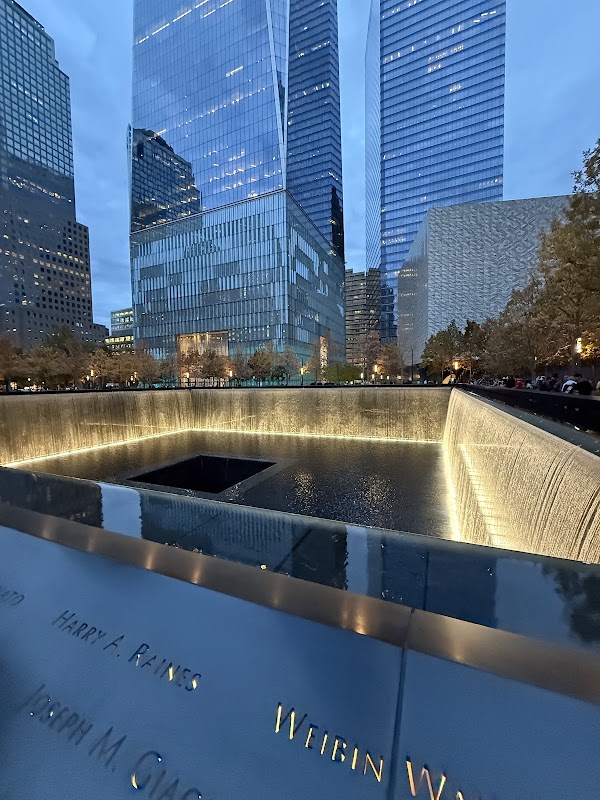
The building also sits in a sensitive place. Just a short walk away, the names of the people who died in 2001 and in the 1993 bombing are cut into bronze around the memorial pools. Many visitors arrive here quietly, after time at those pools. The architects understood that. The plain, calm form of the cube does not shout for attention. It offers a different kind of response to loss — a space where people come together to watch, listen and share a story in the same room.
If you return in the evening, watch the transition from day to night. As the sky darkens, the stone slowly changes from pale grey to glowing gold. The veins in the marble become clearer, like lines on a map. Photographers like to frame the cube against the dark glass of One World Trade Center, or catch its reflection on wet pavement after rain. Even without a camera, it is worth standing still for a few minutes. The change is slow, but it is complete.
Before you move on, look once more at the wall closest to you. Notice the way the marble patterns repeat and break from panel to panel, because every slice came from a different piece of stone. Listen to the sound of the plaza, the footsteps, the distant traffic, the falling water from the memorial. Somewhere inside, a rehearsal may be taking place right now. As you walk away, glance back over your shoulder. The quiet cube will still be there, holding its light among the towers.
Key facts
What to look for
Practical tips
Common questions
Is there a free audio guide to Perelman Performing Arts Center?
Yes — the Lokali app narrates Perelman Performing Arts Center free of charge in 50+ languages. The guide runs about 8 minutes, covers the history, what to look for on site and practical tips, and works offline once downloaded.
Where is Perelman Performing Arts Center?
Perelman Performing Arts Center is in New York, United States, at 40.7126, -74.0123. Tap the map link on this page for directions from where you are.
What is Perelman Performing Arts Center known for?
Designed by New York architecture firm REX, led by Joshua Ramus. Facade uses thin Portuguese marble laminated between glass layers.
What should you look for at Perelman Performing Arts Center?
Grey and amber veins running across the marble panels. Broad staircase rising from the plaza to the lobby. Unique stone pattern on each individual facade panel.
What should you know before visiting Perelman Performing Arts Center?
Return after dark to see the marble facade glow. Visit the public ground-floor lobby even without a show ticket.
On the map
Opens directions to Perelman Performing Arts Center from your location.
More to see in New York


Hear Perelman Performing Arts Center in your language
The full story, narrated, in 50+ languages. Download it before you go and it plays offline, at your own pace, with no ticket and no tour group.