
St. Nicholas Greek Orthodox Church
40.7103° N · 74.0139° W · Church
Photo: DutchTreat · CC BY-SA 4.0 · Wikimedia Commons
St. Nicholas Greek Orthodox Church is a church in New York City. Original church was a converted row house on Cedar Street. The free Lokali audio guide runs 7 minutes.
✓ Published October 2026 · how we write these guides
Visitor facts
| Lokali audio guide | 7 min · free |
|---|---|
| Type | Church |
| Location | New York, United States |
| Coordinates | 40.7103, -74.0139 |
| Official website | stnicholaswtc.org |
| Languages | 50+, in the Lokali app |
The story
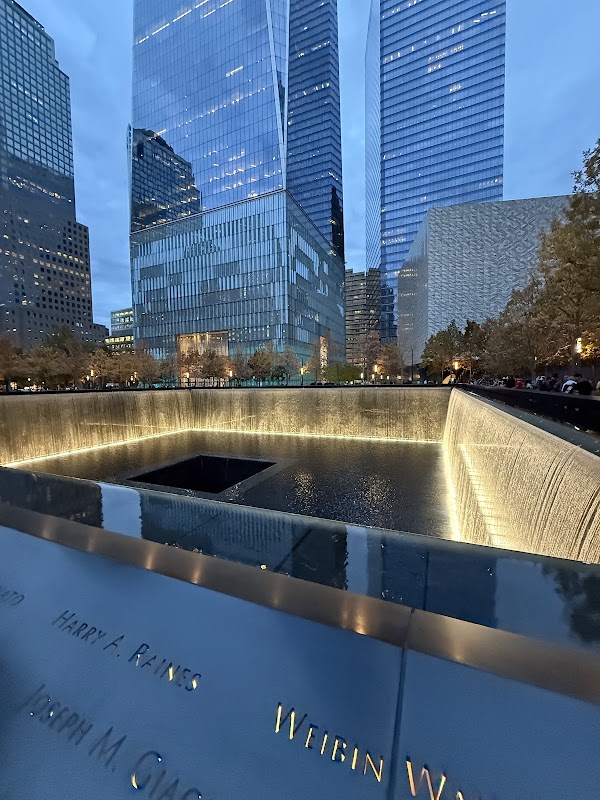
Stand still for a moment and listen. Behind you, water falls without stopping into the memorial pools. Around you, office towers of glass and steel rise into the sky. And in front of you, raised above the street on a green terrace, stands a small white church. Its walls are not quite stone and not quite glass. On a clear day they look like polished marble. As evening comes, they begin to glow from inside, like a lantern left on.
This is the Saint Nicholas Greek Orthodox Church, also known as the National Shrine at the World Trade Center. It is one of the newest sacred buildings in Lower Manhattan. Yet it tells one of the oldest stories in this part of the city. It is a story about immigrants, about a tiny parish that refused to disappear, and about what a community chooses to rebuild after it loses almost everything.
To understand the building in front of you, start with the one that came before it. In the early twentieth century, Greek immigrants worked in the shipping trade and small businesses around the southern tip of Manhattan. Many of them were sailors and dockworkers. They wanted a place to worship close to the waterfront. So they turned a modest row house on Cedar Street into a church. It had no grand dome and no bell tower. From the outside, it looked like a narrow old home squeezed between larger buildings.
The choice of saint was not an accident. In the Orthodox Christian tradition, Saint Nicholas is the protector of sailors and travellers. He was a bishop in what is now southern Turkey, many centuries ago. Many people around the world also know him through the legend that grew into Santa Claus. For Greek seafarers far from home, a church named after him felt like a harbour. It was a small piece of the old country, a few streets from the docks.
Here is something most visitors miss. For decades, that little church stood in the shadow of the Twin Towers. The towers rose all around it, and the parish stayed exactly where it was. Office workers walked past it every day. Many never noticed it was a church at all. Inside, the congregation kept its icons, its candles, and its services, as the skyline grew taller around them.
Then came the morning of September 11, 2001. When the South Tower collapsed, the old church on Cedar Street was crushed beneath the debris. It was the only house of worship completely destroyed in the attacks. In the weeks that followed, recovery workers searched the ruins. They found only a handful of objects from the church. Today the parish treats these surviving items with deep care, as a link between the old building and the new one.
After the attacks, the parish faced a hard question. Should it rebuild, and where? The original lot became part of the larger redevelopment of the World Trade Center site. After long negotiations, the church received a new home here, on an elevated park overlooking the memorial. The new site sits close to the old one. It is higher, more open, and far more visible than the narrow row house ever was.
The new church was designed by the architect Santiago Calatrava. You may know his other work nearby — the white, wing-like transit hall called the Oculus. Here, he took inspiration from two great Byzantine churches in Istanbul. One is Hagia Sophia, the vast domed church that later became a mosque. The other is the Church of the Holy Saviour in Chora, famous for its mosaics. Byzantine means the Eastern Roman Empire, the world where Greek Orthodox Christianity took its shape.
Look closely at the walls. The outer surface uses marble from the Pentelic quarries near Athens. This is the same mountain that supplied marble for the Parthenon, more than two thousand years ago. The stone here is cut very thin and set over glass. During the day, the walls look solid and pale. At night, light from inside passes through the marble, and the whole church glows softly above the memorial.
The road to this moment was not smooth. Construction began, then stopped for several years because of funding problems. For a while, the unfinished shell stood here wrapped in scaffolding, and many people wondered if it would ever open. The project later restarted with new support. The completed church finally welcomed worshippers again in 2022, more than twenty years after the old one fell.
This building has two roles. First, it is a living parish church. Orthodox services take place here, with chanting, incense, and the warm light of beeswax candles. Second, it is a national shrine, meant for everyone who comes to remember. The church has said it wants to welcome visitors of every faith, and of no faith, as a quiet place for reflection after the intensity of the memorial below.
If you step inside, let your eyes rise to the dome. In Orthodox churches, the dome often represents heaven above the gathered people. Notice how the light changes as you move. Notice the icons — painted images of saints, which Orthodox Christians honour as windows to the sacred. Visitors often lower their voices without being asked. After the noise of the city, the quiet inside can feel very sudden.
Before you leave, walk to the edge of the terrace and look back toward the memorial pools. Those two square voids mark where the towers once stood. From here, you can see the whole story in one view. There is the place of loss, the new towers, and this small white church between them. Each one gives a different answer to the same day.
As you walk away, glance back once more. If the sun is setting, the marble may already be warming to a soft gold. The little parish on Cedar Street was easy to miss. This one is not. And somewhere inside, a candle is probably burning for someone a visitor came here to remember.
Key facts
What to look for
Practical tips
Common questions
Is there a free audio guide to St. Nicholas Greek Orthodox Church?
Yes — the Lokali app narrates St. Nicholas Greek Orthodox Church free of charge in 50+ languages. The guide runs about 7 minutes, covers the history, what to look for on site and practical tips, and works offline once downloaded.
Where is St. Nicholas Greek Orthodox Church?
St. Nicholas Greek Orthodox Church is in New York, United States, at 40.7103, -74.0139. Tap the map link on this page for directions from where you are.
What is St. Nicholas Greek Orthodox Church known for?
Original church was a converted row house on Cedar Street. Only house of worship destroyed in the September 11 attacks.
What should you look for at St. Nicholas Greek Orthodox Church?
Thin marble panels letting light pass through the walls. The dome shape echoing Hagia Sophia in Istanbul. Painted icons of saints inside the sanctuary.
What should you know before visiting St. Nicholas Greek Orthodox Church?
Return after dusk to see the marble walls glow. Lower your voice inside; services may be taking place.
When is the best time to visit St. Nicholas Greek Orthodox Church?
Return after dusk to see the marble walls glow.
On the map
Opens directions to St. Nicholas Greek Orthodox Church from your location.
More to see in New York



Hear St. Nicholas Greek Orthodox Church in your language
The full story, narrated, in 50+ languages. Download it before you go and it plays offline, at your own pace, with no ticket and no tour group.