
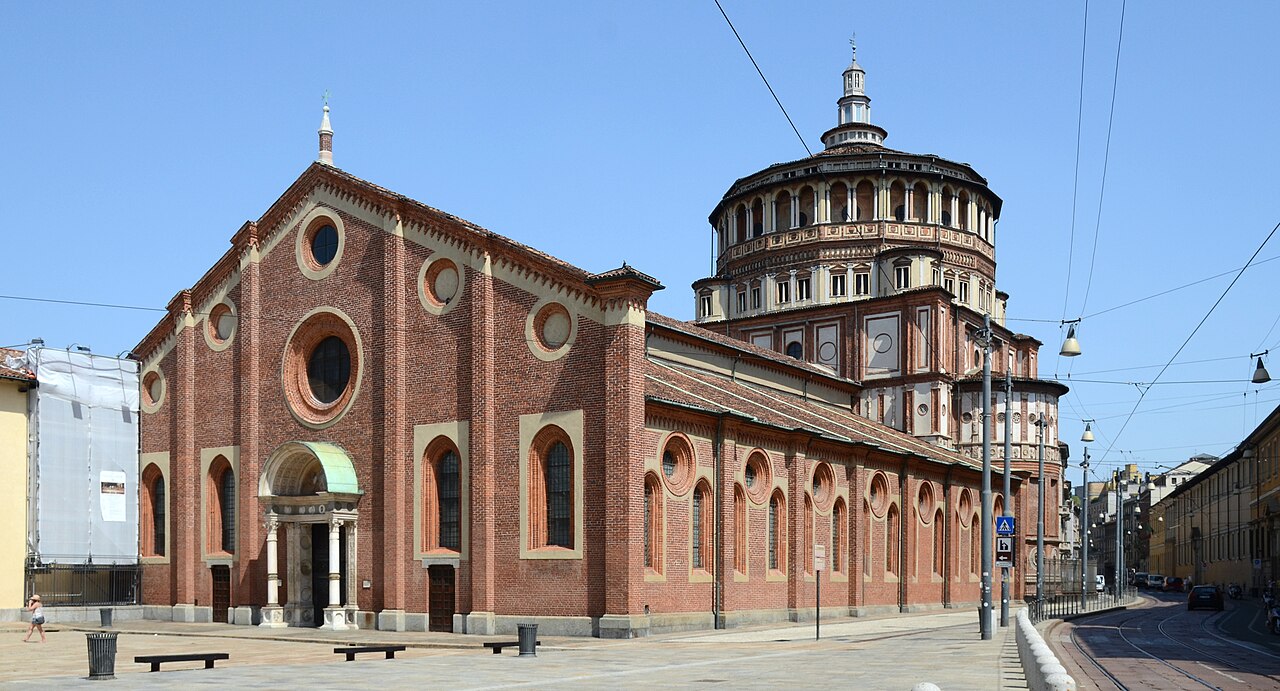
Photo: Mattis · CC BY-SA 3.0 · Wikimedia Commons
Basilica of San Gaudenzio is a church building in Novara, Italy. Dedicated to Saint Gaudentius, first bishop of Novara. The free Lokali audio guide runs 7 minutes.
✓ Published October 2026 · how we write these guides
Visitor facts
| Lokali audio guide | 7 min · free |
|---|---|
| Type | Museum |
| Location | Novara, Italy |
| Coordinates | 45.4488, 8.6197 |
| Languages | 50+, in the Lokali app |
The story
Stand still for a moment and tilt your head back. Above the rooftops of Novara, a pale spire rises in tier after tier of columns and windows, so slender it seems to thin into the sky. On a clear day the Alps sit white on the horizon behind it. Down here at street level, the air smells of warm brick and coffee from the nearby bars. This is the Basilica of San Gaudenzio. For most people in this city, that dome on the skyline simply means home.
The church is named after Saint Gaudentius, the first bishop of Novara. He lived in the late fourth and early fifth centuries, when Christianity was still taking root in this part of northern Italy. Tradition holds that he was a companion of the great bishops of Milan and Vercelli. Over the centuries he became the city's patron saint. His relics rest inside this basilica, and Novara still gathers to honour him every year in late January.
Here is the first surprise. This is not the original church of San Gaudenzio. An older basilica stood outside the city walls. In the sixteenth century, Novara was under Spanish rule, and the Spanish rebuilt the city's fortifications. The old church stood in the way, so it was pulled down. The people of Novara needed a new home for their saint. They chose a site inside the walls, closer to the heart of the town, and work began in the late sixteenth century.
The design came from Pellegrino Tibaldi, an architect and painter who worked for Cardinal Charles Borromeo in Milan. Borromeo led the reform of the Catholic Church in Lombardy after the Council of Trent, a major church gathering that set strict new rules for worship. Tibaldi's church follows that spirit. Look at the facade and the long body of the building. The lines are clear and disciplined, built for preaching, processions and large crowds. It is a serious church, not a playful one.
For almost three centuries, the basilica had no great dome. The crossing waited. Then, in the nineteenth century, the city turned to Alessandro Antonelli. If that name sounds familiar, it should. Antonelli later designed the Mole Antonelliana in Turin, the tall spire that now houses Italy's national cinema museum. Here in Novara, he tested many of the same daring ideas first. He was a local man, born in this region, and San Gaudenzio became his life's long project.
Antonelli's dome is the second surprise. He built it almost entirely of brick and masonry, pushing the material far beyond what most engineers thought safe. The structure rises in layers. First comes a ring of columns, then the dome itself, then a tall lantern, then a needle-like spire. Work stretched across several decades of the nineteenth century. Antonelli kept changing the plan, making it taller and lighter each time. The finished height is usually given as about 121 metres, which puts it among the tallest brick structures in Italy.
At the very top stands a gilded figure of Christ the Saviour. From the square it looks small, almost like a spark of gold. In reality it is a full statue, lifted to a height that made workers of the time very nervous. When the evening sun hits it, the figure flashes for a few seconds before the light moves on. Watch for that moment if you are here near sunset.
Now turn your attention to the bell tower. It stands apart from the church, and it belongs to a different century and a different mind. It was designed in the eighteenth century by Benedetto Alfieri, an architect who worked for the royal court of Savoy in Turin. Its style is more elegant and courtly than Tibaldi's sober church. So in one small area you can see three ages of architecture side by side: late Renaissance reform, eighteenth-century court taste, and nineteenth-century engineering ambition.
Step inside, and the scale changes. The nave is long and calm, with chapels opening along both sides. Many of them hold paintings and sculpture from the sixteenth and seventeenth centuries. Look for the work of Gaudenzio Ferrari, a Renaissance painter from this region. He is one of the great artists of Piedmont and Lombardy. His painted altarpiece here is made of several panels in gilded frames. The colours are soft, the faces are gentle, and the figures feel close and human.
Other chapels carry the darker, more dramatic style of the seventeenth century. In this period, painters used strong light and shadow to move the faithful. Scenes of suffering, death and salvation were common. Take your time as you walk past each chapel. Some are dim, and your eyes need a minute to adjust. Details in the corners, a hand, a candle, a face turned away, often appear only after you stop and wait.
The heart of the church, for local people, is the place where Saint Gaudentius rests. His relics are kept in a richly decorated chapel, and on his feast day crowds come to pray and pass by. Outside, the streets fill with stalls and families. For visitors, it is a reminder that this is not only a monument. It is a living parish church, with daily masses, weddings and funerals. Speak softly, and be aware of people praying.
It is worth stepping back outside and walking around the building. From different streets, the dome changes shape. Close up, it is heavy and solid. From a distance, it becomes thin and almost unreal, like a drawing in the air. Many people in Novara say they know they are nearly home when they see it from the train or the motorway. Across the flat rice fields of the surrounding plain, it can be seen from far away.
Before you go, find a quiet spot in the square and look up one last time. Follow the lines from the solid base of Tibaldi's church, up through Antonelli's columns, to the small gold figure at the top. Notice the swifts circling the lantern, the bells marking the hour, the shadows sliding across the brick. Generations of builders worked on what you are seeing now. As you walk away, glance back once more. The spire will follow you for a long time through the streets of Novara.
Key facts
What to look for
Practical tips
Common questions
Is there a free audio guide to Basilica of San Gaudenzio?
Yes — the Lokali app narrates Basilica of San Gaudenzio free of charge in 50+ languages. The guide runs about 7 minutes, covers the history, what to look for on site and practical tips, and works offline once downloaded.
Where is Basilica of San Gaudenzio?
Basilica of San Gaudenzio is in Novara, Italy, at 45.4488, 8.6197. Tap the map link on this page for directions from where you are.
What is Basilica of San Gaudenzio known for?
Dedicated to Saint Gaudentius, first bishop of Novara. Original church demolished for Spanish fortifications.
What should you look for at Basilica of San Gaudenzio?
Gilded statue of Christ at the very top. Separate bell tower designed by Benedetto Alfieri. Ring of columns wrapping the base of the dome.
What should you know before visiting Basilica of San Gaudenzio?
Come near sunset to see the gilded statue catch light. Let your eyes adjust in the darker side chapels.
When is the best time to visit Basilica of San Gaudenzio?
Come near sunset to see the gilded statue catch light.
On the map
Opens directions to Basilica of San Gaudenzio from your location.
More to see near Basilica of San Gaudenzio


Hear Basilica of San Gaudenzio in your language
The full story, narrated, in 50+ languages. Download it before you go and it plays offline, at your own pace, with no ticket and no tour group.