
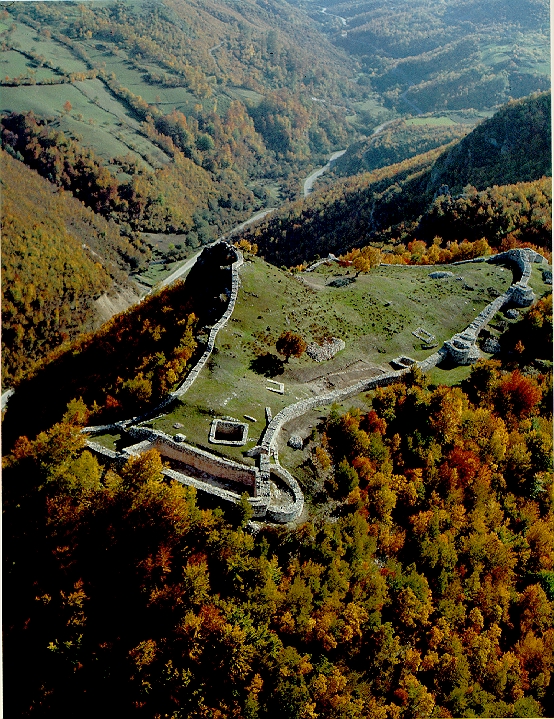
Photo: Pavle Marjanovic · CC BY-SA 3.0 · Wikimedia Commons
Sopoćani Monastery is a monastery in Serbia. Founded by King Stefan Uroš the First in the 1260s. The free Lokali audio guide runs 6 minutes.
✓ Published October 2026 · how we write these guides
Visitor facts
| Lokali audio guide | 6 min · free |
|---|---|
| Type | Monastery |
| Location | Novi Pazar, Serbia |
| Coordinates | 43.1189, 20.4228 |
| Official website | manastirsopocani.org |
| Languages | 50+, in the Lokali app |
The story
Listen first. Out here in the valley, the loudest sounds are often birdsong, the wind in the grass, and the crunch of gravel under your shoes. The monastery sits low in a green bowl of hills, west of Novi Pazar, close to the source of the Raška River. A pale church rises behind a stone enclosure wall. There is no city noise here. For centuries, that silence was part of the point.
This is Sopoćani. It is one of the great monasteries of medieval Serbia. King Stefan Uroš the First founded it in the middle of the thirteenth century, in the 1260s. He meant it to be his own burial church, a mausoleum, built at the heart of his kingdom. The church is dedicated to the Holy Trinity. Today it belongs to a UNESCO World Heritage Site that also includes the remains of nearby Stari Ras, the old medieval capital.
That location matters. In the thirteenth century this valley was not remote. It was the political centre of a young Serbian state. The kingdom was called Raška after this region and this river. Rulers built churches here to show their power and their faith, and to secure prayers for their souls. So you are standing in a royal landscape, even though today it feels like quiet farmland.
Look at the church from the outside. It has a long, simple body, a single nave, and a dome raised on a square base. Scholars call this style the Raška school. It mixes two traditions. The plan and the dome come from Byzantium, the Greek-speaking Christian empire to the east. Details such as the tall, calm walls and the shapes of the windows show the influence of Romanesque building from the Adriatic coast, the heavy rounded-arch style of western Europe.
Now step inside, and give your eyes a moment to adjust. This is why most people come here. The walls are covered with frescoes, painted in the second half of the thirteenth century. Many art historians place them among the finest paintings of the whole medieval world. The figures are large, calm, and solid. Their robes fall in heavy folds, almost like ancient Greek sculpture. They do not look flat or stiff.
Here is the first surprise. Notice the warm yellow background behind many of the scenes. Look closely and you may see thin painted lines that form a grid. The painters were imitating gold mosaic, the costly glass tiles used in the grand churches of Constantinople. Gold leaf was applied to the walls, and the grid made the surface read as mosaic. Much of the gold has gone, but the warm yellow ground still fills the space with a soft glow.
Turn toward the west wall of the nave, the wall above the main entrance. Here is the most celebrated painting in Sopoćani — the Dormition of the Virgin. Dormition means falling asleep. It is the Orthodox name for the death of Mary. She lies on a bier, surrounded by grieving apostles. Above her, Christ holds her soul, shown as a small figure wrapped in white. Angels crowd the sky. The scene is enormous, yet it feels quiet and human.
Take a little time with the faces. The apostles bend forward, press their hands to their cheeks, and lean on one another. Their grief is restrained, not theatrical. This is the quality that made the Sopoćani painters famous. They gave holy figures real weight and real emotion. Many writers have compared these frescoes with the work of the early Italian Renaissance. That comparison is striking, because these walls were painted before Giotto began his career in Italy.
The church also shows its founders. In the narthex, the entrance hall, you can find paintings of the royal family. The king appears with members of his dynasty, the Nemanjić family, who ruled Serbia for about two centuries. Founder portraits like these were a statement. They told every visitor who paid for this church, who protected it, and who expected to be remembered in its prayers.
Now the second surprise. These frescoes survived something that should have destroyed them. In the late seventeenth century, during the long wars between the Ottoman and Habsburg empires, the monastery was damaged and abandoned. The roof eventually fell in. For roughly two centuries the paintings stood open to rain, snow, and summer sun. Some walls lost their colour. Others kept it. That is why parts of the church look worn while other scenes still look fresh.
Restoration came in the twentieth century. Conservators and architects rebuilt the roof, strengthened the walls, and cleaned and secured the paintings. As you walk around, you may notice the difference between areas of bright, intact colour and patches where only plaster or faint outlines remain. Those gaps are honest. They show you the real story of the building — not a perfect copy, but survival with scars.
Life has returned here too. A monastic community lives at Sopoćani again, so this is a working place of worship, not only a museum. You may hear chanting, smell candle wax and incense, or see a monk crossing the courtyard. Around the church, look for the low foundations of older monastery buildings in the grass. They mark where dormitories and a refectory, the shared dining hall, once stood.
Before you leave, walk slowly back out into the light. Turn and look at the church once more, its pale walls against the green hills. Inside, the apostles are still bending over Mary, as they have for more than seven centuries, through war, ruin, and open sky. Listen again to the wind and the birds. The valley sounds much as it did when the painters packed up their brushes and went home.
Key facts
What to look for
Practical tips
Common questions
Is there a free audio guide to Sopoćani Monastery?
Yes — the Lokali app narrates Sopoćani Monastery free of charge in 50+ languages. The guide runs about 6 minutes, covers the history, what to look for on site and practical tips, and works offline once downloaded.
Where is Sopoćani Monastery?
Sopoćani Monastery is near Novi Pazar, Serbia, at 43.1189, 20.4228. Tap the map link on this page for directions from where you are.
What is Sopoćani Monastery known for?
Founded by King Stefan Uroš the First in the 1260s. Church is dedicated to the Holy Trinity.
What should you look for at Sopoćani Monastery?
Dormition of the Virgin on the west wall. Painted grid lines imitating gold mosaic tiles. Warm yellow ochre backgrounds behind the saints.
What should you know before visiting Sopoćani Monastery?
Let your eyes adjust inside before studying the frescoes. Dress modestly with covered shoulders and knees.
On the map
Opens directions to Sopoćani Monastery from your location.
More to see near Sopoćani Monastery

Hear Sopoćani Monastery in your language
The full story, narrated, in 50+ languages. Download it before you go and it plays offline, at your own pace, with no ticket and no tour group.