
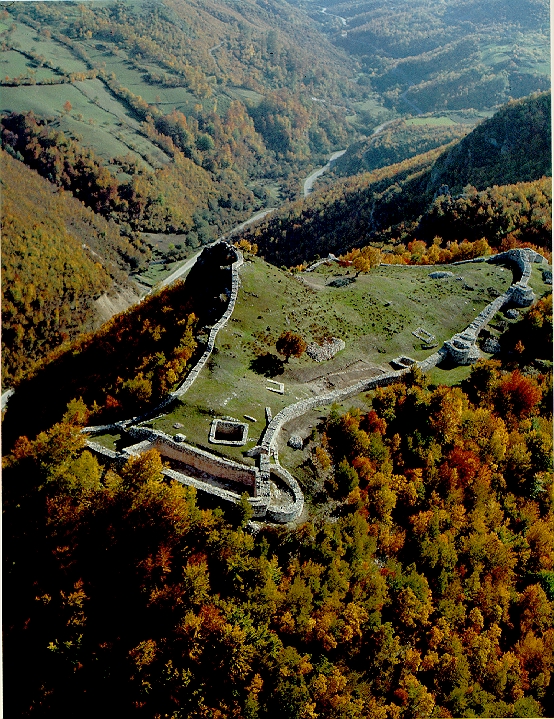
Photo: Pudelek (Marcin Szala) · CC BY-SA 3.0 · Wikimedia Commons
Studenica Monastery is a Serbian Church historic UNESCO site in Kraljevo, Serbia. Founded by Stefan Nemanja in the late twelfth century. The free Lokali audio guide runs 7 minutes.
✓ Published October 2026 · how we write these guides
Visitor facts
| Lokali audio guide | 7 min · free |
|---|---|
| Type | Monastery |
| Location | Raška, Serbia |
| Coordinates | 43.4867, 20.5316 |
| Official website | manastirstudenica.rs |
| Languages | 50+, in the Lokali app |
The story
Listen first. Under the voices of visitors you can hear water. It is the Studenica River, running cold and quick through the wooded valley below. The air smells of pine and wet stone. Ahead of you, inside a ring of old walls, stands a church so pale it almost glows against the green hills. That pale surface is marble, and it is the first thing that tells you this place was built to be different.
You are standing in Studenica, one of the oldest and most important monasteries in Serbia. It lies in a quiet valley in the Raška region, on the slopes of the mountains southwest of the town of Kraljevo. This land was the heart of the medieval Serbian state, which was also called Raška. Studenica was its spiritual centre. In 1986, UNESCO added the monastery to its World Heritage List.
The founder was Stefan Nemanja, the ruler who united the Serbian lands in the second half of the twelfth century. He began the monastery in the late twelfth century, around the 1190s. Then he did something unusual for a powerful ruler. He gave up his throne, became a monk, and took the name Simeon. He travelled to Mount Athos in Greece, the great centre of Orthodox monastic life. He died there in 1199.
Here is the first surprise. Nemanja did not stay buried on Athos. His son, the monk who became Saint Sava, later brought his father's remains back to Studenica. Saint Sava was the first archbishop of the independent Serbian Church, and he is still one of the most loved figures in Serbian history. He served as abbot here. He also wrote the rules that governed daily life in the monastery, a founding document for Serbian monastic tradition.
Now walk toward the main church. It is the Church of the Virgin, the oldest and largest building inside the walls. Notice its shape. The tall dome and the cross plan come from Byzantium, the Greek-speaking Christian empire to the east. But the walls, the carved doorways, and the arched windows come from the West. They follow the Romanesque style, the heavy, round-arched style of churches in Italy and along the Adriatic coast.
This mix of East and West has a name. Historians call it the Raška school of architecture. Studenica is one of its finest examples. The builders took a Byzantine interior and wrapped it in a Western exterior. For a Serbian ruler standing between two great Christian worlds, that choice made sense. The building shows both influences at once, in one body of stone.
Look closely at the carved stone around the main entrance on the west side. Above the door, the Virgin Mary sits with the Christ child. Around them are figures and fine plant patterns cut into the marble. Then walk around to the eastern end of the church, behind the altar. There you will find a large triple window, framed with rich carving. Many visitors photograph the front of the church and never see this window at all.
Step inside, and your eyes need a moment to adjust. The light drops. The air is cooler, and it often carries the smell of beeswax candles and incense. This is not a museum. It is a working monastery, and monks still live and pray here. Services take place in this church. Move slowly, speak softly, and let the paintings appear around you as your eyes get used to the dim light.
The frescoes are the second great treasure of Studenica. An inscription dates the earliest paintings to 1208 and 1209. The most famous of them is the Crucifixion on the west wall. Look at the deep blue background behind the figures. Look at the faces of Mary and Saint John at the foot of the cross. Their grief is quiet and controlled. Many art historians consider this one of the most important works of Byzantine-style painting in the Balkans.
The church also holds the tomb of the founder himself. Stefan Nemanja, Saint Simeon, rests here, in the building he started. His son, Stefan the First-Crowned, also rests at Studenica. He was the first king of Serbia. In the decades that followed, a later king added a wide entrance hall to the western end of the church. You can see where the newer walls meet the original marble church.
Now come back out into the light and walk across the courtyard. You will find a much smaller church, low and compact. This is the King's Church, built in 1314 by King Milutin, a great-grandson of Nemanja. It is dedicated to Saint Joachim and Saint Anne, the parents of the Virgin Mary. Do not let its size fool you. Inside, the walls carry some of the finest paintings of their period.
The King's Church is a small surprise of its own. Its frescoes show the birth of the Virgin with soft colour and lively, human detail. Look for the women caring for the newborn child, and for the domestic scenes around them. A century separates these paintings from the Crucifixion in the main church. You can see how painting changed. The figures are smaller, busier, and more full of movement.
There is a third small church in the complex, dedicated to Saint Nicholas. It is plain and simple, and it carries painted fragments inside. Around all the churches runs the oval wall of the monastery. Other buildings once stood inside it — living quarters, a dining hall, workshops. Some survive only as foundations and low remains. Today they help you picture a full community, busy with prayer, work, and study.
Before you leave, stand still in the courtyard for a moment. Look again at the white marble of the main church. Notice how the light moves across it as the clouds pass. Listen again for the river below the walls. Eight centuries ago, a ruler gave up his crown and chose this valley. As you walk back through the gate, the quiet of the place stays with you for a while.
Key facts
What to look for
Practical tips
Common questions
Is there a free audio guide to Studenica Monastery?
Yes — the Lokali app narrates Studenica Monastery free of charge in 50+ languages. The guide runs about 7 minutes, covers the history, what to look for on site and practical tips, and works offline once downloaded.
Where is Studenica Monastery?
Studenica Monastery is near Raška, Serbia, at 43.4867, 20.5316. Tap the map link on this page for directions from where you are.
What is Studenica Monastery known for?
Founded by Stefan Nemanja in the late twelfth century. Main frescoes dated by inscription to 1208 and 1209.
What should you look for at Studenica Monastery?
White marble walls of the Church of the Virgin. Carved Virgin and Child above the west doorway. Richly carved triple window at the eastern end.
What should you know before visiting Studenica Monastery?
Dress modestly with covered shoulders and knees. Keep voices low since monks still live here.
On the map
Opens directions to Studenica Monastery from your location.
More to see near Studenica Monastery


Hear Studenica Monastery in your language
The full story, narrated, in 50+ languages. Download it before you go and it plays offline, at your own pace, with no ticket and no tour group.