Photo: Саша Стефановић!!! (talk) The original uploader was Kolossus at English Wikipedia. · Public domain · Wikimedia Commons
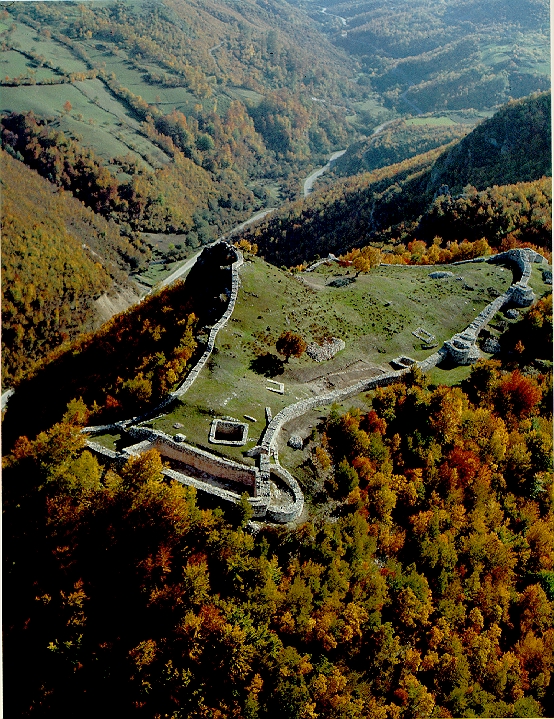
Stari Ras is an archaeological site in Serbia. Stari Ras means Old Ras in Serbian. The free Lokali audio guide runs 7 minutes.
✓ Published October 2026 · how we write these guides
Visitor facts
| Lokali audio guide | 7 min · free |
|---|---|
| Type | Archaeological Site |
| Location | Novi Pazar, Serbia |
| Coordinates | 43.1283, 20.4157 |
| Languages | 50+, in the Lokali app |
The story
Wind moves through dry grass on the hilltop, and somewhere below, water runs over stones. Underfoot, the ground is uneven. Low lines of rubble and old wall show through the turf. There is no gate to walk through and no roof overhead. Just open sky, the green valleys of southwest Serbia, and the quiet feeling that something large once stood here. This is Stari Ras, which means Old Ras. For a long stretch of the Middle Ages, this ground sat at the centre of a young Serbian state.
The name matters more than it first seems. From Ras came Raška, the name of the medieval Serbian realm that grew up in these hills. In Latin sources the region appears as Rascia. So when you hear historians talk about Raška as an early Serbian state, they are using a word born on the slopes around you. A whole kingdom took its name from a fortress and the settlement that grew beside it.
Why here? Look at the land. Rivers meet in these valleys, and old routes ran through them, linking the Adriatic coast with the interior of the Balkans. Whoever held these heights could watch the roads, the river crossings and the traders who used them. Ras appears in Byzantine writing, which shows that the empire to the south knew this place and cared about who controlled it. For centuries, this was contested frontier ground between Byzantium and the Serbian rulers.
The fortress on the hill is often called Gradina, a simple word meaning a fortified place. What remains today is mostly foundation: traces of walls, towers and buildings, uncovered and studied by archaeologists over many decades. It takes some imagination. Try to picture stone ramparts following the edge of the slope, smoke rising from hearths, and horses climbing the path from the valley. The settlement below the fortress was where everyday life happened... markets, workshops and homes.
Stari Ras is not one building. It is a cluster of sites spread across the surrounding hills. In 1979, UNESCO added Stari Ras and the nearby monastery of Sopoćani to its World Heritage List. The listing covers the fortress area, several churches and monasteries, and the medieval landscape that ties them together. So the best way to understand this place is as a network — a capital made of stone on several hilltops, not a single citadel.
Here is the first surprise. Close to Novi Pazar stands the Church of Saint Peter, a small stone church with a round plan and a dome. It is widely considered the oldest preserved church in Serbia. Its earliest phases are usually dated to roughly the ninth or tenth century, long before the great monasteries were built. It is still a working church, and the old cemetery around it carries centuries of graves. Inside, the walls are thick, the space is close, and the light is low.
According to tradition, Stefan Nemanja was baptised at this church. Nemanja is the founder of the Nemanjić dynasty, the family that ruled Serbia for about two centuries and built many of its most important monasteries. Because the story is tradition rather than a firmly documented event, it is best to hold it lightly. Still, it shows how Serbians connect this small round church with the very beginning of their medieval state and its Christian identity.
Now raise your eyes to the hills. On one ridge stands the monastery of Đurđevi Stupovi, which means the Pillars of Saint George. Nemanja founded it in the second half of the twelfth century. Its towers once gave it that name, rising above the valley like stone posts. Legend has it that Nemanja promised to build a church to Saint George if he was freed from captivity, and that this monastery fulfilled his vow. The building suffered heavy damage over the centuries and has been carefully restored.
The second surprise waits a little further away, at Sopoćani. This monastery was built in the thirteenth century under King Stefan Uroš the First, a later Nemanjić ruler. Its frescoes are among the most admired paintings of medieval Europe. The large scene of the Dormition of the Virgin — the moment of Mary's death, surrounded by apostles — shows calm, heavy figures and soft colour. Many art historians see in these walls a warmth and naturalism that came before the Italian Renaissance.
So what happened to the old capital? Over time, the Serbian state moved its centre of power to other regions, and Ras slowly lost its role. Later, the Ottoman Empire took control of this area. In the fifteenth century, the Ottomans developed a new market town in the valley below. They called it Novi Pazar, which means New Market. The name itself tells the story: a new trading town rose beside an old capital that was fading into ruins.
That layering is still visible today. Novi Pazar is a town where mosques and minarets stand alongside Orthodox churches, and where the old Ottoman bazaar streets sit within reach of medieval Serbian monasteries. The region is often called Sandžak, a name from the Ottoman administrative system. Walking between these sites, you move through Byzantine, Serbian and Ottoman chapters of history within a short drive. Few places in the Balkans show these layers so close together.
As you explore, take your time between the sites. The roads climb and twist, and the views change at every bend. Grazing animals, small farms and stacks of hay are part of the scene. Wear good shoes, because the fortress ground is rough, and bring water on warm days. At the working churches and monasteries, dress modestly and speak quietly. Monks and local worshippers still use these spaces, and the silence inside is part of what you have come for.
Before you leave, stand still for a moment and look out across the valley. The rivers still run below. The same routes still cross the land, now as asphalt instead of dirt tracks. Novi Pazar spreads out in the distance, busy with its own daily life. Up here, among broken walls and long grass, a kingdom once took its name and its first shape. Listen to the wind once more... and notice how much of that story the hills still hold.
Key facts
What to look for
Practical tips
Common questions
Is there a free audio guide to Stari Ras?
Yes — the Lokali app narrates Stari Ras free of charge in 50+ languages. The guide runs about 7 minutes, covers the history, what to look for on site and practical tips, and works offline once downloaded.
Where is Stari Ras?
Stari Ras is near Novi Pazar, Serbia, at 43.1283, 20.4157. Tap the map link on this page for directions from where you are.
What is Stari Ras known for?
Stari Ras means Old Ras in Serbian. Medieval Serbian state Raška took its name from Ras.
What should you look for at Stari Ras?
Low lines of old wall showing through the hilltop grass. The round plan and dome of the Church of Saint Peter. Old gravestones in the cemetery around Saint Peter's.
What should you know before visiting Stari Ras?
Wear sturdy shoes for the uneven fortress ground. Plan transport between sites; they spread across several hills.
When is the best time to visit Stari Ras?
Bring water on summer days; shade is limited on hilltops.
On the map
Opens directions to Stari Ras from your location.
More to see near Stari Ras


Hear Stari Ras in your language
The full story, narrated, in 50+ languages. Download it before you go and it plays offline, at your own pace, with no ticket and no tour group.