
Frauenkirche, Nuremberg
49.4540° N · 11.0782° E · Church
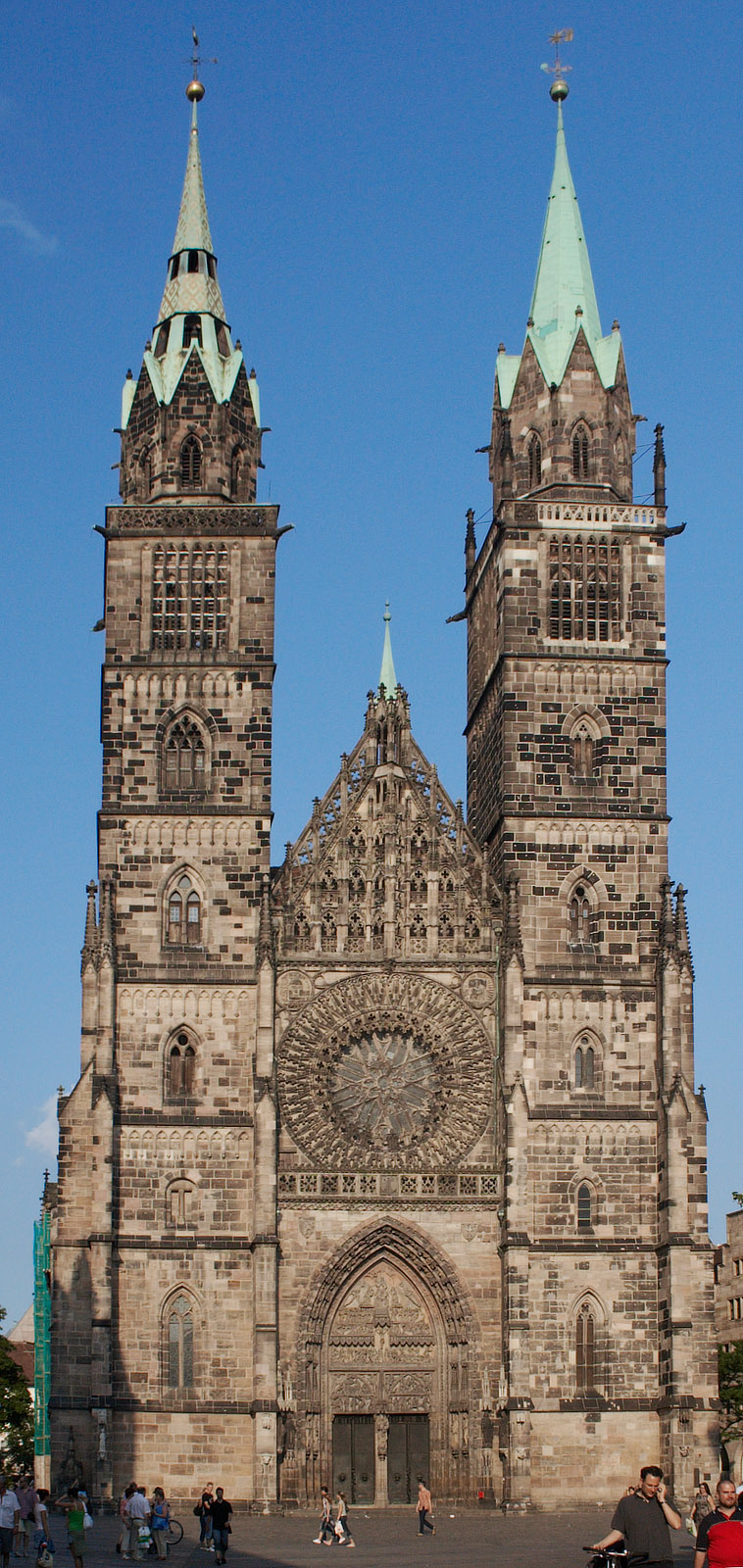
Photo: jailbird · CC BY-SA 2.0 de · Wikimedia Commons
Frauenkirche, Nuremberg is a parish church in Nuremberg, Germany. Built in the 1350s on the site of a synagogue. The free Lokali audio guide runs 7 minutes.
✓ Published October 2026 · how we write these guides
Visitor facts
| Lokali audio guide | 7 min · free |
|---|---|
| Type | Church |
| Location | Nuremberg, Germany |
| Coordinates | 49.4540, 11.0782 |
| Official website | frauenkirche-nuernberg.de |
| Languages | 50+, in the Lokali app |
The story
Stand on the cobbles of the Hauptmarkt and look east. The ground is uneven under your shoes, worn smooth by centuries of market carts. Around you, stall awnings flap, pigeons lift off the stones, and the smell of grilled sausages drifts across the square. Then your eye climbs. A sandstone gable rises in front of you, tall and lace-like, with pinnacles, niches and a small clock face high above the door. This is the Frauenkirche, the Church of Our Lady.
At first glance, it looks like a calm, pretty Gothic church on a market square. But the square itself is the first part of the story. This open space did not grow here naturally. It was made. In the middle of the fourteenth century, this ground was the heart of Nuremberg's Jewish quarter, with houses, lanes, and a synagogue. The church stands on the site where that synagogue once stood.
In 1349, as the Black Death spread across Europe, Jewish communities were blamed and attacked in many cities. In Nuremberg, the quarter was destroyed in a pogrom, and hundreds of Jewish residents were killed. The emperor, Charles the Fourth, had already given permission for the quarter to be cleared. The houses came down, and the open market square appeared. Soon after, in the 1350s, the emperor ordered a church to be built on the synagogue's site — dedicated to the Virgin Mary.
It is a hard beginning, and it is important to hold it in mind as you look up at the fine stonework. Today a plaque and the city's own historians openly acknowledge this past. The beauty of the facade and the violence behind the square sit side by side. Many visitors walk past without knowing it. Now, as you stand here, you do.
Charles the Fourth wanted more than a parish church. He was the Holy Roman Emperor, a ruler over a loose union of German lands, and Nuremberg was one of his favourite imperial cities. The Frauenkirche was built as an imperial chapel, a place that tied the emperor's name to the city. The design is sometimes linked to the Parler family of master builders, who worked for Charles in Prague, though historians still debate exactly who drew the plans.
Look at the shape of the building. Inside, it is a hall church, which means the side aisles rise to the same height as the central nave. The effect is one large, open, airy room instead of a tall central space with low corridors at its sides. Outside, the stepped and decorated gable is the real showpiece. It was made to face the square, almost like a stage backdrop, because the square was where public life happened.
Now raise your eyes to the clock high on the gable. This is the Männleinlaufen, which roughly means the running of the little men. It was installed in 1509. Every day at noon, the mechanism comes alive. Small figures of the seven prince-electors — the powerful German rulers who chose the emperor — walk out and circle around a seated figure of Charles the Fourth. They bow to him, one after another, as bells and pipes sound.
The little procession remembers a real political moment. In 1356, Charles issued a famous decree called the Golden Bull. It set the rules for how emperors would be elected, and it named the seven electors who had that right. Part of the law was proclaimed here in Nuremberg. So the clock is a piece of medieval constitutional history, turned into a puppet show. Children love it. Most adults don't realise they are watching a lesson in imperial law.
If you arrive just before noon, watch the crowd as much as the clock. Phones go up, conversations stop, and for a few minutes the whole square turns in one direction. Then the electors finish their circle, the doors close, and the market noise rushes back in. It is one of the quietest kinds of city ritual — repeated daily, and still able to gather strangers together.
Step inside if the doors are open. The light is softer, and the sound of the square drops away at once. Much of what you see is a careful reconstruction. Nuremberg's old town was heavily bombed in the Second World War, and the Frauenkirche was badly damaged. It was rebuilt in the years after the war. Look for older treasures that survived, including a fifteenth-century altarpiece known as the Tucher Altar, with painted panels full of gold and deep colour.
The church has also changed faith. Nuremberg became Protestant during the Reformation in the sixteenth century, and the city's churches followed. In the early nineteenth century, after Nuremberg became part of the Kingdom of Bavaria, the Frauenkirche was handed to the Catholic community. It still serves as a Catholic church today. So one building has carried an imperial chapel, a Protestant city, and a modern Catholic parish.
The square in front of you has carried other names too. During the Nazi period, it was renamed after Adolf Hitler, in a city the regime used for its giant party rallies. After the war, the old name returned. Today the Hauptmarkt is best known for gentler things. Every winter, the Christmas market fills these cobbles, and its opening speech is given from the church's gallery above the main entrance, by a young woman dressed as the Christ Child.
Turn slightly and you will see the Schöner Brunnen, the Beautiful Fountain, rising like a gilded spire at the corner of the square. Locals say that if you turn the brass ring in its railing, your wish will come true. That is folklore, not history — but watch how many people try it. The fountain and the church face each other across the market, two pieces of Gothic stone framing the daily trade.
Before you walk on, look once more at the gable. Notice the colour of the sandstone, warm in some places and grey in others, where old blocks meet newer repairs. Listen to the market around you. The vendors, the bells, the footsteps — all of it happens on ground with a long and difficult memory. As you leave the square, let the little electors keep their slow circle above you, and carry the whole story with you.
Key facts
What to look for
Practical tips
Common questions
Is there a free audio guide to Frauenkirche, Nuremberg?
Yes — the Lokali app narrates Frauenkirche, Nuremberg free of charge in 50+ languages. The guide runs about 7 minutes, covers the history, what to look for on site and practical tips, and works offline once downloaded.
Where is Frauenkirche, Nuremberg?
Frauenkirche, Nuremberg is in Nuremberg, Germany, at 49.4540, 11.0782. Tap the map link on this page for directions from where you are.
What is Frauenkirche, Nuremberg known for?
Built in the 1350s on the site of a synagogue. Commissioned by Holy Roman Emperor Charles the Fourth.
What should you look for at Frauenkirche, Nuremberg?
Seven electors circling the seated emperor on the gable clock. The gallery above the entrance used for the Christmas speech. Colour differences in the sandstone from post-war repairs.
What should you know before visiting Frauenkirche, Nuremberg?
Arrive a few minutes early to watch the noon clock. Stand in the middle of the square for the clearest view.
When is the best time to visit Frauenkirche, Nuremberg?
Expect large crowds here during the Christmas market season.
On the map
Opens directions to Frauenkirche, Nuremberg from your location.
More to see in Nuremberg



Hear Frauenkirche, Nuremberg in your language
The full story, narrated, in 50+ languages. Download it before you go and it plays offline, at your own pace, with no ticket and no tour group.