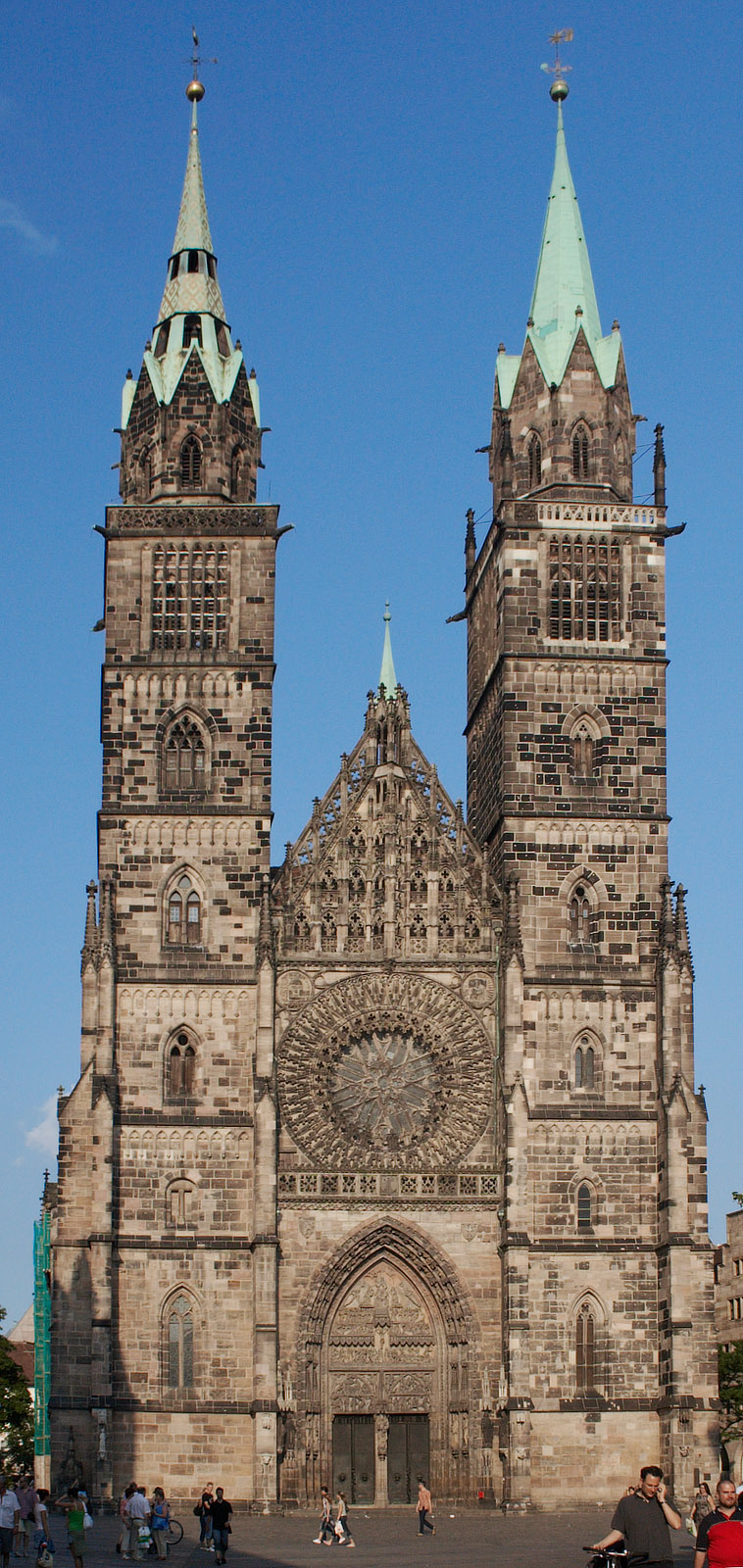
St. Lorenz, Nuremberg
49.4510° N · 11.0787° E · Church
Photo: jailbird · CC BY-SA 2.0 de · Wikimedia Commons
St. Lorenz, Nuremberg is a church building in Nuremberg, Germany. Named for Saint Lawrence, a third-century Roman deacon. The free Lokali audio guide runs 8 minutes.
✓ Published October 2026 · how we write these guides
Visitor facts
| Lokali audio guide | 8 min · free |
|---|---|
| Type | Church |
| Location | Nuremberg, Germany |
| Coordinates | 49.4510, 11.0787 |
| Official website | lorenzkirche.de |
| Languages | 50+, in the Lokali app |
The story
Stand still for a moment in front of the west front. The stone here is red sandstone, a warm, rusty pink that turns almost copper when the late sun hits it. Run your eyes upward. Two towers rise side by side, and between them sits a great round window, as delicate as lace cut from stone. This is the Church of Saint Lawrence. In German, Sankt Lorenz. For centuries it has anchored the southern half of Nuremberg's old town.
The church takes its name from Saint Lawrence, a deacon of the early Christian church in Rome. He was martyred in the third century. According to tradition, he was roasted alive on a gridiron. Legend has it that he even joked with his executioners, telling them to turn him over because one side was done. That grim gridiron became his symbol. Keep an eye out for it as you explore. It appears in carvings and paintings throughout the building.
Before you go inside, notice where you are standing. The river Pegnitz runs through the middle of Nuremberg's old town. The quarter south of the river grew up around this church, and it is still called the Lorenz side. North of the river, the Sebaldus side gathers around another great church, Saint Sebald. For generations, the two parishes competed. Each wanted the finer building, the richer art, the taller ambitions. Much of what you will see today comes out of that friendly rivalry.
Now look at the main portal below the rose window. The doorway is framed by rows of carved figures. Above the door, the stone shows scenes from the Last Judgment. The saved rise toward heaven on one side. The damned are dragged away on the other. Medieval visitors could not read, but they could read this. The message was simple, and it greeted everyone who walked through the door.
Step inside, and let your eyes adjust. The first thing most people feel is the height. The nave is tall and fairly narrow, with the high central space flanked by lower aisles. Then, as you walk east, something changes. The choir at the far end opens out into a wide, bright hall. Here the aisles reach the same height as the centre. This hall choir was added in the fifteenth century, in the late Gothic style. It replaced an older, smaller end to the church.
Gothic, briefly, is the medieval style of pointed arches, slender columns and large windows. At its best, it makes heavy stone feel light. In the choir here, look at the ceiling. The ribs of the vault branch and cross like the threads of a net. The columns rise without interruption, almost like tree trunks. In the late afternoon, colour from the stained glass falls across the floor in soft patches.
And then you look up, into the open space of the choir... and you see it. A huge carved wreath hangs in the air, suspended from the vault. Inside it stand two figures, larger than life. On one side is the Angel Gabriel. On the other is the Virgin Mary. This is the Angelic Salutation, the moment the angel tells Mary she will bear a child. It was carved in lindenwood by Veit Stoss, one of the great sculptors of late medieval Germany, in the early sixteenth century.
Take your time with it. The wreath around the figures is a rosary, a ring of roses and beads. Set into it are small round medallions showing scenes from Mary's life. Above, God the Father looks down. Gabriel's robes seem to move, as though he has only just landed. Here is a detail many visitors miss. The piece was a gift from a wealthy Nuremberg patrician, a member of the city's ruling merchant families. Art like this was also a statement of family pride.
That brings us to a surprise. Nuremberg turned Protestant early, in the 1520s, during the Reformation. In many cities, that shift led to images being stripped out of churches and destroyed. Here, much of the Catholic art stayed in place. The great families had paid for these works, and the city council protected them. For long stretches after the Reformation, the Angelic Salutation was kept covered with a cloth. It survived, but quietly, out of sight.
Now turn your attention to the left side of the choir, near the high altar. A tall, thin tower of pale stone rises almost to the ceiling. This is the sacrament house, a shrine built to hold the consecrated bread of the Mass. It was made in the late fifteenth century by the stonemason and sculptor Adam Kraft. It climbs roughly twenty metres. Look at the very top. The spire bends over in a gentle curl, like the head of a bishop's staff, as it meets the vault.
Now look down to the base. Here is the second surprise. Kneeling beneath the whole structure, apparently holding it up on his shoulders, is Adam Kraft himself. He carved his own portrait, with tools in hand and a cap on his head. Two other kneeling figures share the load with him, usually understood as his helpers. It is a rare thing for a medieval craftsman to put himself so clearly in his own work. Here, he did it with a sense of humour.
The building you see today is also a story of survival. During the Second World War, Nuremberg's old town was very heavily bombed, and Saint Lorenz was badly damaged. Its roofs and vaults suffered severe destruction. Before the worst of the air raids, many of the most valuable artworks had been taken down and stored safely, including the Angelic Salutation. After the war, the church was carefully rebuilt. If you look closely at the stonework, you can sometimes see the difference between older and newer blocks.
As you walk back toward the west doors, pause for a moment in the nave. Listen to the sounds of the space. Footsteps echo off the stone floor. Voices drop to a murmur without anyone asking them to. If the organ is playing, the sound fills the vault and seems to come from everywhere at once. This is still a working Lutheran parish church. Services, concerts and quiet prayer continue here, as they have for centuries.
When you step back out into the square, turn around once more. Look at the red stone of the towers and the round window between them. Somewhere inside, an angel still hangs in the air, and a stonemason still kneels under his own work. Around you, the Lorenz side of the city carries on with its everyday life. As you walk away, notice how often the two towers reappear between the rooftops, guiding you back.
Key facts
What to look for
Practical tips
Common questions
Is there a free audio guide to St. Lorenz, Nuremberg?
Yes — the Lokali app narrates St. Lorenz, Nuremberg free of charge in 50+ languages. The guide runs about 8 minutes, covers the history, what to look for on site and practical tips, and works offline once downloaded.
Where is St. Lorenz, Nuremberg?
St. Lorenz, Nuremberg is in Nuremberg, Germany, at 49.4510, 11.0787. Tap the map link on this page for directions from where you are.
What is St. Lorenz, Nuremberg known for?
Named for Saint Lawrence, a third-century Roman deacon. The late Gothic hall choir dates from the fifteenth century.
What should you look for at St. Lorenz, Nuremberg?
The large stone rose window between the twin towers. Last Judgment carvings above the main west portal. Gridiron symbols of Saint Lawrence in carvings and paintings.
What should you know before visiting St. Lorenz, Nuremberg?
Visit in late afternoon for warm light on the facade. Bring binoculars to study the hanging Angelic Salutation.
When is the best time to visit St. Lorenz, Nuremberg?
Visit in late afternoon for warm light on the facade.
On the map
Opens directions to St. Lorenz, Nuremberg from your location.
More to see in Nuremberg


Hear St. Lorenz, Nuremberg in your language
The full story, narrated, in 50+ languages. Download it before you go and it plays offline, at your own pace, with no ticket and no tour group.