
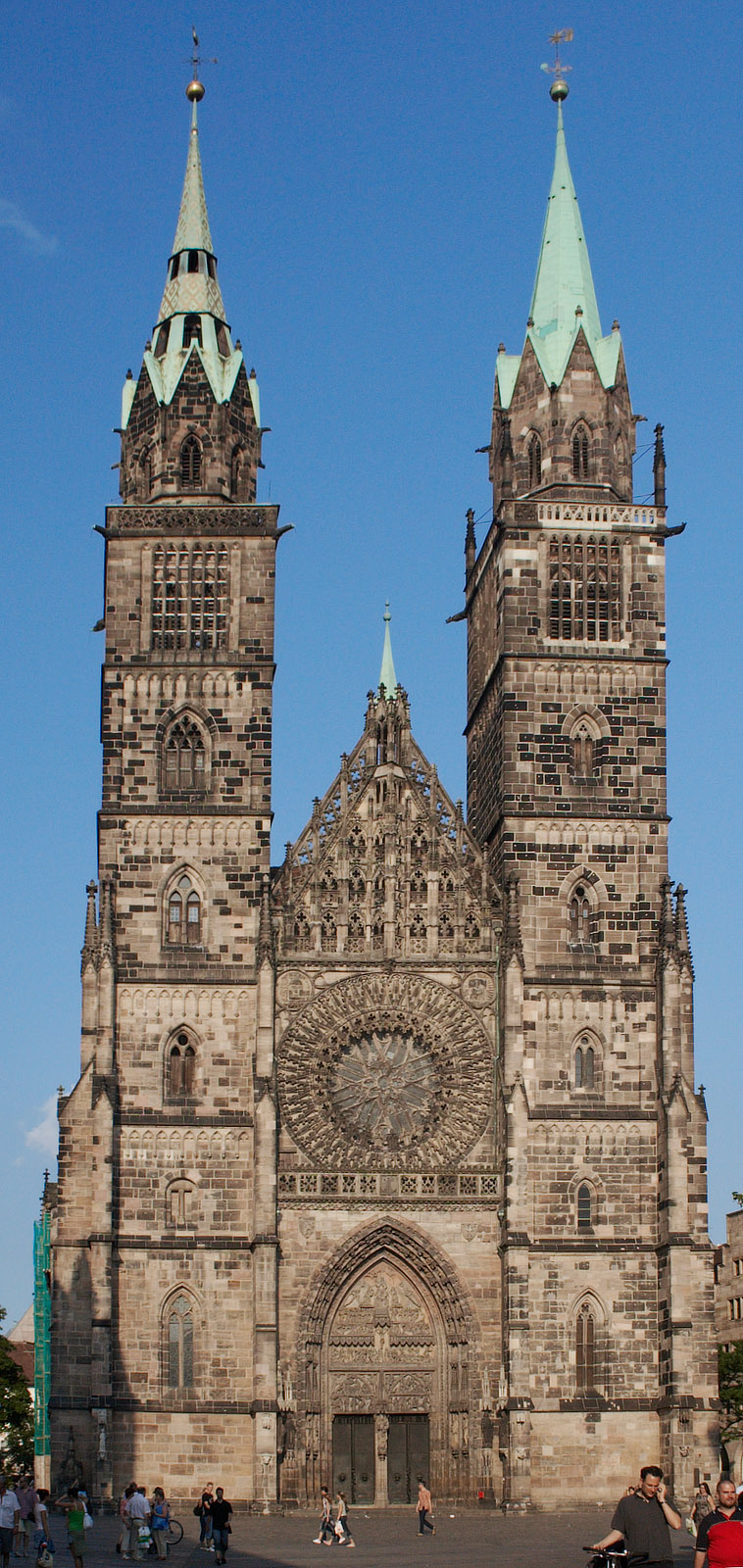
St. Sebaldus Church, Nuremberg
49.4553° N · 11.0765° E · Church
Photo: Vitold Muratov · CC BY-SA 3.0 · Wikimedia Commons
St. Sebaldus Church, Nuremberg is a church building in Nuremberg, Germany. Oldest parish church in Nuremberg's old town. The free Lokali audio guide runs 7 minutes.
✓ Published October 2026 · how we write these guides
Visitor facts
| Lokali audio guide | 7 min · free |
|---|---|
| Type | Church |
| Location | Nuremberg, Germany |
| Coordinates | 49.4553, 11.0765 |
| Official website | sebalduskirche.de |
| Languages | 50+, in the Lokali app |
The story
Listen first. The noise of the market square fades behind you, and the air inside turns cool and still. Your footsteps sound soft on the stone floor. Light falls in coloured patches from tall windows, and the walls glow the colour of dark honey. This is red sandstone, the local stone of Nuremberg, and it covers almost every surface around you. You are standing in the oldest parish church in the city... Saint Sebaldus.
Take a moment to place yourself. The church stands on a gentle slope in the old town, between the main market square and the hill that rises toward the Imperial Castle. For centuries this was the parish of the northern half of Nuremberg, the side closest to the castle. The other great parish church, Saint Lorenz, served the southern half across the river. The two churches were rivals, and the wealthy families on each side spent heavily to make their own church more splendid.
The church takes its name from Saint Sebald, the patron saint of Nuremberg. Very little about his life is certain. He was a hermit who lived in the forests around the town, probably in the early medieval period. Most of what people tell about him is legend. One popular tale says he was cold in a poor family's house in winter, so he lit a fire with icicles... and the ice burned like wood. Other stories describe healings and miracles at his grave.
Those stories mattered. Pilgrims came to pray at Sebald's grave, and the town grew proud of its own saint. The Church in Rome formally declared him a saint in the fifteenth century. For a merchant city like Nuremberg, a famous saint brought visitors, money, and prestige. So the people of Nuremberg built this church around his relics, and then they kept making it larger.
Now look along the length of the building, because it is really two churches joined together. The western part, with its heavier, rounder forms, comes from the thirteenth century. It is in the Romanesque style, the older style of thick walls and round arches. The eastern end is completely different. It is a tall, light Gothic hall, finished in the late fourteenth century. Here the windows are huge and the columns are slender. Walk from one end to the other, and you can feel the change in your body.
Here is a detail most visitors miss. The church has a choir, the area for the altar, at both ends. Most churches have only one, in the east. Saint Sebaldus also has a western choir, facing toward the setting sun. This double design is unusual and very old. It is one reason the church has no main entrance in the centre of its west front. Instead, people come in through doors on the sides.
Now walk toward the middle of the eastern hall. Here you will find the heart of the church — the Shrine of Saint Sebald. It is a large bronze structure, like a small Gothic building made of metal. Inside it rests an older silver coffin that holds the saint's remains. The bronze casting workshop of Peter Vischer the Elder made the shrine, together with his sons. The work took many years, and they completed it in 1519.
Come close and look slowly, because this shrine holds a crowd of tiny figures. There are apostles, prophets, sea creatures, and mythical figures from the ancient Greek and Roman world. And then the surprise — the whole heavy shrine stands on bronze snails. Look down at its feet and you will find them. Look also for a small bearded man in a work apron, holding his tools. Many people see him as a self-portrait of Peter Vischer himself, the master who signed his work in bronze.
Around the walls you will see more art from the same golden age, around the year 1500. At that time Nuremberg was one of the richest cities in the Holy Roman Empire, the large union of German lands. The sculptor Veit Stoss, one of the great woodcarvers of his time, left works for this church. The stone carver Adam Kraft also worked here. Rich families paid for these works as memorials, so that people would pray for their souls.
This leads to a second surprise. In 1525, Nuremberg became one of the first cities to accept the Protestant Reformation, the religious movement started by Martin Luther. In many places, Protestants removed or destroyed images in churches. Here in Nuremberg, the city council kept most of them. The saints, the shrine, and the altars stayed in place. So this Lutheran church still holds the Catholic art of the late Middle Ages, which is rare.
Music is part of this church's story too. Johann Pachelbel worked here as organist in the last years of his life, around 1700. Today most people know him for one piece, the Canon in D. If you are lucky, you may hear the organ during your visit. The sound fills the tall Gothic hall and stays in the air for several seconds after the last note ends.
The church you see today also carries a darker history. Bombing raids in the Second World War destroyed most of Nuremberg's old town, and this church suffered heavy damage. Parts of the roof and vaults fell in. Much of the movable art had been taken to safe places before the raids, so many treasures survived. After the war, the people of Nuremberg rebuilt the church with great care. Look closely at the stone, and you can see newer blocks next to old, weathered ones.
Before you leave, walk outside around the eastern end. On the outer walls you will find carved stone scenes of the Passion of Christ, the story of his last days. On the north side, look for the Bride's Door, where couples once stood to marry. Its figures show the wise and foolish virgins from a story Jesus told about being ready. Then turn back toward the market square. The bells may ring as you go — the same voice this neighbourhood has heard for more than seven hundred years.
Key facts
What to look for
Practical tips
Common questions
Is there a free audio guide to St. Sebaldus Church, Nuremberg?
Yes — the Lokali app narrates St. Sebaldus Church, Nuremberg free of charge in 50+ languages. The guide runs about 7 minutes, covers the history, what to look for on site and practical tips, and works offline once downloaded.
Where is St. Sebaldus Church, Nuremberg?
St. Sebaldus Church, Nuremberg is in Nuremberg, Germany, at 49.4553, 11.0765. Tap the map link on this page for directions from where you are.
What is St. Sebaldus Church, Nuremberg known for?
Oldest parish church in Nuremberg's old town. Named after Saint Sebald, the city's patron saint.
What should you look for at St. Sebaldus Church, Nuremberg?
Bronze snails supporting the Shrine of Saint Sebald. Small bearded figure in a work apron on the shrine. The change from round Romanesque to tall Gothic forms.
What should you know before visiting St. Sebaldus Church, Nuremberg?
Visit early in the day for a quieter interior. Check for organ concerts during your stay.
When is the best time to visit St. Sebaldus Church, Nuremberg?
Visit early in the day for a quieter interior.
On the map
Opens directions to St. Sebaldus Church, Nuremberg from your location.
More to see in Nuremberg


Hear St. Sebaldus Church, Nuremberg in your language
The full story, narrated, in 50+ languages. Download it before you go and it plays offline, at your own pace, with no ticket and no tour group.