
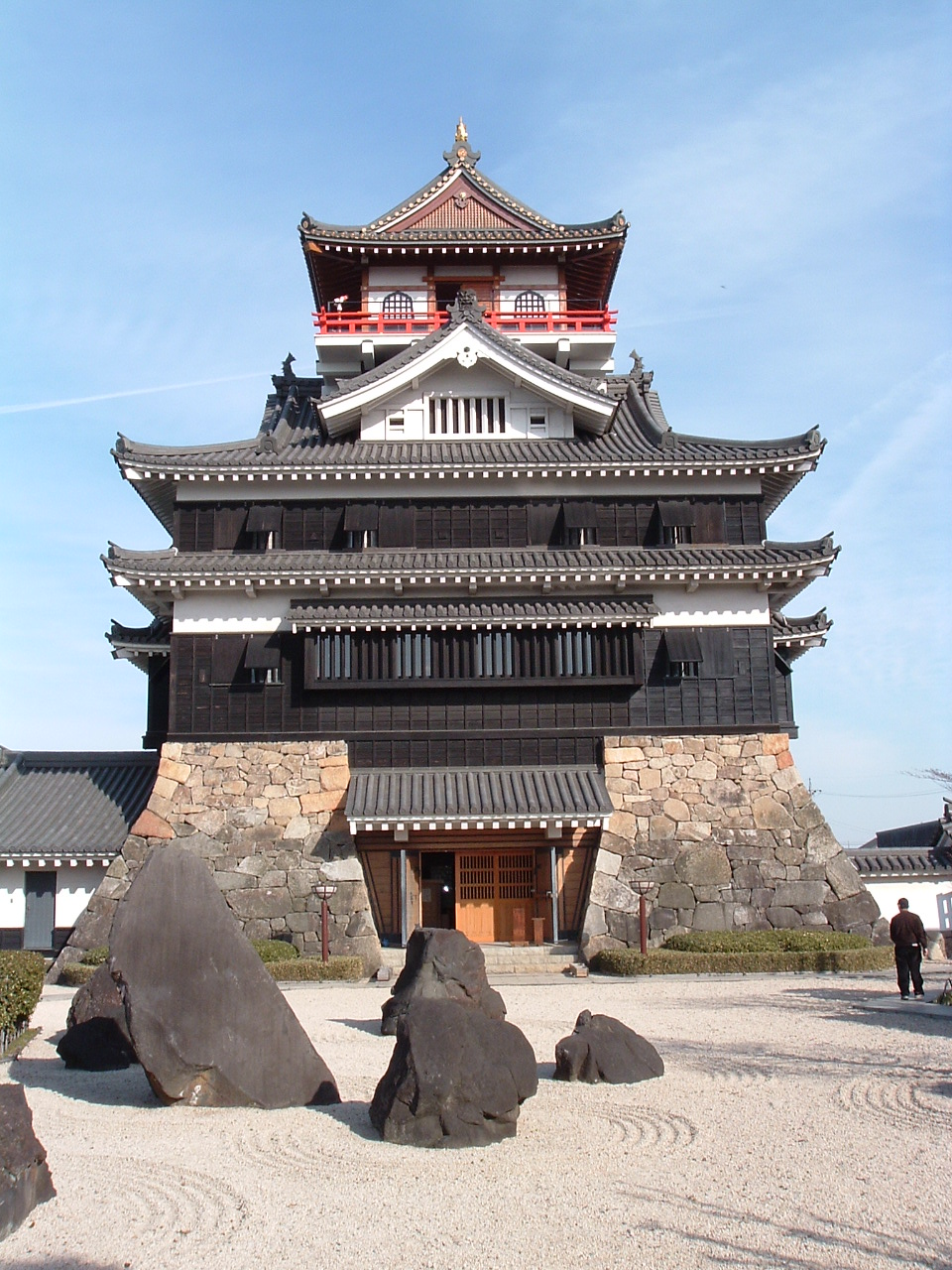
Photo: Akonnchiroll · CC BY-SA 4.0 · Wikimedia Commons
Okazaki Castle is a castle in Okazaki, Aichi Prefecture, Japan. Tokugawa Ieyasu was born at Okazaki Castle in 1543. The free Lokali audio guide runs 6 minutes.
✓ Published October 2026 · how we write these guides
Visitor facts
| Lokali audio guide | 6 min · free |
|---|---|
| Type | Castle |
| Location | Okazaki, Japan |
| Coordinates | 34.9564, 137.1589 |
| Official website | okazaki-kanko.jp |
| Languages | 50+, in the Lokali app |
The story
Listen first. Gravel crunches under your shoes, and somewhere below the stone walls, water moves slowly through the old moat. Pine branches shift in the wind. Then the white walls of the keep appear above the trees, with dark tiled roofs stacked one on top of the other. It looks calm today. But this hill in Okazaki holds one of the most important birth stories in Japanese history.
This is Okazaki Castle, in Aichi Prefecture, in central Japan. A castle has stood on this site since the mid-fifteenth century. It began as a modest fortress, built by a local warrior family to watch over the surrounding plain and the rivers that cross it. Over the following generations, the castle passed to the Matsudaira clan. That name may not mean much to you yet. But one boy from that family would change the country completely.
In 1543, a child was born inside these grounds. As a boy he carried other names, but history remembers him as Tokugawa Ieyasu. Decades later, he would unite Japan after more than a century of civil war. In 1603, he founded the Tokugawa shogunate, a military government that ruled Japan for more than two and a half centuries. Every road of that long peace leads back, in a sense, to this hill.
Here is the first surprise. Ieyasu's childhood was not comfortable or safe. His family was weak, squeezed between two powerful neighbours. As a small boy, he was sent away as a political hostage. He spent much of his youth far from Okazaki, under the control of the Imagawa clan. While he was gone, other men managed his family's castle. The future ruler of Japan grew up as a guest who could not choose to leave.
Everything changed in 1560. At the Battle of Okehazama, the warlord Oda Nobunaga defeated and killed Imagawa Yoshimoto. Suddenly, the young Ieyasu was free. He returned here, to the castle of his birth, and made it his base. From Okazaki, he slowly built his strength. He formed an alliance with Nobunaga and began the long climb toward national power. For the people of this city, that return is the real start of the story.
The castle also holds a darker memory. Ieyasu's eldest son, Nobuyasu, later served as lord of Okazaki. In 1579, under pressure connected to his alliance with Nobunaga, Ieyasu ordered his own son to take his life. Historians still debate the exact reasons. It is a reminder that the age of warring states demanded terrible choices, even inside a family. As you walk these paths, that quieter tragedy sits beside the famous triumph.
Now look at the keep in front of you. Here is the second surprise. This is not the original tower. During the early Meiji era, in the 1870s, Japan's new government ordered many old castles to be taken down. Okazaki Castle's keep was dismantled. For decades, only the stone walls and moats remained. The building you see today is a reconstruction, completed in 1959 in reinforced concrete and designed to look like the historic keep.
Do not let that disappoint you. The stone walls at the base are far older than the tower above them. Look closely at the way the large stones fit together. They lean inward slightly, and the corners curve upward in a long, elegant line. Builders shaped walls like this to make them strong and difficult to climb. Many of these stones have stayed in place through earthquakes, fires and centuries of rain.
Inside the keep, you will find a museum. The floors hold displays about the castle, the Matsudaira and Tokugawa families, and the samurai culture of the Mikawa region. Mikawa is the old name for this eastern part of Aichi. Its warriors had a reputation for loyalty and toughness, and they formed the core of Ieyasu's army. At the top, an observation level opens views across the city, the rivers and the low hills beyond.
Back outside, the grounds form Okazaki Park, and they carry several small traces of Ieyasu's birth. Look for an old well. According to local tradition, its water was used for the newborn's first bath. Nearby, a mound is said to mark the place where his placenta was buried, as was the custom. These are traditions, not documented facts. But they show how deeply the city treasures its connection to the man.
You will also see a large statue of Ieyasu in the park. Families stop here for photographs, and school groups gather around it. In spring, the grounds change completely. Cherry trees bloom along the moats and paths, and the white keep rises above clouds of pale pink. Locals spread blue sheets on the grass and share food under the branches. In autumn, the light turns golden against the dark roofs.
The city around the castle has its own flavour, quite literally. Okazaki is the home of Hatcho miso, a dark, rich soybean paste with a long history in this area. Local tradition links it to Ieyasu and his soldiers. In the Edo period, Okazaki was also a stop on the Tokaido, the great road between Edo and Kyoto. Travellers, merchants and lords passed through, and the castle watched them all.
Before you leave, stand still for a moment near the moat. Look up at the keep, then down at the old stones beneath it. One part is new, one part is ancient, and together they keep a story alive. Listen again to the water, the wind in the pines and the voices in the park. A boy was born here who would end a century of war. Today, the hill simply offers you a quiet place to walk.
Key facts
What to look for
Practical tips
Common questions
Is there a free audio guide to Okazaki Castle?
Yes — the Lokali app narrates Okazaki Castle free of charge in 50+ languages. The guide runs about 6 minutes, covers the history, what to look for on site and practical tips, and works offline once downloaded.
Where is Okazaki Castle?
Okazaki Castle is in Okazaki, Japan, at 34.9564, 137.1589. Tap the map link on this page for directions from where you are.
What is Okazaki Castle known for?
Tokugawa Ieyasu was born at Okazaki Castle in 1543. The first castle on this site dates from the fifteenth century.
What should you look for at Okazaki Castle?
Inward-leaning stone walls with gently curving corners. The well linked by tradition to Ieyasu's first bath. The large statue of Ieyasu inside the park.
What should you know before visiting Okazaki Castle?
Climb to the top floor for wide views over the city. Visit in spring when cherry trees line the castle moats.
When is the best time to visit Okazaki Castle?
Come early on weekends to avoid school and tour groups.
On the map
Opens directions to Okazaki Castle from your location.
More to see near Okazaki Castle


Hear Okazaki Castle in your language
The full story, narrated, in 50+ languages. Download it before you go and it plays offline, at your own pace, with no ticket and no tour group.