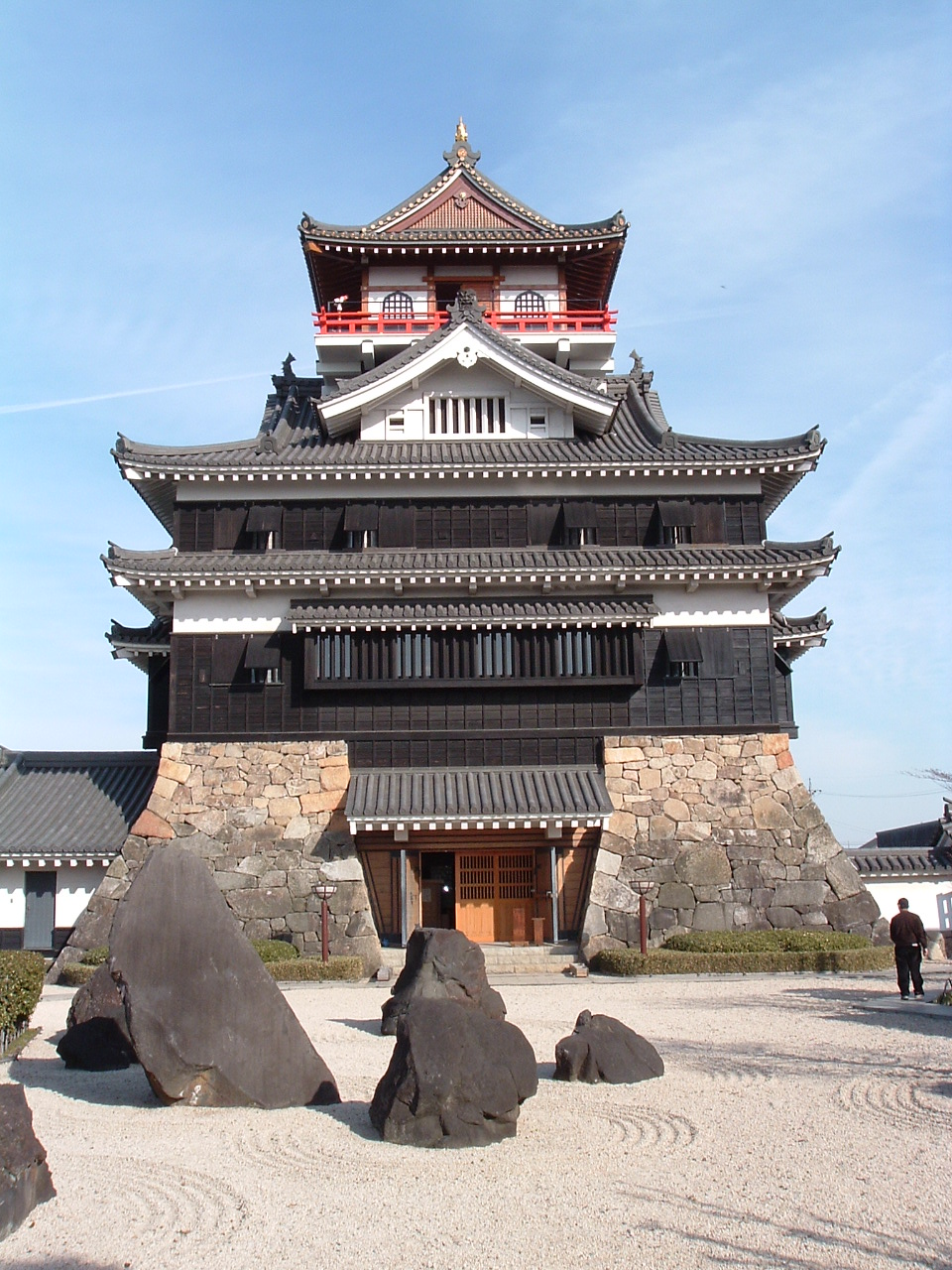
Photo: de:Benutzer:Oliver Mayer · CC BY-SA 3.0 · Wikimedia Commons
Kiyosu Castle is a Japanese castle located in Kiyosu, eastern Aichi Prefecture, Japan. Oda Nobunaga made Kiyosu his base in the 1550s. The free Lokali audio guide runs 6 minutes.
✓ Published October 2026 · how we write these guides
Visitor facts
| Lokali audio guide | 6 min · free |
|---|---|
| Type | Castle |
| Location | Kiyosu, Japan |
| Coordinates | 35.2170, 136.8440 |
| Languages | 50+, in the Lokali app |
The story
Stand on the red bridge for a moment and listen. Below you, the Gojō River moves slowly between grassy banks. Somewhere nearby, a train hums past on its way to Nagoya. Ahead, a white tower with dark roofs rises over the trees. It looks calm and tidy today. But this quiet patch of ground was once the political centre of a young and very ambitious warlord.
A quick note on where you are. Kiyosu Castle stands in the small city of Kiyosu, a short ride from Komaki, in the same corner of Aichi Prefecture. The two places share a story. They both belong to the early career of one man. That man was Oda Nobunaga, the sixteenth-century warlord who began the work of unifying a divided Japan. Here, his rise took real shape.
To understand this place, picture Japan in the sixteenth century. Historians call it the Sengoku period, which means the age of warring states. Central government had collapsed. Local lords fought each other for land, rice and loyalty. The province around you was called Owari. It was flat, fertile and well connected by rivers and roads. Whoever held Kiyosu held a strong position in Owari.
Nobunaga took control of Kiyosu in the 1550s and made it his base. From here he worked to bring the rest of Owari under his command. His rivals included members of his own family. It was not a clean story. It involved alliances, betrayals and short, sharp fights. By the end of that decade, the young lord from Kiyosu was the leading power in the province.
Then came 1560, and the moment that changed everything. A much larger army, led by the powerful lord Imagawa Yoshimoto, marched into Owari. Most people expected Nobunaga to lose. Instead, he rode out from Kiyosu with a small force and struck the Imagawa camp at a place called Okehazama. Yoshimoto was killed. The victory made Nobunaga famous across Japan almost overnight... and it began here.
Here is a detail that many visitors miss. Kiyosu is also linked to one of the most important partnerships in Japanese history. In the early 1560s, Nobunaga made an alliance with a young lord named Matsudaira Motoyasu. Today we know him as Tokugawa Ieyasu — the man who would later found the Tokugawa shogunate, which ruled Japan for more than two and a half centuries. Their pact is often called the Kiyosu Alliance.
And now the link to Komaki. In 1563, Nobunaga left Kiyosu and moved his headquarters to Mount Komaki, the lone hill you may have seen rising over Komaki city. He built a castle on its summit. A few years later, he moved again, further north to Gifu. Each move pushed his reach outward. So if you visit both places, you are following his path, one step at a time.
Kiyosu returned to the centre of the story in 1582. That year, Nobunaga died in the Honnō-ji Incident, when one of his own generals turned against him in Kyoto. His senior retainers met here, at Kiyosu, to decide who would lead the Oda house next. This gathering is known as the Kiyosu Conference. One of the men in that room was Toyotomi Hideyoshi, who would soon take control of the country himself.
So what happened to the original castle? In the early seventeenth century, the Tokugawa decided to build a new castle town at Nagoya. The people, temples and businesses of Kiyosu were moved there, almost as a whole community. This great relocation is remembered as the Kiyosu Move. Over time, the old castle was taken apart. Tradition says some of its materials went into Nagoya Castle, where one corner turret is still called the Kiyosu Turret.
That means the tower in front of you is not the original. It is a modern reconstruction, built in 1989. No detailed plans of the first keep survive, so its design is an informed idea of a castle from this era, not an exact copy. It is worth knowing this as you look up at it. The building is a way to remember the site, and inside it tells the story of the people connected to it.
Inside, you can expect displays about Nobunaga, the Oda family and the history of Kiyosu. Exhibits usually include armour, maps and models that help you picture the old castle and its town. As you climb, the rooms change, and the windows open onto the wider plain. From the upper levels, you can see how flat Owari really is, and why a castle beside a river mattered so much here.
When you come back outside, cross the river to the park on the far bank. There you will find a statue of Nobunaga, shown as a young warrior. Nearby, a statue of his wife, often called Nōhime, has been added in recent years. The park is a pleasant place to sit. Families walk dogs here. In spring, cherry trees along the river turn the banks pale pink, and the area fills with people.
Before you leave, pause again on the red bridge. Look at the white walls, the dark tiled roofs and the slow brown water underneath. The ground of the old castle lies partly beneath the railway lines that cross this area now. When the next train passes, think of the messengers, soldiers and merchants who once crossed this same river. The roads have changed. The river is still here, running the way it always has.
Key facts
What to look for
Practical tips
Common questions
Is there a free audio guide to Kiyosu Castle?
Yes — the Lokali app narrates Kiyosu Castle free of charge in 50+ languages. The guide runs about 6 minutes, covers the history, what to look for on site and practical tips, and works offline once downloaded.
Where is Kiyosu Castle?
Kiyosu Castle is in Kiyosu, Japan, at 35.2170, 136.8440. Tap the map link on this page for directions from where you are.
What is Kiyosu Castle known for?
Oda Nobunaga made Kiyosu his base in the 1550s. Nobunaga rode from here to win at Okehazama in 1560.
What should you look for at Kiyosu Castle?
The red bridge over the slow Gojō River. White walls contrasting with dark tiled roofs. The bronze statue of young Nobunaga in the park.
What should you know before visiting Kiyosu Castle?
Cross the red bridge to see the castle across the river. Visit the riverside park for the Nobunaga statue.
When is the best time to visit Kiyosu Castle?
Come in cherry blossom season for pink riverbanks.
On the map
Opens directions to Kiyosu Castle from your location.
More to see near Kiyosu Castle


Hear Kiyosu Castle in your language
The full story, narrated, in 50+ languages. Download it before you go and it plays offline, at your own pace, with no ticket and no tour group.