
Photo: Alpsdake · CC BY-SA 3.0 · Wikimedia Commons
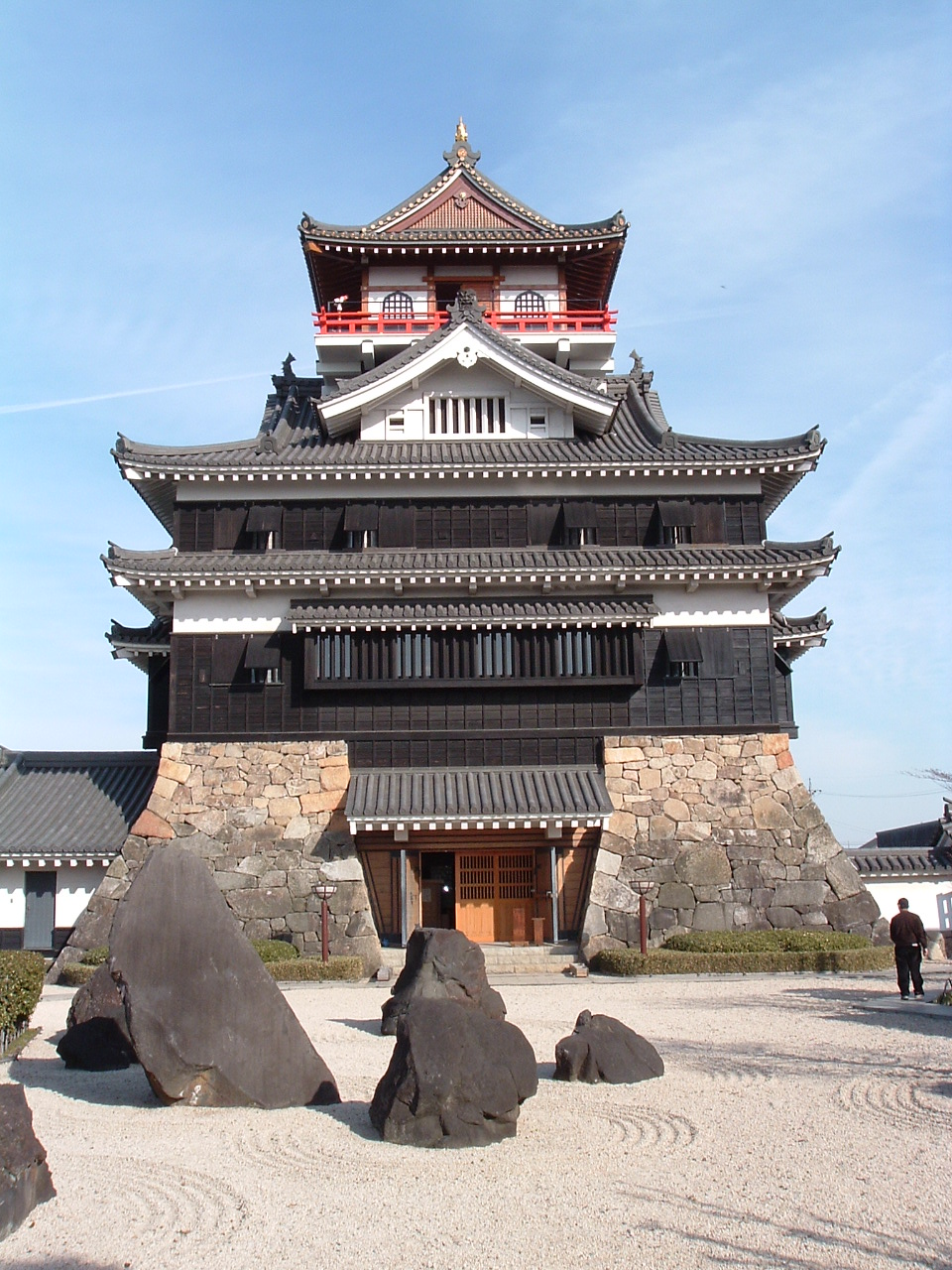
Gifu Castle is a fortification. It is in Gifu, Japan. Castle stands on Mount Kinka, about 329 metres high. The free Lokali audio guide runs 7 minutes.
✓ Published October 2026 · how we write these guides
Visitor facts
| Lokali audio guide | 7 min · free |
|---|---|
| Type | Castle |
| Location | Gifu, Japan |
| Coordinates | 35.4339, 136.7822 |
| Official website | city.gifu.lg.jp |
| Languages | 50+, in the Lokali app |
The story
Feel the air change as you climb. Down in the city it was warm and still, but up here on the summit, a breeze moves through the trees. The ground underfoot is old rock, worn smooth by centuries of feet. Crows call somewhere below you. Then the forest opens, and a small white keep appears on the very top of the mountain, against the open sky.
This is Gifu Castle, on the summit of Mount Kinka, about 329 metres above the city of Gifu. The mountain rises suddenly from the flat plain, which is why people have used it as a fortress for so long. From this height you can see a wide sweep of central Japan. A defender standing here could watch armies moving across the land for many kilometres in every direction.
For much of its history, this place had a different name. It was known as Inabayama Castle, and the mountain itself was called Inabayama. In the sixteenth century it was the stronghold of Saito Dosan, a warlord with a fearsome reputation. Stories describe him as a man who rose from humble beginnings to rule the whole province of Mino. Many details of his early life are uncertain, and some of the popular tales are closer to legend than to history.
This was the Sengoku period, often called the Warring States era. For more than a century, rival lords fought across Japan, and no single ruler held real power. A castle on a mountain like this one was a prize. Whoever controlled Mino controlled important routes between eastern and western Japan. That made this summit one of the most valuable positions in the country.
In 1567, Oda Nobunaga captured the castle. Nobunaga was the warlord who began the long process of uniting Japan. Here is the first surprise for many visitors... the name of this city comes from him. Nobunaga renamed the town Gifu. The first part refers to Mount Qi in ancient China, linked to the rise of the Zhou dynasty. The second part is usually connected to Qufu, the hometown of Confucius. The name was a statement of ambition — a ruler announcing that a new age would begin here.
Around this time, Nobunaga began using a seal with the phrase "Tenka Fubu." It is often translated as "rule the realm by military force." Historians still discuss its exact meaning. What is clear is that Gifu became his base as he pushed toward Kyoto, the imperial capital. Much of the story of a united Japan started on this mountain and the town below it.
Nobunaga did not live only on the summit. At the foot of the mountain he built a large residence with gardens. A Portuguese Jesuit missionary, Luis Frois, visited him and wrote an admiring description of the palace. That account is one of the rare outside views of Nobunaga's court. Archaeologists have excavated parts of the site at the base of Mount Kinka, and they have found traces of stone walls and garden features.
After Nobunaga's death, the castle passed to other lords. Its fighting history ended around the time of the Battle of Sekigahara in 1600. That battle decided who would rule Japan for the next two and a half centuries. The castle's lord had joined the losing side, and the castle fell. Soon afterward, it was taken apart. Some of its materials are said to have been reused at a new castle built nearby in the plain.
So here is the second surprise. The keep in front of you is not the sixteenth-century original. A first reconstruction stood here in the early twentieth century, but it was lost to fire during the Second World War years. The building you see today was rebuilt in concrete in the 1950s. It follows the general look of an old castle keep, with white walls and dark curved roofs. It is a modern tribute rather than an ancient survivor.
Inside, the keep holds a small exhibition. You may see armour, swords, and other objects connected to the warring lords of the region. The rooms are compact, and the stairs are steep. Take your time on them. The real reward waits at the top floor, where an open viewing deck lets you walk around the outside of the building and look in every direction.
From the top, look down to the Nagara River as it curves past the mountain. The river is known for ukai, a traditional form of fishing with trained cormorants. Fishermen work from wooden boats at night, with fires burning to attract the fish. The tradition here is very old, and Nobunaga himself is said to have shown it to honoured guests. On clear days you can also see distant mountain ranges and, far to the south, the plain stretching toward Nagoya.
There are two ways to reach this summit. Most visitors ride the ropeway from Gifu Park, and the cabin rises steeply over the forest in just a few minutes. Others hike up on one of several trails. The walking routes are steep and rocky in places, and they take some effort. But climbing on foot gives you a clear sense of why attackers found this fortress so hard to take.
As you walk around the summit, notice the stone. Sections of old stone walls still remain along the paths. Look for wells and small flat terraces cut into the slope. These features belong to the older castle, the one that existed before the modern keep. They are easy to pass without a second look, yet they are among the most genuine pieces of history on the mountain.
Before you leave, stand for a moment at the edge of the viewing area. Listen to the wind in the trees, and look at the city spread below. A warlord once stood near this spot and gave that city its name. Today the streets carry ordinary life — trains, schools, river boats. When you start back down, watch the forest close around you again, and remember that every step follows a path that soldiers, lords, and travellers have used for centuries.
Key facts
What to look for
Practical tips
Common questions
Is there a free audio guide to Gifu Castle?
Yes — the Lokali app narrates Gifu Castle free of charge in 50+ languages. The guide runs about 7 minutes, covers the history, what to look for on site and practical tips, and works offline once downloaded.
Where is Gifu Castle?
Gifu Castle is in Gifu, Japan, at 35.4339, 136.7822. Tap the map link on this page for directions from where you are.
What is Gifu Castle known for?
Castle stands on Mount Kinka, about 329 metres high. Formerly known as Inabayama Castle under Saito Dosan.
What should you look for at Gifu Castle?
Old stone wall sections along the summit paths. The Nagara River curving below the mountain. White walls and dark curved roofs of the keep.
What should you know before visiting Gifu Castle?
Ride the Kinkazan Ropeway up from Gifu Park. Wear sturdy shoes if you hike the trails.
When is the best time to visit Gifu Castle?
Stay for evening cormorant fishing on the Nagara River.
On the map
Opens directions to Gifu Castle from your location.
More to see near Gifu Castle



Hear Gifu Castle in your language
The full story, narrated, in 50+ languages. Download it before you go and it plays offline, at your own pace, with no ticket and no tour group.