
Photo: Mc681 · CC BY-SA 4.0 · Wikimedia Commons
Tsūtenkaku is an observation tower. It is in Osaka, Japan. First Tsūtenkaku opened in 1912 in Shinsekai. The free Lokali audio guide runs 7 minutes.
✓ Published October 2026 · how we write these guides
Visitor facts
| Lokali audio guide | 7 min · free |
|---|---|
| Type | Tower |
| Location | Osaka, Japan |
| Coordinates | 34.6522, 135.5061 |
| Official website | tsutenkaku.co.jp |
| Languages | 50+, in the Lokali app |
The story
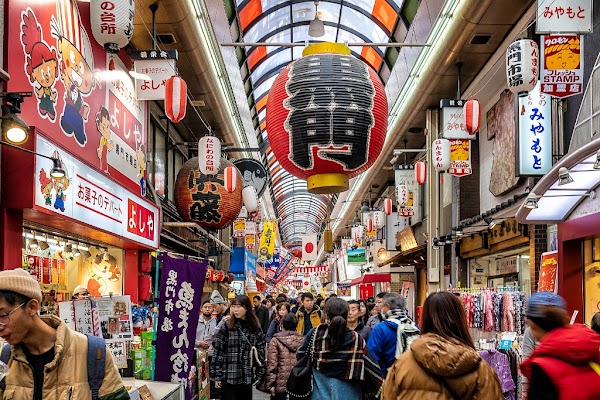
Listen first. Overhead, a soft electric hum comes from the neon. Below it, oil hisses in a dozen small kitchens. Street hawkers call out, and somewhere a pachinko parlour spills a wave of metal clatter into the street. Then you look up. A steel tower rises from the middle of the noise, wrapped in lights, with a large company name glowing down its sides. This is Tsūtenkaku. It stands in the Shinsekai district of Osaka, a short train ride north of Sakai, and it has watched over this neighbourhood for more than a century.
Start with the name. Tsūtenkaku is usually translated as "the tower reaching to heaven". The three Japanese characters mean, roughly, passing through, sky, and tall building. It is a grand name for a structure that is not very tall by modern standards. The current tower is a little over one hundred metres high. In a country of glass skyscrapers, that sounds modest. But height was never really the point. This tower was built to be a landmark people could love, not a record to break.
To understand it, you need to know about the ground under your feet. In the early twentieth century, Osaka hosted a large national industrial exhibition here. After it closed, developers turned the site into an amusement quarter. They called it Shinsekai, which simply means "New World". The plan was bold. The northern half was laid out like a Paris boulevard, and the southern half imitated Coney Island in New York, with a park called Luna Park.
At the centre of this dream stood the first Tsūtenkaku, which opened in 1912. Its design copied two Paris landmarks at once. The upper part looked like the Eiffel Tower. The base looked like the Arc de Triomphe, the great triumphal arch in Paris. For a time, a cable car linked the tower to Luna Park nearby. Imagine Osaka families in the 1910s, riding through the air above rooftops, to see a little piece of Europe built in their own city.
That first tower did not survive. In 1943, a fire damaged it badly. Japan was at war, and steel was precious. Instead of repairing the tower, the authorities dismantled it, and the metal went to the war effort. For more than a decade, Shinsekai had no tower at all. Many locals felt the loss deeply. The neighbourhood had lost its symbol, and the area itself faced hard years after the war.
Here is the first surprise. The tower you see today was not rebuilt by the city or by a big corporation. Local residents and business owners organised to bring it back. They formed a company to fund a new Tsūtenkaku, and it opened in 1956. The engineer was Tachū Naitō, a leading structural designer of his era. Just a few years later, he also designed Tokyo Tower. So this neighbourhood tower is a close relative of one of Japan's most famous structures.
Look carefully at the shape. The second tower is not a copy of the first. It is more angular, with an octagonal body and a squared-off silhouette. Its lower section still opens up at street level, so traffic and pedestrians pass beneath it. Stand underneath and look straight up. The ceiling of this passage carries a large decorative painting. It recreates the spirit of an artwork that decorated the original tower, a quiet link to the 1912 structure that was lost.
Now, the second surprise sits at the top of the tower. Watch the lights near the summit as evening falls. They are not only decoration. The colours show the next day's weather forecast for Osaka. Locals learn the code. White means clear skies, orange means clouds, and blue means rain. It is a small, practical gift to the neighbourhood. People walking home can glance up and decide whether they need an umbrella tomorrow.
Up on the observation deck, you will meet a strange little figure. He has a pointed head, a wide grin, and he sits with his legs stretched forward. This is Billiken. Surprisingly, he is not Japanese at all. He began as a lucky charm character created in the United States in the early twentieth century. He arrived in Shinsekai during its first boom years. Visitors rub the soles of his feet for good fortune, which is why the wood there looks worn and smooth.
Billiken became so loved here that you will see him everywhere in Shinsekai. He appears on shop signs, souvenirs, and statues outside restaurants. Locals call him a god of things as they ought to be. Whether you believe in luck or not, it is a charming ritual. Waiting in line, you will hear people laughing and joking with strangers. That easy, slightly cheeky friendliness is very typical of Osaka.
Back at street level, follow your nose. Shinsekai is the home ground of kushikatsu, which are skewers of meat, vegetables, or seafood, coated in breadcrumbs and deep fried. Many restaurants serve them with a shared tray of thin dipping sauce. That brings a famous house rule: no double dipping. Once you bite a skewer, it must not go back into the shared sauce. Many shop signs show this rule with a stern cartoon face. If you want more sauce, use a piece of raw cabbage as a scoop.
Walk a few minutes from the tower and the atmosphere changes again. Narrow alleys hold old-style shops, standing bars, and game parlours where older men play shogi, a Japanese board game similar to chess. Shinsekai was once seen as rough and run-down. Today it mixes that older character with crowds of visitors. The district has kept its loud signs and its nostalgic, slightly faded feel. Nowhere else in Osaka looks quite the same.
Before you leave, step back to a spot where you can see the whole tower at once. Notice how the steel frame catches the last daylight, and how the neon takes over as the sky darkens. Listen again to the fryers, the voices, and the music from the shops. This tower was built twice, by dreamers and then by neighbours. As you walk away, glance up one more time and check the colour at the top. It might tell you what tomorrow will bring.
Key facts
What to look for
Practical tips
Common questions
Is there a free audio guide to Tsūtenkaku?
Yes — the Lokali app narrates Tsūtenkaku free of charge in 50+ languages. The guide runs about 7 minutes, covers the history, what to look for on site and practical tips, and works offline once downloaded.
Where is Tsūtenkaku?
Tsūtenkaku is in Osaka, Japan, at 34.6522, 135.5061. Tap the map link on this page for directions from where you are.
What is Tsūtenkaku known for?
First Tsūtenkaku opened in 1912 in Shinsekai. Original tower dismantled after a 1943 fire.
What should you look for at Tsūtenkaku?
Weather forecast colours in the lights at the summit. Worn, smooth soles on the Billiken statue's feet. Decorative painted ceiling under the tower's base.
What should you know before visiting Tsūtenkaku?
Come at dusk to see the neon switch on. Expect queues for the observation deck on weekends.
When is the best time to visit Tsūtenkaku?
Come at dusk to see the neon switch on.
On the map
Opens directions to Tsūtenkaku from your location.
More to see in Osaka



Hear Tsūtenkaku in your language
The full story, narrated, in 50+ languages. Download it before you go and it plays offline, at your own pace, with no ticket and no tour group.