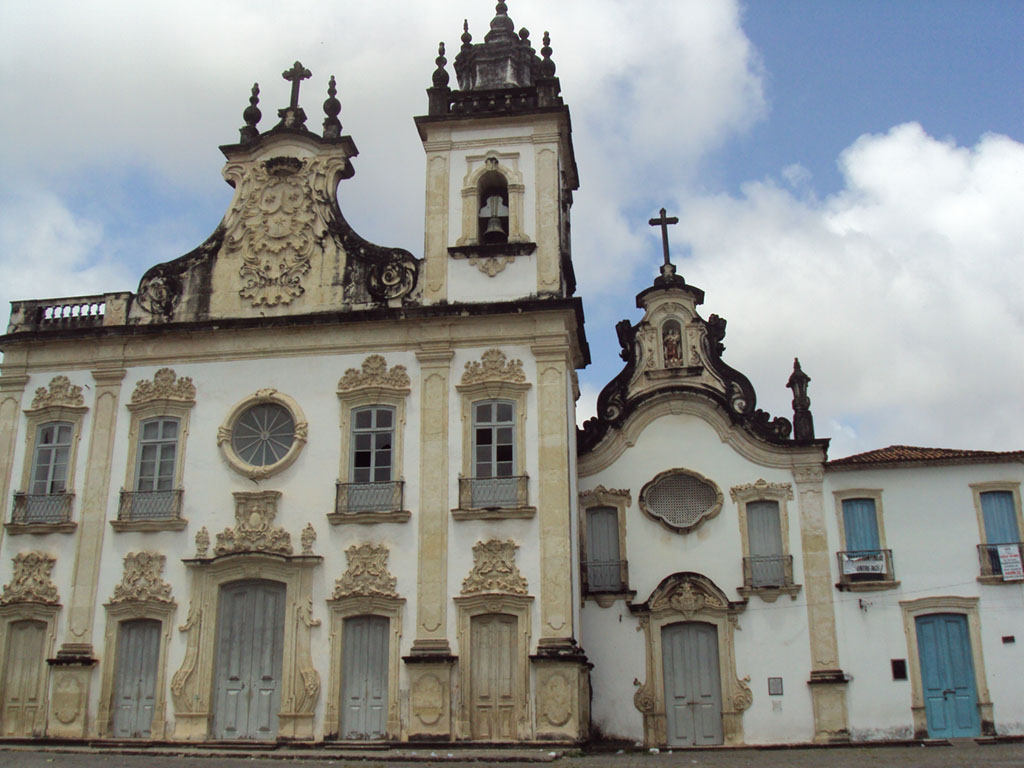
Church of Our Lady of Carmo
20.3868° S · 43.5058° W · Church
Church of Our Lady of Carmo is a church in Ouro Preto, Brazil. Rococo church completed in 1772, featuring a striking octagonal bell tower and interior decorated with azulejo tiles. Most visitors spend 40–50 min here. The free Lokali audio guide runs 5 minutes.
✓ Verified August 2026 · how we write these guides
Visitor facts
| Time needed | 40–50 min |
|---|---|
| Lokali audio guide | 5 min · free |
| Type | Church |
| Best for | Editors' pick |
| Location | Ouro Preto, Brazil |
| Coordinates | -20.3868, -43.5058 |
| Languages | 45, in the Lokali app |
The story
Walk a short way from the main square and you will find this church standing along a sloping street. Twin towers rise above a front of pale, plain stone. A carved doorway breaks the smooth wall at the centre, drawing the eye. The line of the roof curves gently against the open sky. Stop on the street below for a moment and take in the whole shape before you climb the steps.
This is the Church of Our Lady of Carmo. It was built by a lay brotherhood known as the Third Order of Carmo. Such groups were made up of ordinary faithful people, not priests at all. They gathered the money, chose the artists, and raised fine churches of their own. Membership brought real standing in the town, and each order took deep pride in its building.
Work on the church began in 1766. It went on for decades, slowly, as the money allowed. The wealth came from gold pulled out of the hills all around the town. Building a church on this scale took years of patient effort, skilled hands, and a steady flow of that gold into the careful keeping of the order. Few towns of this size have ever raised so many fine churches from a single trade, and the cost was matched only by the faith behind it.
Two well-known names are tied to this front. The first plan came from Manuel Francisco Lisboa, a respected master builder of the day. His son went on to even greater fame than the father. That son was Antonio Francisco Lisboa, the sculptor known to all as Aleijadinho, whose patient hand shaped so much of the art in this town.
Look closely at the carved stone around the main door. The softer, more flowing detail here is linked to Aleijadinho himself. He reworked the front of the church and cut its soapstone forms by hand. Soapstone is gentle and grey when fresh, and it darkens slowly with age. Trace the curling shapes above the doorway with your eyes before you step inside.
Move inside and let the light grow soft around you. The room is long and narrow, and it draws your gaze steadily toward the altar at the far end. Carved wood lines the walls, and gold catches what little light there is. The style is Rococo, lighter than the heavy Baroque, and fond of curves, shells, and open, airy space.
Walk slowly toward the front. Side altars stand along the way, each one carved with care and set into its own shallow bay. Above and around them, the woodwork twists into leaves, scrolls, and small figures. The craftsmen spent long months on work that most visitors pass in a single glance. Give it more than a glance as you go.
Ask, if you can, to see the sacristy, the room set aside for priests to prepare for the service. Within it are carved washing basins cut from soapstone. These too are linked to the hand of Aleijadinho. They show how even a plain and useful object, made for daily use, could be turned into a real piece of art.
The painted and gilded work inside drew on the skill of the region's finest artists. The same circle of painters and carvers that decorated the other great churches of the town worked here as well. What you see around you is the result of many hands, joined together across many years, all working toward a single, shared effect.
Think for a moment about how this church was used. The brotherhood met here, prayed here, and buried its own members here. Births, marriages, and deaths all passed through these same doors over the generations. For the families of the order, this was never only a place of beauty. It was the steady centre of their shared daily life.
Turn back toward the entrance before you leave. From inside, the open doorway frames a bright rectangle of the street and the green hills beyond. The contrast is strong and sudden, the dim gold within set against the plain daylight outside. Stand quietly in that meeting of dark and light for a moment before you go.
Step out and look up one last time at the towers above you. A father drew the first plan, and a famous son shaped the stone. Around them, a brotherhood of ordinary people gave their money and their years to raise it. Carry that thought down the street with you, into the rest of the old town and its many churches.
Key facts
What to look for
Practical tips
Common questions
How long do you need at Church of Our Lady of Carmo?
Plan 40–50 min. That is the time most visitors spend at Church of Our Lady of Carmo. The free Lokali audio guide adds about 5 minutes of narration you can listen to as you walk, so it fits inside your visit rather than adding to it.
Is there a free audio guide to Church of Our Lady of Carmo?
Yes — the Lokali app narrates Church of Our Lady of Carmo free of charge in 50+ languages. It covers the history, what to look for on site and practical tips, and it works offline once downloaded.
Where is Church of Our Lady of Carmo?
Church of Our Lady of Carmo is in Ouro Preto, Brazil, at -20.3868, -43.5058. Tap the map link on this page for directions from where you are.
What should you know before visiting Church of Our Lady of Carmo?
Allow about thirty minutes for your visit.
What is Church of Our Lady of Carmo known for?
Construction began in 1766 in Ouro Preto.
What is the best time to visit Church of Our Lady of Carmo?
The bell tower offers a steep climb but rewards with views across the terracotta roofscape.
On the map
Opens directions to Church of Our Lady of Carmo from your location.
More to see in Ouro Preto


Hear Church of Our Lady of Carmo in your language
The full story, narrated, in 50+ languages. Download it before you go and it plays offline, at your own pace, with no ticket and no tour group.