
Photo: Didier Descouens · CC BY-SA 4.0 · Wikimedia Commons
Abbey of Santa Giustina is a basilica in Padua. Dedicated to Saint Justina, a local early Christian martyr. The free Lokali audio guide runs 6 minutes.
✓ Published October 2026 · how we write these guides
Visitor facts
| Lokali audio guide | 6 min · free |
|---|---|
| Type | Church |
| Location | Padua, Italy |
| Coordinates | 45.3964, 11.8797 |
| Official website | abbaziasantagiustina.org |
| Languages | 50+, in the Lokali app |
The story
Start with the sound under your feet. On the edge of Prato della Valle, gravel and paving stones give way to a wide flight of steps. Above them rises a wall of raw, rough brick. It has no marble skin and no carved saints. It is just brick, warm and slightly uneven, catching the light at different angles. Many visitors think the façade is still being restored. In fact, it was simply never finished.
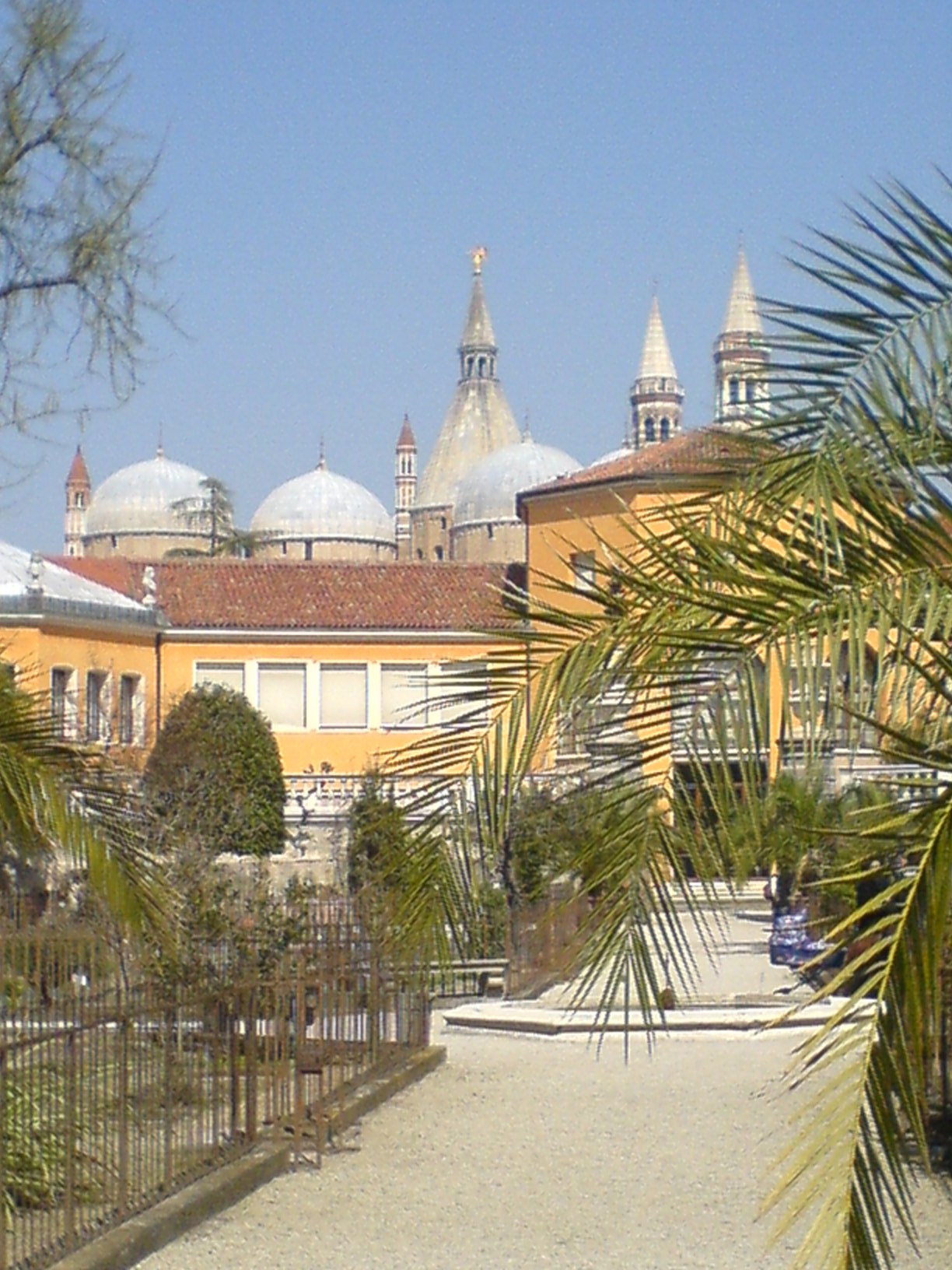
This is the Abbey of Santa Giustina, one of the great Benedictine houses of Italy. The church in front of you is huge. It ranks among the largest churches in the country, and its scale is easier to feel than to describe. Behind the plain front, a cluster of domes rises over the nave. Each dome is topped with a small figure. From the square they look like a line of hills on the skyline.
The abbey takes its name from Saint Justina. According to tradition, she was a young Christian woman of Padua, martyred around the start of the fourth century. That was during the persecutions under the Roman emperor Diocletian. Very little about her life can be confirmed. Her story comes down to us through devotion and legend more than documents. Even so, Padua has honoured her on this spot for well over a thousand years.
Long before this church existed, there was an earlier shrine here. Christians gathered around the graves of local martyrs, outside the old Roman town. Over the centuries, chapels and churches were built, damaged, and rebuilt on the same ground. Some of those older layers survive inside. So when you walk in, you enter a sixteenth-century building that stands on a much older holy site.
Now a surprise that most visitors miss. In the fifteenth century, this abbey became the heart of a major religious reform. A Venetian nobleman and abbot, Ludovico Barbo, set out to restore strict Benedictine life here. Other monasteries joined the movement, and they formed a network known as the Congregation of Santa Giustina. Later, when the famous abbey of Montecassino joined, the network took the name Cassinese Congregation. For a time, a quiet abbey in Padua shaped monastic life across Italy.
That reform brought monks, money, and confidence. In the sixteenth century, the community decided to replace the older church with something grander. Construction took decades, and the work passed through several hands and designs. The result is a calm, ordered interior in the style of the High Renaissance. That means clear geometry, repeated arches, and pale stone, rather than the pointed arches of the Gothic period. The façade was meant to be dressed in stone. The money and the moment never came.
Step inside, and the temperature drops. The light is soft and even. White and grey stone runs down the long nave toward the high altar. The space feels almost empty, because it is so large. Your footsteps echo, and voices fade into the vaults. If monks are singing, the sound travels a long way. Take a moment near the entrance and let your eyes adjust before you walk forward.
Here is the second surprise. This church claims to hold the remains of Saint Luke the Evangelist, the author of one of the four Gospels. His tomb lies in the left transept, which is one arm of the cross-shaped plan. In the late 1990s, scientists were allowed to study the remains. Their research suggested that the bones were consistent with a man from the eastern Mediterranean, from the right period. It did not prove the identity, but it made the old tradition harder to dismiss.
Luke is not alone. The church also keeps relics associated with Saint Matthias, the apostle chosen to replace Judas. And there is the early Christian chapel of Saint Prosdocimus, honoured as the first bishop of Padua. This small chapel is much older than the basilica around it. Its walls carry fragments of early marble work. Standing in it, you are close to the oldest Christian layer of the city.
Look toward the far end of the church, behind the high altar. There, in the apse, hangs a large painting of the martyrdom of Saint Justina by Paolo Veronese. Veronese was one of the leading Venetian painters of the sixteenth century, known for rich colour and crowded, theatrical scenes. Here the saint is at the centre, with figures pressing around her and heaven opening above. Give your eyes time. The details reward patience.
The abbey's story also includes long silence. In the early nineteenth century, under Napoleon's rule, many monasteries in northern Italy were suppressed. Santa Giustina was one of them. The monks were sent away, and parts of the complex were put to other uses, including military ones. Benedictine life returned only in the twentieth century. Today, a monastic community lives here again, keeping the old rhythm of prayer and work behind the walls.
When you leave, turn around on the steps and look out. In front of you is Prato della Valle, an enormous oval square. It was once a damp, open field, and the monks owned land around it. In the 1770s, the Venetian official Andrea Memmo redesigned it. He added a ring-shaped canal and rows of statues of notable figures. The abbey and the square grew up side by side, and they still frame each other today.
Before you go, stand still for a moment. Feel the rough brick of the façade behind you, warm or cool depending on the hour. Listen to the bicycles on the paving stones and the water in the canal. Somewhere behind you, monks still follow a daily schedule shaped centuries ago. The front was never finished... and perhaps that suits a place that is still living, still in use, still part of the city around it.
Key facts
What to look for
Practical tips
Common questions
Is there a free audio guide to Abbey of Santa Giustina?
Yes — the Lokali app narrates Abbey of Santa Giustina free of charge in 50+ languages. The guide runs about 6 minutes, covers the history, what to look for on site and practical tips, and works offline once downloaded.
Where is Abbey of Santa Giustina?
Abbey of Santa Giustina is in Padua, Italy, at 45.3964, 11.8797. Tap the map link on this page for directions from where you are.
What is Abbey of Santa Giustina known for?
Dedicated to Saint Justina, a local early Christian martyr. Fifteenth-century reform here founded the Congregation of Santa Giustina.
What should you look for at Abbey of Santa Giustina?
The bare, unfinished brick façade facing the square. Small statues crowning the domes above the roofline. Saint Luke's tomb in the left transept.
What should you know before visiting Abbey of Santa Giustina?
Pause inside the entrance to let your eyes adjust. Check for sung monastic prayers to hear the acoustics.
On the map
Opens directions to Abbey of Santa Giustina from your location.
More to see in Padua


Hear Abbey of Santa Giustina in your language
The full story, narrated, in 50+ languages. Download it before you go and it plays offline, at your own pace, with no ticket and no tour group.