
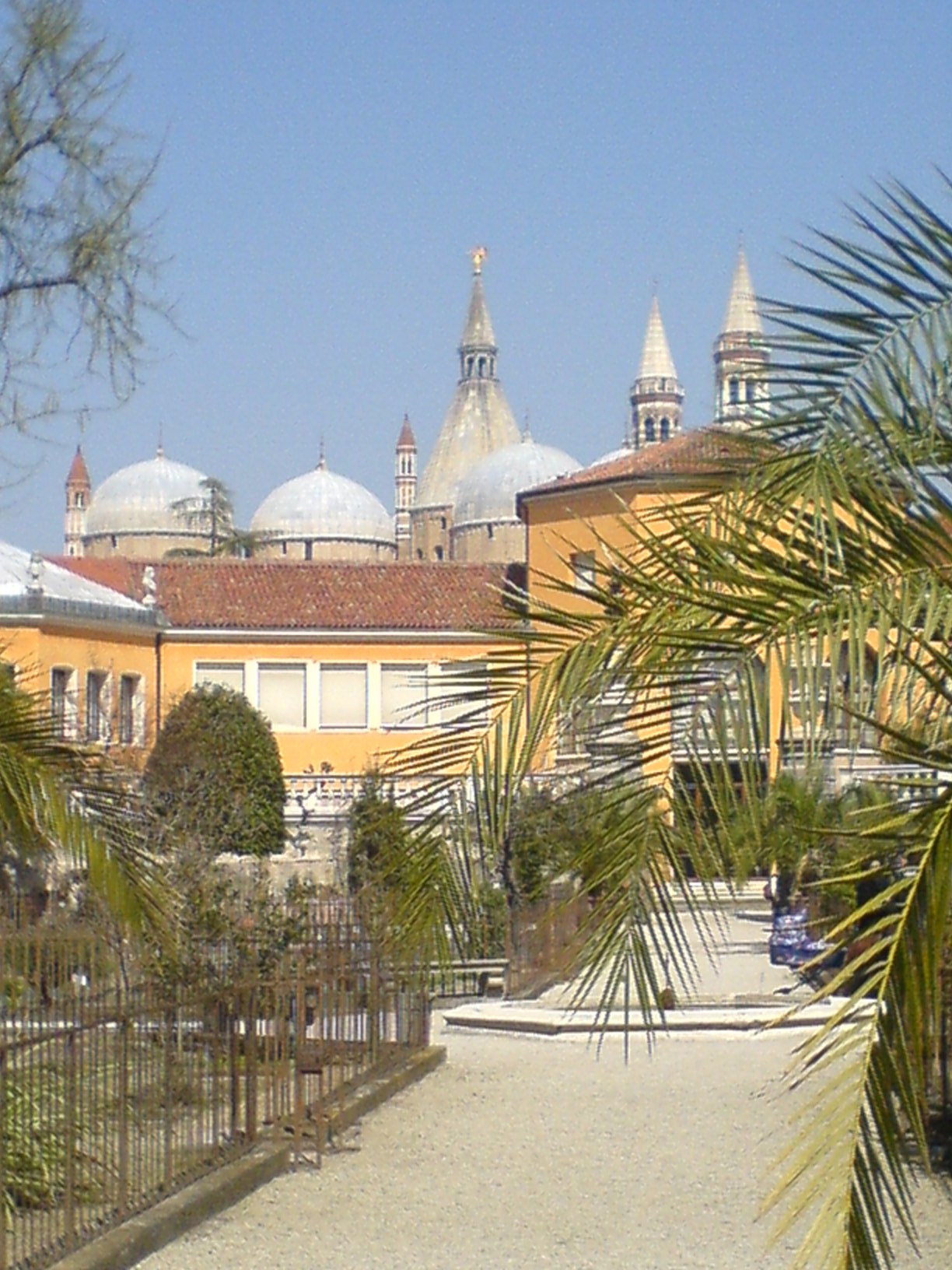
Photo: Didier Descouens · CC BY-SA 4.0 · Wikimedia Commons
Padua Cathedral is a cathedral in Padua, Veneto, Italy. Dedicated to Santa Maria Assunta, the Virgin Mary. The free Lokali audio guide runs 7 minutes.
✓ Published October 2026 · how we write these guides
Visitor facts
| Lokali audio guide | 7 min · free |
|---|---|
| Type | Cathedral |
| Location | Padua, Italy |
| Coordinates | 45.4064, 11.8717 |
| Official website | diocesipadova.it |
| Languages | 50+, in the Lokali app |
The story
Stand in the square for a moment and look up. The front of the cathedral is not stone or marble at all. It is plain, rough brick, the colour of dry earth, with dark holes where scaffolding once sat. Pigeons settle in those gaps. In the late afternoon the brick turns warm and orange, and the whole wall looks less like a finished church and more like a building that is still waiting for someone to come back and complete it.
That feeling is accurate. The façade of Padua Cathedral was never given its decorative skin. Many Italian churches have this look, because cladding a front in marble was expensive and was often left for later. Sometimes later never came. So what you see is the bare structure, honest and unpolished. It is a good place to start, because this cathedral has always been a little quieter than its famous neighbours, and it rewards people who slow down.
First, a small surprise for many visitors. This is not the great domed basilica that most pilgrims come to Padua to see. That building is the Basilica of Saint Anthony, a short walk to the south-east, and locals simply call it Il Santo, which means the Saint. This church is different. It is the cathedral, the seat of the bishop of Padua. Its full name is the Cathedral of Santa Maria Assunta, dedicated to the Virgin Mary taken up into heaven.
Christians have worshipped on this spot for a very long time. Several earlier churches stood here before the present one. A strong earthquake struck northern Italy in 1117 and badly damaged the medieval cathedral, which was then rebuilt. That older building lasted for centuries. In the middle of the sixteenth century, however, the church leaders of Padua decided they wanted something larger and more modern, in the new style of the Renaissance.
Here is the second surprise. The design of the new cathedral is linked to Michelangelo, the Florentine artist who painted the Sistine Chapel ceiling in Rome. He is said to have provided a plan, or at least ideas, for the building. But Michelangelo never came to supervise the work. Local architects adapted and changed his design as construction went on. So you should think of this cathedral as a conversation between a famous name and the local builders who actually laid the bricks.
And those builders needed patience. Work began in the sixteenth century and continued, slowly and with long pauses, for about two hundred years. The main structure was only completed in the eighteenth century. Generations of masons, carpenters and priests came and went while the walls rose. Some of the people who blessed the first stones never saw the roof. When you walk inside, you are walking through two centuries of slow, careful effort.
Step through the doors now. The change is sudden. After the warm, rough brick outside, the interior is cool, pale and calm. The walls and columns are mostly white and soft grey. The light falls from high windows and from the domes above the crossing. Your footsteps echo on the floor. There is very little gold or bright colour here, and that restraint is the point. The space feels open and measured, built for clear proportions rather than drama.
Look at the plan of the church as you walk. It follows the shape of a Latin cross, with a long nave leading to the altar and two arms reaching out to the sides. Above the crossing, where the arms meet, the domes lift the ceiling and pull your eye upward. Stand under them for a moment and turn slowly. You will notice how the lines of the arches repeat, guiding you naturally toward the altar.
The cathedral also keeps the memory of people who shaped the city. One of them is Saint Gregory Barbarigo, a bishop of Padua in the seventeenth century. He was known for his work in education and for reforming the local seminary, the school that trained priests. He was later declared a saint, and his body rests inside this church. Local Catholics still come to pray at his tomb, so you may see someone kneeling quietly there.
Another name connected to this cathedral may surprise you. The poet Petrarch, one of the great writers of the Italian language, held a position here as a canon. A canon was a member of the clergy attached to the cathedral, with duties and an income. Petrarch spent his last years in the hills near Padua. So the man whose love poems shaped European literature once had his own place among the clergy of this church.
Now, when you leave, do not miss the small building beside the cathedral. This is the Baptistery, where people were baptised, and for many visitors it is the real treasure of the square. It is older and plainer than the cathedral outside. Inside, however, nearly every surface is covered in fourteenth-century frescoes, which are paintings made on wet plaster. They were painted by the artist Giusto de' Menabuoi, who worked in Padua at that time.
Inside the Baptistery, look up into the dome. Rows and rows of saints surround the figure of Christ, all set against gold, in a vision of paradise. The walls below tell stories from the Bible in clear, lively scenes. These paintings are part of a group of fourteenth-century fresco cycles in Padua that are now listed by UNESCO as World Heritage. The Baptistery usually needs its own separate ticket, so plan for that before you go in.
When you step back into the square, take one last look at that unfinished brick front. Behind it is a calm Renaissance interior, a saint's tomb, and a link to a poet. Beside it is a small room full of medieval colour. Listen to the sounds around you: café cups, bicycles on the stones, voices in Italian. The cathedral sits in the middle of ordinary daily life, as it always has. Take your time as you walk away... and notice how the brick changes colour behind you.
Key facts
What to look for
Practical tips
Common questions
Is there a free audio guide to Padua Cathedral?
Yes — the Lokali app narrates Padua Cathedral free of charge in 50+ languages. The guide runs about 7 minutes, covers the history, what to look for on site and practical tips, and works offline once downloaded.
Where is Padua Cathedral?
Padua Cathedral is in Padua, Italy, at 45.4064, 11.8717. Tap the map link on this page for directions from where you are.
What is Padua Cathedral known for?
Dedicated to Santa Maria Assunta, the Virgin Mary. Present building begun in the sixteenth century.
What should you look for at Padua Cathedral?
Bare brick façade with old scaffolding holes. Pale white and grey interior under high domes. Latin cross plan leading toward the altar.
What should you know before visiting Padua Cathedral?
Visit the Baptistery next door for its fourteenth-century frescoes. Plan for a separate ticket to enter the Baptistery.
When is the best time to visit Padua Cathedral?
Come in late afternoon when the brick façade glows.
On the map
Opens directions to Padua Cathedral from your location.
More to see in Padua



Hear Padua Cathedral in your language
The full story, narrated, in 50+ languages. Download it before you go and it plays offline, at your own pace, with no ticket and no tour group.