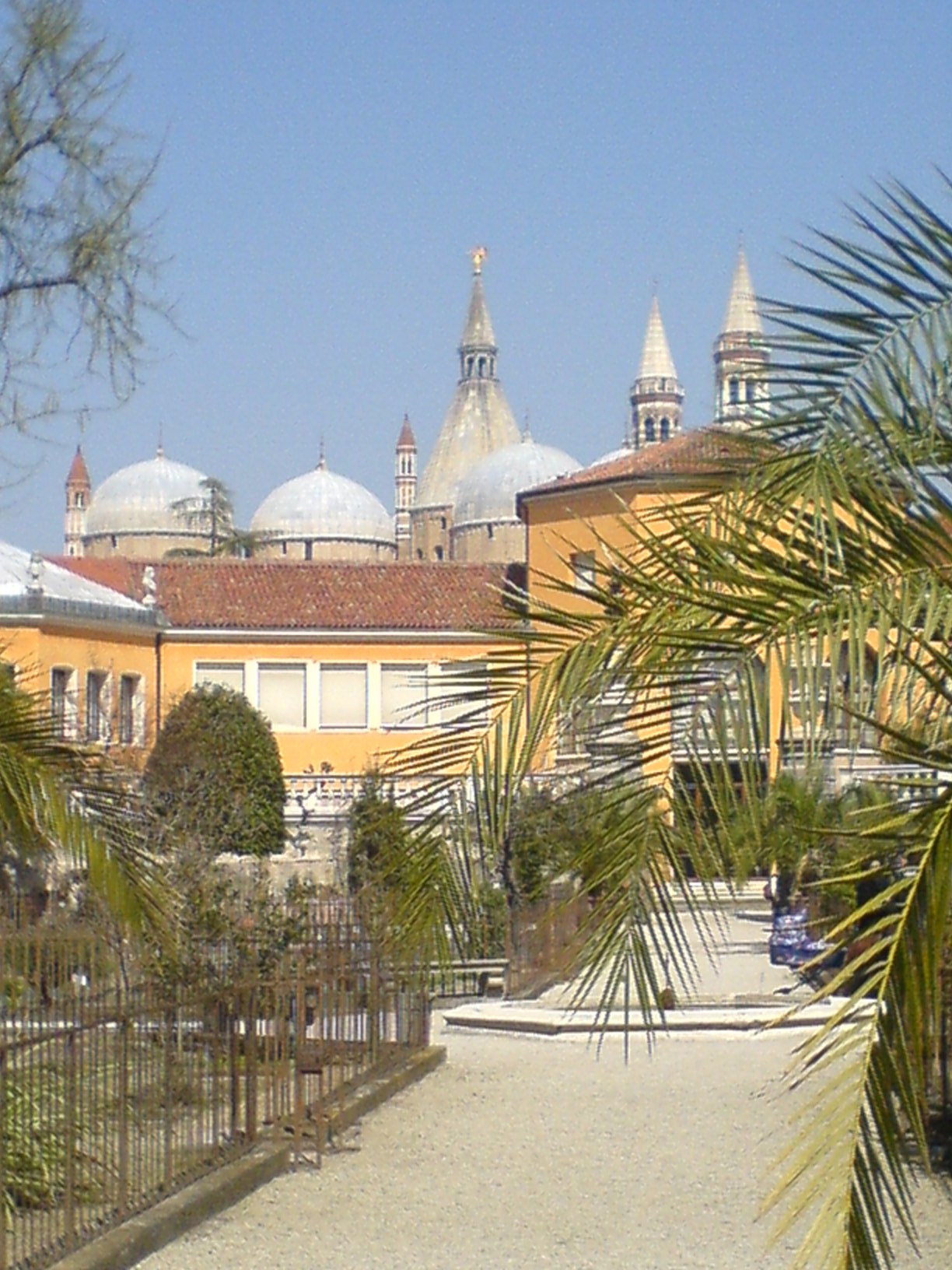
Orto botanico di Padova
45.3995° N · 11.8807° E · Botanical Garden
Photo: Wikimedia Commons contributor · CC BY-SA 2.5 · Wikimedia Commons
Orto botanico di Padova is a botanical garden in Italy. Founded in 1545 by the Republic of Venice. The free Lokali audio guide runs 6 minutes.
✓ Published October 2026 · how we write these guides
Visitor facts
| Lokali audio guide | 6 min · free |
|---|---|
| Type | Botanical Garden |
| Location | Padua, Italy |
| Coordinates | 45.3995, 11.8807 |
| Official website | ortobotanicopd.it |
| Languages | 50+, in the Lokali app |
The story
Listen for a moment. The traffic of Padua softens here, as if someone has closed a heavy door behind you. Gravel crunches underfoot. The air smells of damp earth, clipped leaves, and faint resin from the old trees. In front of you, a low circular wall holds a garden laid out in careful geometry. Beds sit in neat rows. Small labels stand beside each plant. This is not a park. It is a laboratory that has been growing for nearly five centuries.
The Orto botanico di Padova was founded in 1545. The Republic of Venice, which governed Padua at the time, created it for the city's university. Its first purpose was very practical. Doctors and students needed to study medicinal plants, which people then called simples. Many plants sold as cures were confused with one another, or faked. A living collection meant that a student could see the true plant, touch it, and learn it.
Here is the detail most visitors miss. Padua's garden is widely recognised as the oldest university botanical garden in the world that still stands in its original place. Other gardens from the same period were moved, rebuilt, or lost. This one has kept its location and its basic layout since the sixteenth century. In 1997, UNESCO added it to the World Heritage List. The reason was simple: this garden became a model for botanical gardens across Europe and beyond.
Look at the shape around you. The central garden is a circle, enclosed by a wall. Inside the circle sits a square, divided into four quarters by paths that cross at right angles. Renaissance thinkers loved this kind of figure. The circle could stand for the heavens, and the square for the earth. Some describe the four quarters as an echo of the four known continents of the time. The design is a small map of the world, made of soil and stone.
The wall has a more earthly story too. Rare plants were valuable, and some were valuable as medicine. According to the account most often told, the enclosure was built because people kept stealing from the beds at night. So this graceful circle is partly a security fence. Walk along it and look at the gates and the stone details. They are elegant, but they were also meant to keep people out after dark.
Now find the old palm, which stands in its own glass house. It is a Mediterranean fan palm, and it is often described as the oldest plant in the garden. Records place its planting in the late sixteenth century. In 1786, the German writer Johann Wolfgang von Goethe visited Padua. He studied this palm closely, comparing its leaves from base to tip. The palm helped him shape his ideas about how plants change their form as they grow.
Think about that for a second. A poet, famous for drama and verse, stood here and thought about leaves. He wrote about plant metamorphosis, meaning the idea that many parts of a plant are variations of one basic form. Scientists today see his work as an early step, not a final answer. But the palm is still here. It is still growing. Locals simply call it Goethe's palm.
As you walk the quarters, notice how the beds are organised. Plants are grouped by family, by use, or by habitat. Some beds hold medicinal species. Others hold poisonous plants, which is a useful reminder that medicine and danger often grow side by side. Read a few labels as you pass. Each one gives a scientific name in Latin. That system of names came later than the garden itself, but gardens like this one made it necessary.
The garden also played a part in the movement of plants. Over the centuries, many species arrived in Europe through botanical gardens, and Padua was an important stop. Accounts often credit this garden with helping introduce certain plants to Italy, though historians debate some of the exact firsts. What is clear is the method. Seeds and cuttings came in, were grown and studied here, and were then shared with other gardens and scholars.
Beyond the old circle, the mood changes. A large modern greenhouse complex, called the Garden of Biodiversity, opened in the 2010s. Its glass walls hold several climate zones, from tropical rainforest to dry desert. Inside, the air turns warm and humid, then dry and bright. The building uses modern systems to save energy and collect water. It continues the old mission in a new form, showing how plants and people depend on each other.
Take a moment to compare the two spaces. In the old garden, the structure is about order and naming. In the greenhouses, the story is about ecosystems and survival. One belongs to the Renaissance scholar with a notebook. The other belongs to the modern visitor worried about climate and forests. Yet both sit inside the same small piece of the city, only a short walk apart.
The neighbourhood around you adds its own layer. The domes and towers of the Basilica of Saint Anthony rise nearby, and on a clear day you can see them over the trees. A short walk away is Prato della Valle, one of the largest squares in Italy, ringed with statues and a canal. Padua is a university city, and you will often see students crossing these streets, books under their arms, much as they have for centuries.
Before you leave, stand still near the edge of the circle. Look at the low wall, the crossing paths, and the small labels in their rows. Listen to the gravel, the birds, perhaps a fountain somewhere behind you. People have walked these same paths to learn the names of plants since the 1540s. As you step back into the street, you may notice the trees and weeds along the pavement a little differently... each one with a name, and a story.
Key facts
What to look for
Practical tips
Common questions
Is there a free audio guide to Orto botanico di Padova?
Yes — the Lokali app narrates Orto botanico di Padova free of charge in 50+ languages. The guide runs about 6 minutes, covers the history, what to look for on site and practical tips, and works offline once downloaded.
Where is Orto botanico di Padova?
Orto botanico di Padova is near Padua, Italy, at 45.3995, 11.8807. Tap the map link on this page for directions from where you are.
What is Orto botanico di Padova known for?
Founded in 1545 by the Republic of Venice. Created to study medicinal plants for university students.
What should you look for at Orto botanico di Padova?
The circular wall enclosing the original Renaissance garden. Four square quarters divided by crossing gravel paths. Goethe's fan palm standing inside its own glass house.
What should you know before visiting Orto botanico di Padova?
Start in the old circular garden, then visit the greenhouses. Come early on hot days before the greenhouses feel stuffy.
When is the best time to visit Orto botanico di Padova?
Come early on hot days before the greenhouses feel stuffy.
On the map
Opens directions to Orto botanico di Padova from your location.
More to see in Padua


Hear Orto botanico di Padova in your language
The full story, narrated, in 50+ languages. Download it before you go and it plays offline, at your own pace, with no ticket and no tour group.