
Photo: Szilas · CC BY-SA 4.0 · Wikimedia Commons
Pont Royal is a bridge across the Seine in Paris. Third oldest standing bridge in Paris after Pont Neuf, Pont Marie. The free Lokali audio guide runs 7 minutes.
✓ Published October 2026 · how we write these guides
Visitor facts
| Lokali audio guide | 7 min · free |
|---|---|
| Type | Bridge |
| Location | Paris, France |
| Coordinates | 48.8600, 2.3297 |
| Languages | 50+, in the Lokali app |
The story
Stand at the middle of the bridge and press your palm to the parapet. The stone is pale and cool, smoothed by more than three centuries of elbows and coat sleeves. Below you, the Seine moves green and grey, slapping softly against the piers. To one side runs the long wall of the Louvre. To the other, the quays of the Left Bank. You are standing on the Pont Royal, and the bridge under your feet is older than almost anything else that crosses this river.
Among the bridges of Paris that still stand today, only the Pont Neuf and the Pont Marie are older. That surprises many visitors. This crossing looks quiet and modest, without statues or gilded lamps. It was built in the 1680s, in the reign of Louis the Fourteenth, the king remembered as the Sun King. He paid for the bridge from royal funds. That is where the name comes from. It is simply the King's Bridge.
Before the stone, there was wood. Earlier in the seventeenth century, a timber toll bridge stood at roughly this spot. Parisians often called it the Red Bridge, after the colour of its paint. Wooden bridges on the Seine had a hard life. They burned, they rotted, and they broke apart when the river rose. In 1684, floodwater and ice carried much of the old structure away. The king decided that the next bridge would be built to last.
The design is linked to two important names. Jules Hardouin-Mansart was the royal architect who also worked at Versailles. Jacques Gabriel came from a family of builders who shaped French architecture for generations. But the hardest part of the work happened underwater. A Dominican friar named François Romain was brought in for his skill with foundations. Setting stone piers firmly into the riverbed was difficult and dangerous work, and his methods helped make it possible.
Now look along the length of the bridge. It has five arches, and they are not perfect half-circles. They are flatter, wider curves, closer to an ellipse. This shape lets more water pass beneath and keeps the roadway lower. You may also notice that the deck rises gently toward the centre, where the arch is widest. Walk across slowly, and you can feel that soft hump under your feet.
Here is a detail most people walk straight past. On the stone near the ends of the bridge, there are graduated scales, marked like a giant ruler. For a long time, Parisians used them to read the height of the Seine. When the river swelled in winter, people came here to see how high the water had climbed. During the great flood of 1910, the river rose far up these piers, and the whole city watched it with fear.
The bridge has also carried the city's politics. During the French Revolution, anything named for the king became a problem. For a time, the crossing was renamed the National Bridge, a name better suited to a new republic. Later, under Napoleon, it carried yet another name. Eventually, the old royal title returned and stayed. The stones did not change, but the words people used for them changed with each new government.
Think about what this crossing connected. On the Right Bank stood the Tuileries Palace and its gardens, the seat of royal and later imperial power. The palace burned in 1871, but the gardens remain just behind you. On the Left Bank lay the Faubourg Saint-Germain, a district where aristocratic families built grand private houses. The bridge tied the court to its nobility. Carriages, servants, messengers and gossip all rolled across this stone.
Turn toward the Left Bank and follow the line of the road. It runs straight into the Rue du Bac. The name means ferry street. Before any bridge stood here, a ferry boat carried people and goods across the Seine. Stone blocks were once moved this way for the building of the Tuileries. So the street remembers an older crossing, one made by boat. The bridge simply replaced the ferry with something that could not sink.
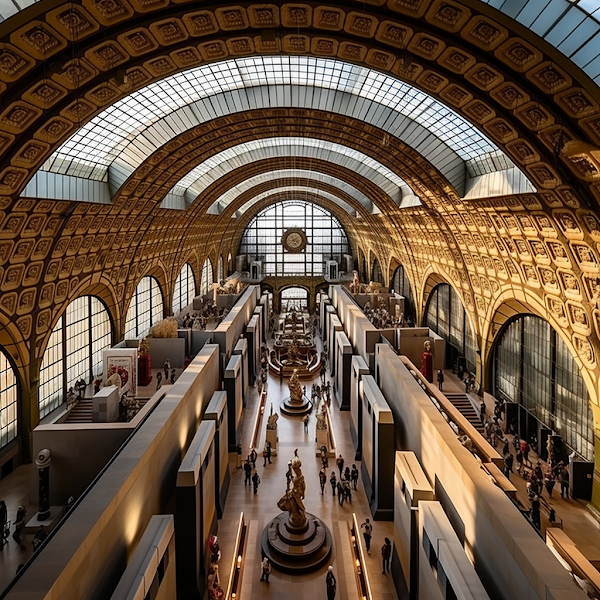
Now look downstream, along the Left Bank. The great building with large clocks on its front is the Musée d'Orsay. It began life as a railway station, built for the Paris world's fair of 1900. Today it holds one of the world's great collections of Impressionist paintings. Many of those painters worked along this river. They studied the light on the water from quays like these, just a short walk from where you stand.
The Quai Voltaire, at the Left Bank end of the bridge, carries the name of the writer and philosopher Voltaire. He spent his final weeks in a house on this quay in 1778. Along the parapet, you may see the green wooden boxes of the bouquinistes. These are the open-air booksellers of the Seine. Their stalls hold old books, prints, postcards and maps. Browsing them is one of the oldest small pleasures of a walk in Paris.
The bridge itself was listed as a historic monument in 1939, which protects it today. Traffic still crosses it every day, so this is not a museum piece. Cars, buses and bicycles pass beside you, just as carriages once did. The best way to enjoy it is on foot. Pause at the centre, where the views open both ways along the river. On a clear day, you can follow the Seine far toward the west.
Listen for a moment. There is the hum of the road, the cry of gulls, perhaps the low engine of a tour boat sliding beneath the arches. When a boat passes, look down and watch how it lines up with the curve above it. Builders in the seventeenth century could not imagine those boats. Yet their arches still give them room to pass, more than three hundred years later.
Before you walk on, rest your hand on the parapet once more. Look at the small marks in the stone, the patches of newer repair, the moss low near the waterline. This bridge has outlived a palace, a monarchy, a revolution and an empire. It has watched the river rise and fall many thousands of times. As you step off toward the Louvre or toward the Rue du Bac, you are taking one of the oldest walks in Paris.
Key facts
What to look for
Practical tips
Common questions
Is there a free audio guide to Pont Royal?
Yes — the Lokali app narrates Pont Royal free of charge in 50+ languages. The guide runs about 7 minutes, covers the history, what to look for on site and practical tips, and works offline once downloaded.
Where is Pont Royal?
Pont Royal is in Paris, France, at 48.8600, 2.3297. Tap the map link on this page for directions from where you are.
What is Pont Royal known for?
Third oldest standing bridge in Paris after Pont Neuf, Pont Marie. Built in the 1680s under King Louis the Fourteenth.
What should you look for at Pont Royal?
Graduated flood scales carved into the stone near the ends. Five flattened elliptical arches instead of round half-circles. The gentle rise of the roadway toward the central arch.
What should you know before visiting Pont Royal?
Cross on foot and pause at the centre for river views. Browse the bouquinistes' green stalls along the Quai Voltaire.
On the map
Opens directions to Pont Royal from your location.
More to see in Paris


Hear Pont Royal in your language
The full story, narrated, in 50+ languages. Download it before you go and it plays offline, at your own pace, with no ticket and no tour group.