
Naranjo
17.1336° N · 89.2622° W · Archaeological Site
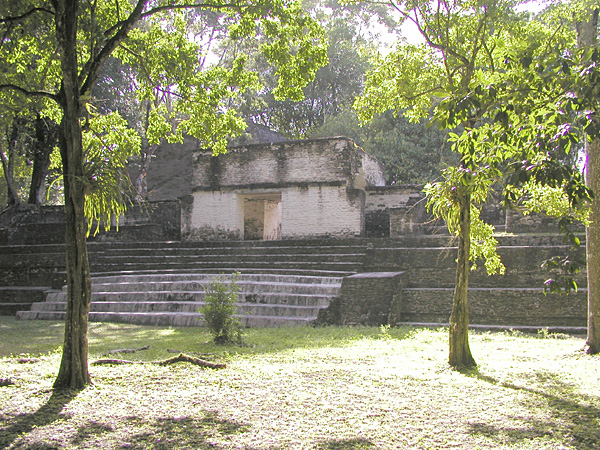
Photo: Rudy Canales · CC BY-SA 3.0 · Wikimedia Commons
Naranjo is an archaeological site in Petén Department, Guatemala. Lady Six Sky arrived at Naranjo in 682. The free Lokali audio guide runs 6 minutes.
✓ Published October 2026 · how we write these guides
Visitor facts
| Lokali audio guide | 6 min · free |
|---|---|
| Type | Archaeological Site |
| Location | Petén Department, Guatemala |
| Coordinates | 17.1336, -89.2622 |
| Languages | 50+, in the Lokali app |
The story
Listen first. Howler monkeys roar somewhere in the canopy, a deep sound that rolls through the trees like distant thunder. The air is thick and damp, and it smells of leaf litter and wet limestone. Under your feet, the ground rises in odd, steep humps. Those humps are not hills. They are buildings, thirteen centuries old, wrapped in soil and roots.
You are standing in Naranjo, an ancient Maya city in the northeastern corner of Guatemala's Petén region, close to the border with Belize. Today it sits inside a protected national park that also includes the sites of Yaxhá and Nakum. Far fewer people come here than to Tikal. That quiet is part of the experience. Here you meet the forest and the ruins almost alone.
The name Naranjo is Spanish for orange tree. It is a modern label, given long after the city was abandoned. The people who lived here had their own name for their kingdom. Scholars read it from a sign carved into the city's monuments, called an emblem glyph. A glyph is a single block of Maya writing, and an emblem glyph works a little like a royal title. Naranjo's glyph is usually read as Sa'al, a kingdom name in the Maya script.
During the Classic period, roughly the third to the ninth centuries, Naranjo was a serious regional power. Its kings built temples, palaces and ball courts. They set up tall carved stone slabs, called stelae, to record their deeds and their dates. The city sat between larger rivals. To the west lay the great powers of Tikal and Calakmul. To the southeast lay Caracol, in what is now Belize. Naranjo's story is shaped by all of them.
The rivalry with Caracol produced one of the strangest twists in Maya history. In the early seventh century, Caracol defeated Naranjo in war. The victors did something unusual. A hieroglyphic stairway, a staircase with written steps, was set up here at Naranjo. Scholars believe it was a Caracol monument that boasted of the victory. Imagine your enemy building a stone record of your defeat in the middle of your own city.
That defeat led to a period of weakness. Then, in the year 682, a woman arrived who changed everything. Modern scholars call her Lady Six Sky. She was a princess from Dos Pilas, a city in southwestern Petén, and her family was allied with mighty Calakmul. She came to Naranjo to restore its royal line. The inscriptions treat her arrival as a new beginning for the kingdom.
Here is a detail many visitors miss. Lady Six Sky never seems to have taken the title of king herself. Yet for years she held real power here. In 693 her young son, K'ahk' Tiliw Chan Chahk, became ruler at about five years old. A child cannot run a war or a court. Most scholars agree that his mother guided the kingdom in his early years, and Naranjo grew strong again.
The monuments show her clearly. On at least one carved stela, Lady Six Sky stands in full royal dress above a bound captive. That is the pose of a warrior ruler. In the Maya world, this image was usually reserved for men. Her portraits are among the most striking images of a royal woman in all of Maya art. Some are now kept in museums, but her presence still shapes how people understand this place.
Under her son, Naranjo fought many campaigns against neighbouring towns. The inscriptions record battles, captives and rituals. The city also produced fine painted pottery. Naranjo's artists made cylinder vessels with smooth surfaces, painted in red, orange, black and cream. Some carry glyphs naming the owner or the painter. These vessels show that this was a centre of high craft, not only of war.
Now look closely at the mounds around you. On many of them you may see deep trenches and dark holes cut into the sides. These are not the work of archaeologists. In the twentieth century, looters tunnelled into many of Naranjo's buildings. They searched for tombs, painted vessels and carved stones to sell abroad. The damage was severe. In recent decades, Guatemalan teams have worked to map the tunnels, fill them and stabilise the structures.
This is the second surprise of Naranjo. The city you see is partly a rescue project. Many of the restored walls and backfilled trenches show careful modern work. Explorers recorded the site's monuments in the early twentieth century, and later researchers drew and photographed the inscriptions before more were lost. Much of what we know about Lady Six Sky survives because people copied the texts in time.
As you walk, notice how the forest and the ruins blend together. Tall trees grow straight out of temple platforms. Roots split old stone joints. The pale limestone shows through moss and soil in patches of grey and cream. Plazas that once held crowds are now open clearings with long shadows. Listen for parrots, toucans and the steady buzz of insects. Watch your footing on uneven stone and loose earth.
Naranjo, like many Classic Maya cities, declined in the ninth century. Building slowed, the written monuments stopped, and people gradually moved away. The forest returned. For more than a thousand years, the city slept under the trees. Today rangers, archaeologists and local communities help protect it. Their work keeps this landscape open to visitors and closed to looters.
Before you leave, stand still for a moment in one of the open plazas. Look up at the nearest mound and picture its temple whole, painted and bright. Somewhere near here, a princess from a distant city stepped into this place and rebuilt a kingdom. Now there is only birdsong, damp air and the green light under the canopy. As you walk back down the trail, notice the rise and fall of the ground. Each small hill may still hold a story.
Key facts
What to look for
Practical tips
Common questions
Is there a free audio guide to Naranjo?
Yes — the Lokali app narrates Naranjo free of charge in 50+ languages. The guide runs about 6 minutes, covers the history, what to look for on site and practical tips, and works offline once downloaded.
Where is Naranjo?
Naranjo is in Petén Department, Guatemala, at 17.1336, -89.2622. Tap the map link on this page for directions from where you are.
What is Naranjo known for?
Lady Six Sky arrived at Naranjo in 682. Her son became ruler in 693 at about age five.
What should you look for at Naranjo?
Looters' trenches cut into the sides of mounds. Trees growing straight out of temple platforms. Pale limestone blocks showing through moss and soil.
What should you know before visiting Naranjo?
Visit with a local guide; trails here are remote. Wear sturdy shoes for uneven, muddy forest paths.
On the map
Opens directions to Naranjo from your location.
More to see in Petén Department



Hear Naranjo in your language
The full story, narrated, in 50+ languages. Download it before you go and it plays offline, at your own pace, with no ticket and no tour group.