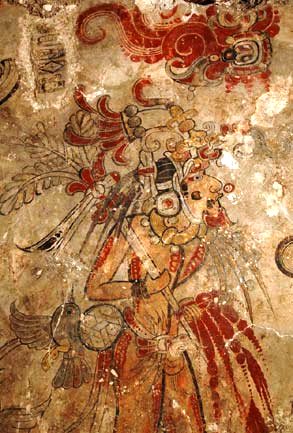
San Bartolo
17.5517° N · 89.4089° W · Archaeological Site
Photo: No machine-readable author provided. Authenticmaya~commonswiki assumed (based on copyright · CC BY-SA 3.0 · Wikimedia Commons
San Bartolo is a mayan arqueological site in Guatemala. Murals discovered in 2001 by archaeologist William Saturno. The free Lokali audio guide runs 7 minutes.
✓ Published October 2026 · how we write these guides
Visitor facts
| Lokali audio guide | 7 min · free |
|---|---|
| Type | Archaeological Site |
| Location | Petén Department, Guatemala |
| Coordinates | 17.5517, -89.4089 |
| Languages | 50+, in the Lokali app |
The story
The air under the forest canopy is thick and warm. It smells of wet leaves, damp earth, and something faintly sweet from fallen fruit. Somewhere above you, a howler monkey lets out a long, rolling roar that seems far too big for any animal. The ground is uneven here. Under the soil and the roots lies pale limestone, and under that limestone lies one of the most important discoveries in the study of the ancient Maya. Welcome to San Bartolo.
You are in the far northeast of Petén, the lowland department of northern Guatemala. This is a region of tropical forest, scattered wetlands, and the ruins of many Maya cities. Some, like Tikal, draw large crowds. San Bartolo is different. It is remote, it is hard to reach, and much of it still looks like a series of forested hills. Those hills are not natural. Each one is a building, wrapped in centuries of soil and trees.
The story of how San Bartolo became famous begins with a very ordinary moment. In 2001, the archaeologist William Saturno was travelling through this area. The day was hot, and he looked for shade. He stepped into a tunnel that looters had dug into the side of one of these mounds. When he shone his light on the wall... he saw painted plaster. Bright colours, careful lines, and the outline of a figure. He had found an ancient Maya mural.
That looters' tunnel is worth thinking about for a moment. Looting is a serious problem across Petén. People dig into ruins at night, searching for pots and carvings to sell. Most of the time, this destroys the history it touches. Here, by chance, a looters' trench led a scientist to something the looters had missed. The painted wall was still in place. It is one of the strange twists of this site — destruction and discovery, side by side in the same tunnel.
The mound that held the paintings is now known as Las Pinturas, which simply means 'the paintings' in Spanish. To understand why the murals survived, you need to know one habit of Maya builders. They rarely tore down an old temple. Instead, they built a new, larger one directly over it. The older structure became a core inside the newer one. Layer by layer, a pyramid grew. And each hidden layer was sealed away from sun, rain, and time.
The murals sat in a small room inside one of these earlier layers. Specialists date them to around one hundred years before Christ. That is many centuries before the great period of Maya kings that most visitors picture. For a long time, scholars believed that complex Maya art and royal ideas developed later. San Bartolo changed that view. It showed that by this early date, Maya painters already worked with great skill and confidence.
What do the paintings show? The main scenes are religious. A central figure is the Maize God, a deity tied to corn, the most important crop in Maya life. Maize meant food, survival, and the cycle of planting and harvest. The murals present scenes connected to creation and renewal, with gods, offerings, and sacred trees. One section shows a ruler receiving a headdress, which scholars read as a scene of coronation — a king taking power.
That coronation scene carries a powerful idea. It links the authority of a human ruler to the world of the gods. The message is clear even without words: this king rules because the sacred order of the world supports him. Here is a surprise many visitors miss. This shows that Maya ideas of divine kingship were already well formed at a time when many people assumed Maya society was still quite simple. The roots of royal power run deep in this ground.
San Bartolo had a second surprise. Within the same building complex, researchers found fragments of painted plaster carrying writing. This was Maya script — the system of signs the Maya used to record language. These fragments are dated to roughly three hundred years before Christ. That places them among the earliest known examples of Maya writing. The texts cannot be fully read yet. But their age alone tells us that writing was part of Maya life far earlier than once believed.
You should know one important thing as you stand here. The murals are not on public display at the site. After their discovery, the paintings needed careful protection. Exposed plaster can crack, fade, or grow mould in this humid climate. Conservation work focused on keeping them safe, not on opening them to crowds. So what you see today is mostly forest and mound. The great paintings are known through photographs, studies, and careful reconstructions made by the research team.
That makes this a different kind of visit. Here, imagination does much of the work. Look at the shape of the mound in front of you. Picture the newer pyramid on the outside and the older room buried inside. Picture a painter, more than two thousand years ago, mixing pigments and bending close to the wall. The brushwork they left behind stayed hidden in the dark for centuries, until a tired traveller went looking for shade.
Now listen to the forest itself. Petén is home to toucans, parrots, spider monkeys, and many kinds of insects that buzz and click through the day. The trees include tall hardwoods and palms whose leaves rattle in the wind. The ancient Maya knew these same sounds. They cleared parts of this forest for fields and plazas, and the forest slowly returned when the cities emptied. Today the trees hold the ruins together and hide them from view.
Before you leave, take one more slow look around. The hills that rise between the trees are buildings, waiting for study. Many of them have never been fully explored. The soil under your feet may still hold painted walls, broken pottery, and words no one has read in two thousand years. As you walk away, notice the light coming through the leaves, and the quiet weight of everything still buried here.
Key facts
What to look for
Practical tips
Common questions
Is there a free audio guide to San Bartolo?
Yes — the Lokali app narrates San Bartolo free of charge in 50+ languages. The guide runs about 7 minutes, covers the history, what to look for on site and practical tips, and works offline once downloaded.
Where is San Bartolo?
San Bartolo is near Petén Department, Guatemala, at 17.5517, -89.4089. Tap the map link on this page for directions from where you are.
What is San Bartolo known for?
Murals discovered in 2001 by archaeologist William Saturno. Found by entering a looters' tunnel while seeking shade.
What should you look for at San Bartolo?
Forested mounds that are actually buried Maya buildings. The shape of the Las Pinturas pyramid mound. Pale limestone showing through roots and fallen soil.
What should you know before visiting San Bartolo?
Arrange your trip through authorised guides familiar with Petén access. Confirm site access permissions with Guatemalan authorities in advance.
On the map
Opens directions to San Bartolo from your location.
More to see in Petén Department


Hear San Bartolo in your language
The full story, narrated, in 50+ languages. Download it before you go and it plays offline, at your own pace, with no ticket and no tour group.