
Royal Palace of Cambodia
11.5637° N · 104.9311° E · Palace
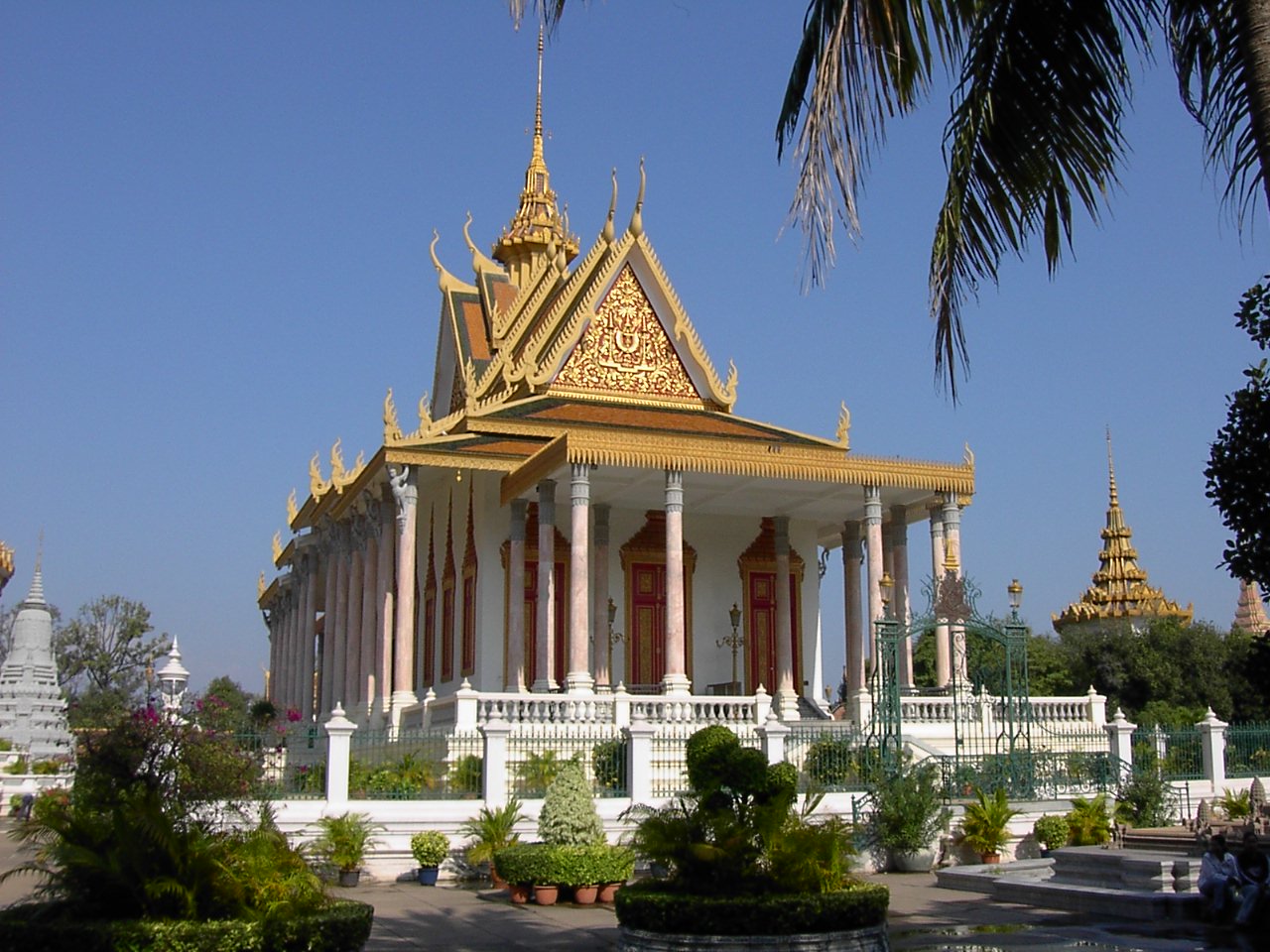
Photo: Jean-Pierre Dalbéra from Paris, France · CC BY 2.0 · Wikimedia Commons
Royal Palace of Cambodia is a complex of buildings in Phnom Penh, Cambodia. King Norodom moved the royal capital to Phnom Penh in the 1860s. The free Lokali audio guide runs 6 minutes.
✓ Published October 2026 · how we write these guides
Visitor facts
| Lokali audio guide | 6 min · free |
|---|---|
| Type | Palace |
| Location | Phnom Penh, Cambodia |
| Coordinates | 11.5637, 104.9311 |
| Languages | 50+, in the Lokali app |
The story
Start with the colour. Golden-yellow roofs rise in layers above the white walls, and each roof ends in a slender hooked tip that curves toward the sky. On a bright Phnom Penh morning the glazed tiles shine almost too much to look at. Beneath your feet, the paths are swept clean. Frangipani trees drop pale flowers onto the lawns. And somewhere nearby, a gardener's broom moves across the stone in slow, patient strokes.
You are standing inside the Royal Palace of Cambodia, the official home of the Khmer kings. This is not a ruin or a museum piece. It is still a working royal residence, and parts of the grounds stay closed because the king lives here. Look up at the flagpoles. When the royal flag flies, people say it means the king is in the city. The palace is, in a very real sense, still in use.
The story of this place begins in the 1860s. Cambodia's royal capital had sat for years at Oudong, a hill town to the north. King Norodom moved his court to Phnom Penh in that decade, and construction of this palace began soon after. His choice of site was not random. The palace faces east, toward a meeting point of great rivers... and that view carries deep meaning in Khmer tradition.
Just beyond the eastern wall, the Tonle Sap River meets the Mekong. Locals call this meeting point Chaktomuk, which means "four faces", because the waters divide into four arms here. For a riverside kingdom, this junction meant trade, fish, and life itself. Placing the royal home at this spot connected the king with the flow of the whole country. If you walk out to the riverfront later, you will see exactly what the founders saw.
Now turn toward the largest building in front of you. This is the Throne Hall, and it is the ceremonial heart of the palace. The current hall dates from the early twentieth century, built under King Sisowath to replace an older wooden structure. Coronations take place here. So do important royal audiences and ceremonies. A tall spire rises from the centre of the roof, and on that spire you may notice a carved face looking out in four directions.
Those four faces echo the towers of the Bayon temple at Angkor, the great stone temple complex in the north of Cambodia. The design links this modern palace to the Angkor kings of many centuries ago. Look along the rooflines, too. You will find the garuda, a mythical bird-man from Hindu and Buddhist stories, holding up the eaves. And the curling roof tips represent the naga, a sacred serpent who protects the Buddha.
Here is a detail many visitors walk straight past. The palace mixes two traditions in its colours. Yellow is often linked with Buddhism, the main religion of Cambodia today. White is linked with Brahmanism, the older Hindu-based faith that shaped Khmer royal ritual for centuries. Both still play a role in court ceremony. So the yellow roofs above white walls are not only beautiful. They carry the two spiritual roots of Khmer kingship.
Then comes the surprise. Among all these Khmer roofs stands a small building of iron and glass that looks completely European. This is the Napoleon the Third Pavilion. According to the popular account, it was first made for Empress Eugénie of France around the opening of the Suez Canal, and was later taken apart, shipped to Cambodia, and rebuilt here as a gift. It is a strange, charming reminder of the French colonial period.
Now follow the path south, through a gateway, into a separate walled compound. This is the Silver Pagoda, known in Khmer as Wat Preah Keo Morakot, the Temple of the Emerald Buddha. Before you enter, you will be asked to remove your shoes. Feel the cool stone under your bare feet. Inside, most of the floor is covered with rugs, but in places you can see what gives the temple its name.
The floor is laid with thousands of solid silver tiles. Over five thousand of them, by the usual count. Most are hidden under carpet to protect them, but a few corners stay uncovered. On a raised altar sits the small Emerald Buddha, which is actually made of green crystal or glass rather than emerald. Below it stands a life-size Buddha of gold, decorated with thousands of diamonds. Photography is not allowed inside, so take your time and simply look.
Here is the second thing most people miss. Back outside, the walls around this courtyard are covered with a long painted mural. It tells the Reamker, the Khmer version of the Ramayana, an ancient Indian epic about a prince, his captured wife, and a war against a demon king. The mural was painted in the early twentieth century. Walk slowly along it. You will find battles, monkey warriors, palaces, and quiet scenes of daily life.
The courtyard also holds several stupas, tall bell-shaped monuments that contain the ashes of royal family members. One holds the remains of King Norodom, the palace founder. You will also find a statue of him on horseback. Many of the palace treasures survived the Khmer Rouge years of the late 1970s, when much of Cambodia's culture was destroyed. That survival gives these objects a weight that goes well beyond their gold and silver.
Before you leave, stand still for a moment near the gate. Listen. The traffic of Sothearos Boulevard hums just beyond the wall, and the river wind moves through the trees. Look back at the golden roofs once more, and at the curved tips pointing upward. As you walk out toward the riverfront, watch the water where the rivers meet. That view, more than any building, is the reason this palace stands exactly here.
Key facts
What to look for
Practical tips
Common questions
Is there a free audio guide to Royal Palace of Cambodia?
Yes — the Lokali app narrates Royal Palace of Cambodia free of charge in 50+ languages. The guide runs about 6 minutes, covers the history, what to look for on site and practical tips, and works offline once downloaded.
Where is Royal Palace of Cambodia?
Royal Palace of Cambodia is in Phnom Penh, Cambodia, at 11.5637, 104.9311. Tap the map link on this page for directions from where you are.
What is Royal Palace of Cambodia known for?
King Norodom moved the royal capital to Phnom Penh in the 1860s. Silver Pagoda floor holds over five thousand silver tiles.
What should you look for at Royal Palace of Cambodia?
Four carved faces on the Throne Hall spire. Garuda figures holding up the Throne Hall roof eaves. Uncovered silver floor tiles in Silver Pagoda corners.
What should you know before visiting Royal Palace of Cambodia?
Wear clothing that covers both shoulders and knees. Bring a small bag for shoes inside the Silver Pagoda.
When is the best time to visit Royal Palace of Cambodia?
Visit early morning to avoid midday heat and crowds.
On the map
Opens directions to Royal Palace of Cambodia from your location.
More to see in Phnom Penh


Hear Royal Palace of Cambodia in your language
The full story, narrated, in 50+ languages. Download it before you go and it plays offline, at your own pace, with no ticket and no tour group.