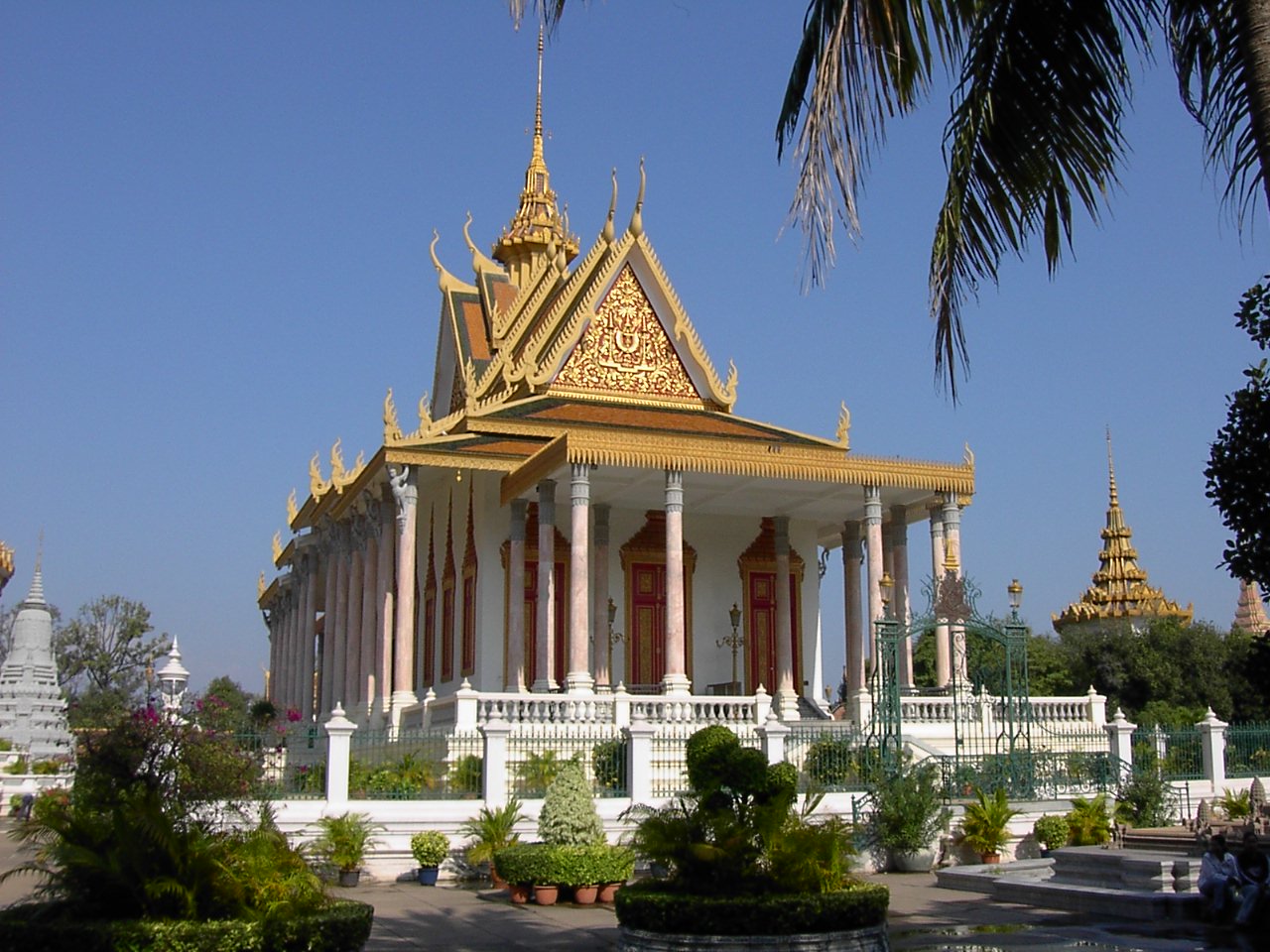
Photo: Original uploader was User:Adam Carr at en.wikipedia · Public domain · Wikimedia Commons
Silver Pagoda is a notable Buddhist temple in Phnom Penh, Cambodia. Official name means Temple of the Emerald Buddha. The free Lokali audio guide runs 6 minutes.
✓ Published October 2026 · how we write these guides
Visitor facts
| Lokali audio guide | 6 min · free |
|---|---|
| Type | Tower |
| Location | Phnom Penh, Cambodia |
| Coordinates | 11.5625, 104.9317 |
| Languages | 50+, in the Lokali app |
The story
Slip off your shoes at the foot of the steps and feel the cool, pale stone under your feet. Above you, a roof of glazed tiles rises in layers, its golden finials curling upward like flames. Somewhere nearby, a broom moves across a courtyard. The air smells faintly of incense and warm marble. You are standing inside the walls of the Royal Palace of Phnom Penh, at the threshold of the Silver Pagoda.
The name you hear most often is the nickname. The official name is Wat Preah Keo Morakot, the Temple of the Emerald Buddha. The nickname comes from something you will mostly not see. The floor inside is laid with more than five thousand solid silver tiles. Each one weighs roughly a kilogram. Together they turn the floor of this sanctuary into a small fortune in metal.
Here is the first surprise. Most of that silver lies hidden under carpets, to protect it from thousands of passing feet. Usually, only a small patch near the entrance is left uncovered. Look down as you step inside. You may catch a dull, grey shine, softer than you might expect. This is not polished jewellery. It is working metal, worn by visitors and time.
This temple is unusual in another way. Monks do not live here. In most Cambodian pagodas, saffron robes move through the grounds at dawn. This one served the royal family instead. Kings came here to pray, to hold ceremonies, and to keep the kingdom's most treasured objects. So the atmosphere is quieter and more formal... closer to a royal treasury than a village temple.
The first temple on this spot was built of wood under King Norodom, in the late nineteenth century. Wood does not last long in a tropical climate. In the 1960s, during the reign of King Norodom Sihanouk, the building was rebuilt in more durable materials. The steps you climbed are marble. The structure you see today belongs to that later rebuilding, though it follows the traditional Khmer form.
Now, look toward the high altar. At the very top sits the temple's namesake — the Emerald Buddha. It is smaller than many visitors expect. Despite the name, it is not carved from emerald. It is usually described as green crystal, and some accounts say it came from European glassworks. Whatever its origin, it glows softly in the dim light. It sits high above you, raised on a gilded pedestal.
Below it stands the second surprise, and it is hard to miss. A life-sized standing Buddha, cast in gold, faces the room. It dates from the early twentieth century, made at the wish of King Sisowath. The figure is reported to contain around ninety kilograms of gold. It is set with thousands of diamonds. The largest stones sit on the crown and on the chest. Lean in carefully, and watch how they catch the light.
Take a slow turn around the room. Glass cases line the walls, filled with gifts given to Cambodian kings over many generations. There are small Buddhas in gold, silver, bronze and crystal. There are ceremonial objects and offerings from foreign visitors. Photography is not allowed inside the sanctuary. That rule has an advantage: it gives you time to actually look, without a screen between you and the gold.
The survival of these treasures is a story in itself. During the Khmer Rouge period in the late 1970s, temples across Cambodia were destroyed and religion was forbidden. This one was largely spared. Historians often suggest the regime kept it to show foreign visitors that Cambodian culture was safe. Even so, many objects are said to have been lost in those years. What you see is what remained.
Step back outside and walk to the covered gallery that surrounds the courtyard. Its walls carry a very long painted mural. It tells the Reamker, the Cambodian version of the Ramayana — an ancient Indian epic about a prince, his kidnapped wife, and a war against a demon king. Many artists painted it in the early twentieth century. Sun and monsoon rain have faded large sections. Some panels are vivid. Others are only ghosts of colour.
Follow the mural slowly, and the story unfolds in battle scenes, palaces, monkeys and gods. Look for the monkey general, a white figure who leaps through many scenes. Notice how ordinary details slip into the epic — boats, houses, and people at work. The painters drew from the world around them. So this mural also shows us how Cambodians in the early twentieth century imagined grandeur.
The courtyard holds several tall stupas, the spire-shaped monuments that keep royal ashes. One honours King Norodom. Another holds the remains of Princess Kantha Bopha, a daughter of King Sihanouk who died as a small child. A bronze statue shows King Norodom on horseback. Toward one side, a small hill called Phnom Mondap carries a shrine with a Buddha footprint. There is also a scale model of Angkor Wat.
Before you leave, stand in the shade for a moment. Listen to the sounds of the city beyond the walls — motorbikes, horns, a distant radio. Inside, only the soft pad of bare feet on stone. Look back at the roof, its layers stepping up toward the sky. Somewhere under the carpets, the silver is still there. You walked across it without seeing it... and that may be the quietest secret this temple keeps.
Key facts
What to look for
Practical tips
Common questions
Is there a free audio guide to Silver Pagoda?
Yes — the Lokali app narrates Silver Pagoda free of charge in 50+ languages. The guide runs about 6 minutes, covers the history, what to look for on site and practical tips, and works offline once downloaded.
Where is Silver Pagoda?
Silver Pagoda is in Phnom Penh, Cambodia, at 11.5625, 104.9317. Tap the map link on this page for directions from where you are.
What is Silver Pagoda known for?
Official name means Temple of the Emerald Buddha. Floor holds over five thousand silver tiles.
What should you look for at Silver Pagoda?
Uncovered patch of silver tiles near the entrance. Small green Buddha raised high above the altar. Diamonds set into the golden Buddha's crown.
What should you know before visiting Silver Pagoda?
Cover shoulders and knees before entering the palace grounds. Remove your shoes before climbing into the sanctuary.
When is the best time to visit Silver Pagoda?
Visit early morning to see the mural in softer light.
On the map
Opens directions to Silver Pagoda from your location.
More to see in Phnom Penh


Hear Silver Pagoda in your language
The full story, narrated, in 50+ languages. Download it before you go and it plays offline, at your own pace, with no ticket and no tour group.