
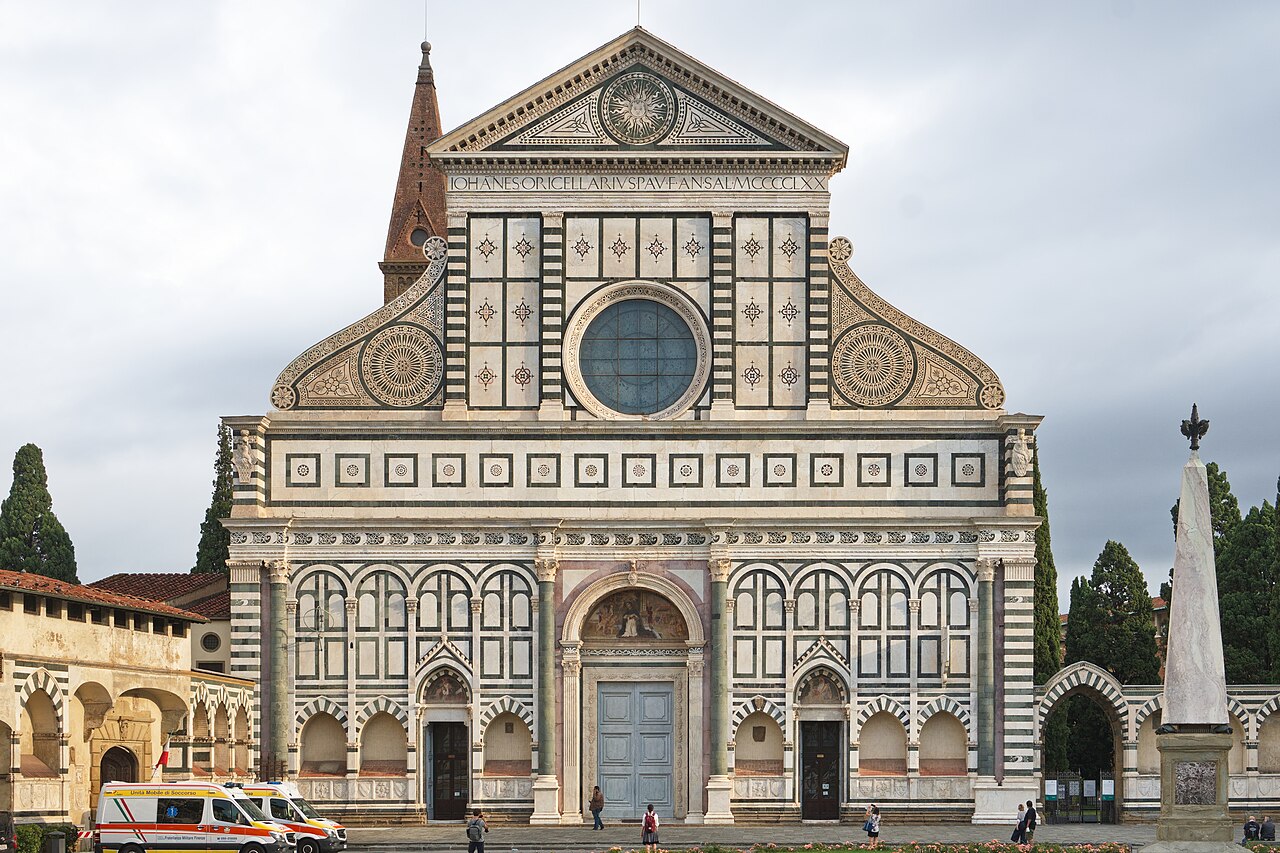
Photo: Etienne (Li) · CC BY-SA 3.0 · Wikimedia Commons
Pistoia Cathedral is a church building in Pistoia, Italy. The cathedral is dedicated to Saint Zeno. The free Lokali audio guide runs 6 minutes.
✓ Published October 2026 · how we write these guides
Visitor facts
| Lokali audio guide | 6 min · free |
|---|---|
| Type | Cathedral |
| Location | Pistoia, Italy |
| Coordinates | 43.9332, 10.9179 |
| Languages | 50+, in the Lokali app |
The story
Stand in the Piazza del Duomo for a moment and listen. Footsteps echo off stone on every side, and pigeons lift from the cornices in short bursts. In front of you rises a wall of green and white marble, striped like a bolt of fine cloth. The bands catch the light differently through the day. At noon the white almost glows, and the dark green turns nearly black. This is the Cathedral of Saint Zeno, the spiritual centre of Pistoia.
The square around you is one of the most complete medieval civic spaces in Tuscany. Look around slowly. The church and its tall bell tower stand on one side. The old Bishop's Palace sits beside them. Across the paving stands the Town Hall, and opposite the façade an octagonal baptistery wears the same striped marble. Church power and city power faced each other here, close enough to watch every move.
The cathedral you see belongs to the Romanesque tradition. Romanesque is the style of medieval Europe before the Gothic, with round arches, thick walls and steady rhythm. In this corner of Tuscany, builders gave it a local accent. They borrowed the striped marble of Pisa and Florence and added rows of small arches across the façade. The building grew over centuries, after earlier churches on this spot were damaged and rebuilt. What stands today carries layers of many generations of work.
Now look at the front porch, the arcaded portico that shelters the doors. It was added later than the façade behind it. Step underneath and tilt your head back. The curved ceiling is covered in glazed terracotta, glossy tiles in blue and white. This is the work of the della Robbia family, the Florentine workshop famous for glazed clay sculpture. Their glaze was durable and kept its colour, so outdoor pieces still look fresh after centuries.
Above the central door is the finest piece. In the curved panel, called a lunette, the Virgin holds the Christ Child, surrounded by angels. It is attributed to Andrea della Robbia. Notice the contrast. The figures are a soft milky white, and the background is a deep, even blue. Many visitors hurry past it on the way inside. Pause instead. In the shade of the portico, the glaze has a quiet shine that photographs rarely capture.
Beside the church rises the bell tower. Here is a surprise. It did not begin as a bell tower at all. It started life as a defensive watchtower, built for looking out over the plain, not for calling people to prayer. Later builders raised it higher and added the open arched levels near the top. Look closely and you can see the change in style, from solid lower walls to the lighter, more decorative upper sections.
Step inside, and the temperature drops. The air smells faintly of stone, candle wax and old wood. Your eyes need a moment. The interior is long and calm, with columns marching toward the altar. Compared with the bright marble outside, the space feels restrained. Pistoia was never as rich as Florence, its larger neighbour, yet the treasures inside this church show how much its citizens were willing to give to their faith.
The greatest of those treasures is the silver altar of Saint James. Saint James is the apostle whose shrine at Santiago de Compostela in Spain drew pilgrims from across Europe. In the twelfth century, Pistoia obtained a relic of the saint. The city became a pilgrim stop in its own right, and Saint James became one of its patrons. Pilgrims on their way to Rome, or to Spain, came here to pray before the relic.
The altar built to honour him is extraordinary. It is made of silver, worked over a period of roughly two centuries by a long series of goldsmiths. Panel after panel shows scenes from the Bible and from the life of the saint, packed with tiny figures. Here is the second surprise. A young Filippo Brunelleschi, the man who later designed the great dome of Florence Cathedral, worked on this altar as a goldsmith, shaping some of its small figures.
The altar sits in its own chapel, and access is sometimes managed separately from the main church. If you can get close, take your time. Look at the faces, the folds of the robes, and the little architectural frames around each scene. Generations of craftsmen added to it, so the styles shift slightly from panel to panel. It is a record of changing taste, held together by one devotion.
Elsewhere in the church, look for the monument to Cardinal Niccolò Forteguerri. He was a native of Pistoia who rose high in the Church in Rome. The memorial was designed by Andrea del Verrocchio, the Florentine sculptor who trained Leonardo da Vinci. It was finished by other hands after his death. Look also for the altarpiece known as the Madonna di Piazza, linked to Lorenzo di Credi, another pupil of Verrocchio's busy workshop.
The square outside is not only a place of history. Every July, around the feast of Saint James, the city holds the Giostra dell'Orso, the Joust of the Bear. Riders from the city's districts compete on horseback in the piazza, watched by crowded stands. The bear is the old symbol of Pistoia. On those days the stone square fills with drums, banners and shouting, and the cathedral becomes a backdrop to a very lively celebration.
When you leave, walk out under the portico again and turn back for one last look. Notice how the striped marble lines up with the baptistery across the square, as if the two buildings are in conversation. Notice the blue of the della Robbia glaze in the shade. Then let your eyes rise up the tower, from its plain old base to its open arches. Above you, perhaps, a bell will ring... the same sound this square has heard for centuries.
Key facts
What to look for
Practical tips
Common questions
Is there a free audio guide to Pistoia Cathedral?
Yes — the Lokali app narrates Pistoia Cathedral free of charge in 50+ languages. The guide runs about 6 minutes, covers the history, what to look for on site and practical tips, and works offline once downloaded.
Where is Pistoia Cathedral?
Pistoia Cathedral is in Pistoia, Italy, at 43.9332, 10.9179. Tap the map link on this page for directions from where you are.
What is Pistoia Cathedral known for?
The cathedral is dedicated to Saint Zeno. The silver altar honours Saint James the Apostle.
What should you look for at Pistoia Cathedral?
Blue and white della Robbia lunette above the door. Glossy terracotta tiles covering the portico vault. Change in style between tower's lower and upper levels.
What should you know before visiting Pistoia Cathedral?
Visit the silver altar chapel, which may need separate access. Stand under the portico to see the glazed ceiling.
On the map
Opens directions to Pistoia Cathedral from your location.
More to see near Pistoia Cathedral


Hear Pistoia Cathedral in your language
The full story, narrated, in 50+ languages. Download it before you go and it plays offline, at your own pace, with no ticket and no tour group.