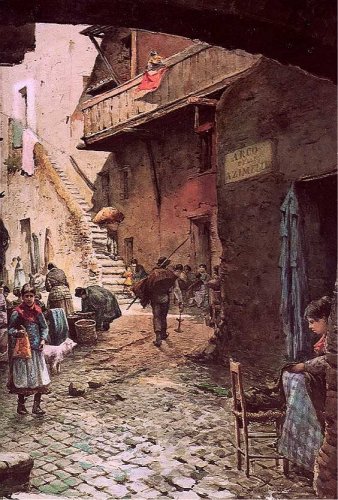
Jewish Quarter is a walled medieval district preserving six centuries of Prague's Jewish heritage through synagogues, a cemetery, and museum collections. It is in Prague, Czechia. Most visitors spend 1–2 hours here. The free Lokali audio guide runs 5 minutes.
✓ Verified August 2026 · how we write these guides
Visitor facts
| Time needed | 1–2 hours |
|---|---|
| Lokali audio guide | 5 min · free |
| Type | Neighborhood |
| Best for | History |
| Location | Prague, Czechia |
| Coordinates | 50.0775, 14.4455 |
| Languages | 45, in the Lokali app |
The story
The streets here are quieter than the busy squares nearby. The crowd thins, and the noise slowly drops away. Narrow lanes run between tall buildings, and the light falls soft and gray between them. This is the old Jewish Quarter of Prague. It holds some of the oldest and most moving places in the whole city, kept close together within a few short streets.
The quarter is named after an emperor who eased the hard laws that once bound the Jewish people here. For hundreds of years they were made to live apart, inside walls, in a crowded corner of the city. Those walls are gone now. The name remembers the ruler whose reforms first helped to open them and ease the old restrictions.
At the heart of the quarter stands a steep-roofed stone building, plain and very old. This is the Old-New Synagogue. It was finished around 1270, which makes it the oldest synagogue still in use anywhere in Europe. For more than seven hundred years, prayers have been said within these same worn walls, without a break across the long centuries.
The building is small and dark, with thick walls and narrow windows. Its tall brick gable rises in a row of steps against the sky above. Inside, old iron lamps hang down from a high vaulted ceiling. The stone underfoot feels worn and cool to the touch. Very little has changed here across all the long years of its daily use.
A legend clings closely to this place. It tells of a wise rabbi who shaped a giant from river clay to guard and protect his people. The creature was called the Golem. When at last its work was done, the rabbi is said to have hidden its body away in the attic of the synagogue. It is only a legend, but it is still told here today.
Near the synagogue lies the old cemetery, and it is a sight unlike any other. The ground is crowded with thousands of leaning headstones, packed close and tilted at every angle. Trees grow up between them. The stones seem to lean upon one another, gray and soft with age, like a silent crowd that has been frozen forever in place.
The cemetery was used for more than three hundred years. Space inside the walls was small, and there was simply nowhere to spread outward. So the dead were buried in layers, one above another, and the earth was raised again and again. Far more people rest here than the stones alone would ever suggest. The ground holds many times their number.
Among the many buried here is the rabbi of the Golem legend. He was a real and deeply learned man, known across the city for his wisdom. He died in 1609. His tomb is larger than most of the others around it, and visitors still leave small stones and folded notes upon it, as a quiet and lasting sign of respect.
Not far away stands a very different building, bright where the others are plain and dark. Its walls are covered, inside and out, with rich patterns in gold and deep color, in a style borrowed from the far south. Called the Spanish Synagogue, it was built much later, in the eighteen hundreds. Its glowing interior surprises nearly everyone who steps inside.
One synagogue holds no gold and no carving at all, only names. Its white walls are covered, from floor to ceiling, with the written names of tens of thousands of people from these lands who were killed in the last century. The names run on and on in small, neat letters. The deep silence inside the rooms is heavy and complete.
Much of the old quarter looks far newer than it truly is. A little more than a hundred years ago, the crowded old houses were torn down and rebuilt. Wide new streets and tall apartment blocks went up in their place, fronted with flowing curves and painted faces. Only the synagogues, the cemetery, and the town hall were spared from the clearing.
Walking these few short streets, you move between the ages quickly. A medieval synagogue stands close beside a grand new street. A crowded graveyard sits hidden behind an elegant wall. The old town hall keeps a clock whose numbers are Hebrew letters, and whose hands, on one of its faces, run backward. Small wonders wait around almost every corner.
The Jewish Quarter asks you to slow down and to look with care. It holds great age, deep loss, and a long and patient faith all within a small space. Standing in its quiet streets, between the worn gray stones and the painted walls, you feel how much a single corner of a city can carry, and still keep whole.
Key facts
What to look for
Practical tips
Common questions
How long do you need at Jewish Quarter?
Plan 1–2 hours. That is the time most visitors spend at Jewish Quarter. The free Lokali audio guide adds about 5 minutes of narration you can listen to as you walk, so it fits inside your visit rather than adding to it.
Is there a free audio guide to Jewish Quarter?
Yes — the Lokali app narrates Jewish Quarter free of charge in 50+ languages. It covers the history, what to look for on site and practical tips, and it works offline once downloaded.
Where is Jewish Quarter?
Jewish Quarter is in Prague, Czechia, at 50.0775, 14.4455. Tap the map link on this page for directions from where you are.
What should you know before visiting Jewish Quarter?
Buy a combined ticket for the museum sites.
What is Jewish Quarter known for?
Named after the Emperor Joseph the Second.
What is the best time to visit Jewish Quarter?
Visit the cemetery at dusk when the tilted gravestones cast long shadows — the effect is both melancholic and beautiful.
On the map
Opens directions to Jewish Quarter from your location.
Reference
More to see in Prague


Hear Jewish Quarter in your language
The full story, narrated, in 50+ languages. Download it before you go and it plays offline, at your own pace, with no ticket and no tour group.