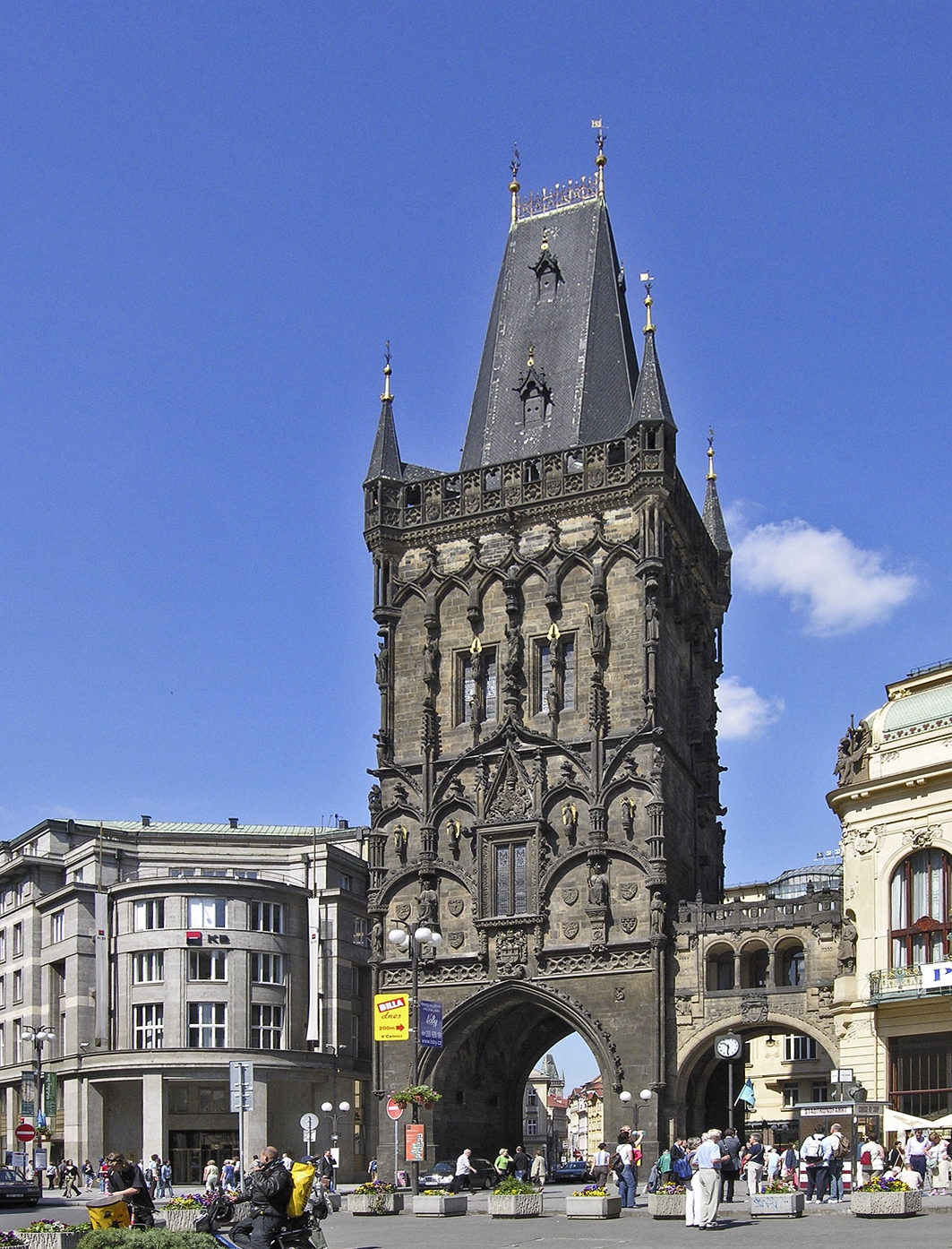
Powder Tower is a 15th-century Gothic tower marking the entrance to Old Town, originally used to store gunpowder. It is in Prague, Czechia. Most visitors spend 30–40 min here. The free Lokali audio guide runs 5 minutes.
✓ Verified August 2026 · how we write these guides
Visitor facts
| Time needed | 30–40 min |
|---|---|
| Lokali audio guide | 5 min · free |
| Type | Tower |
| Best for | Photography |
| Location | Prague, Czechia |
| Coordinates | 50.0883, 14.4366 |
| Languages | 45, in the Lokali app |
The story
You hear the square before you see the tower. Footsteps, voices, and the rattle of a passing tram fill the air. Then it appears, dark and tall, its stone almost black with age. Pointed and deeply carved, the Powder Tower stands at the edge of the old town like a gate from another time. People stream through its high arch all day long.
This was once a true gate in the city wall. Long ago, thirteen such gates guarded the old town of Prague. Most of them are gone now. This one remains, standing where the wall once ran. Through its arch passed merchants, soldiers, and kings on their way into the city. Today the wall has vanished, but the gate still marks the old edge of the town.
Work on the tower began in 1475. The first stone was laid for the king of that time, who wanted a grand gate close to his court. The royal court stood nearby in those years. The tower was meant to be beautiful more than strong, a proud entrance rather than a fortress. Its fine carved stone still shows that early care and ambition.
The man who shaped much of it was a master builder named Matěj Rejsek. He covered the stone with sharp Gothic carving, slender points, and figures of saints and kings. Look closely and you can still find these stone figures watching from the walls above. The work is delicate and patient for something so heavy, so dark, and so large.
The building did not go as planned. After only a few years, the king left the nearby court and moved up to the castle on the hill. The cause was unrest in the streets of the city. With the court gone, work on the tower slowed and then stopped altogether. For a long time afterward it stood unfinished and bare.
Its name came later. The tower was used as a store for gunpowder, kept safe behind its thick stone walls. That is how it earned the name it still carries today. The name held fast even after the powder was long gone. People have called it the Powder Tower for many generations since.
Over the centuries the soft stone slowly wore down. By the late nineteenth century, much of the old carving had crumbled away. A careful restorer then took on the task of saving the tower. He repaired the old work and added new carving in the same sharp Gothic style. Much of the detail you see today comes from that patient repair.
The tower stands about sixty-five meters tall. Inside, a narrow stair winds upward, nearly two hundred steps in all. The climb is tight and dim, lit only by small windows in the stone. Near the top, a gallery runs around the outside of the tower. From there the old town spreads below in a sea of red roofs and spires.
From the gallery you can trace an old route through the city. This gate marked the start of the path that kings once took to their crowning. The road runs from here, across the river, and up to the castle on its hill. Walking it today, you follow the same turns that long royal processions once made through the streets.
Right beside the dark tower stands a very different building. It is bright, covered in glass, gold, and color, built in a softer and newer style. The two stand side by side, stone and shine, old and new. The contrast surprises many who arrive in the square. One speaks of the Middle Ages, the other of a later, gentler age.
At street level, the arch is almost always busy. People pass through on their way to the shops and squares beyond it. Musicians sometimes play in the cool shadow of the gate, and the sound echoes off the old stone. Look up as you pass beneath, and the carving seems to lean over you, dark, sharp, and full of detail.
At night the tower changes its face. Lamps light the stone from below, and the carving throws deep shadows upward. The points of the steep roof stand black against the evening sky. The daytime crowds thin, and the gate grows quiet at last. In that quiet it is easier to feel its great age and the weight of all it has seen.
The Powder Tower has been a gate, a storehouse, a ruin, and now a place to climb and look out. It has watched the city change around it for five hundred years. Passing under its arch, you join a long line of travelers that stretches back across all of that time. The stone remembers every one of them.
Key facts
What to look for
Practical tips
Common questions
How long do you need at Powder Tower?
Plan 30–40 min. That is the time most visitors spend at Powder Tower. The free Lokali audio guide adds about 5 minutes of narration you can listen to as you walk, so it fits inside your visit rather than adding to it.
Is there a free audio guide to Powder Tower?
Yes — the Lokali app narrates Powder Tower free of charge in 50+ languages. It covers the history, what to look for on site and practical tips, and it works offline once downloaded.
Where is Powder Tower?
Powder Tower is in Prague, Czechia, at 50.0883, 14.4366. Tap the map link on this page for directions from where you are.
What should you know before visiting Powder Tower?
Climb the inner stair to the outdoor gallery.
What is Powder Tower known for?
Construction began in 1475 as a city gate.
What is the best time to visit Powder Tower?
The tower's interior is narrow and steep, but the climb rewards with views few tourists bother to reach.
On the map
Opens directions to Powder Tower from your location.
More to see in Prague


Hear Powder Tower in your language
The full story, narrated, in 50+ languages. Download it before you go and it plays offline, at your own pace, with no ticket and no tour group.