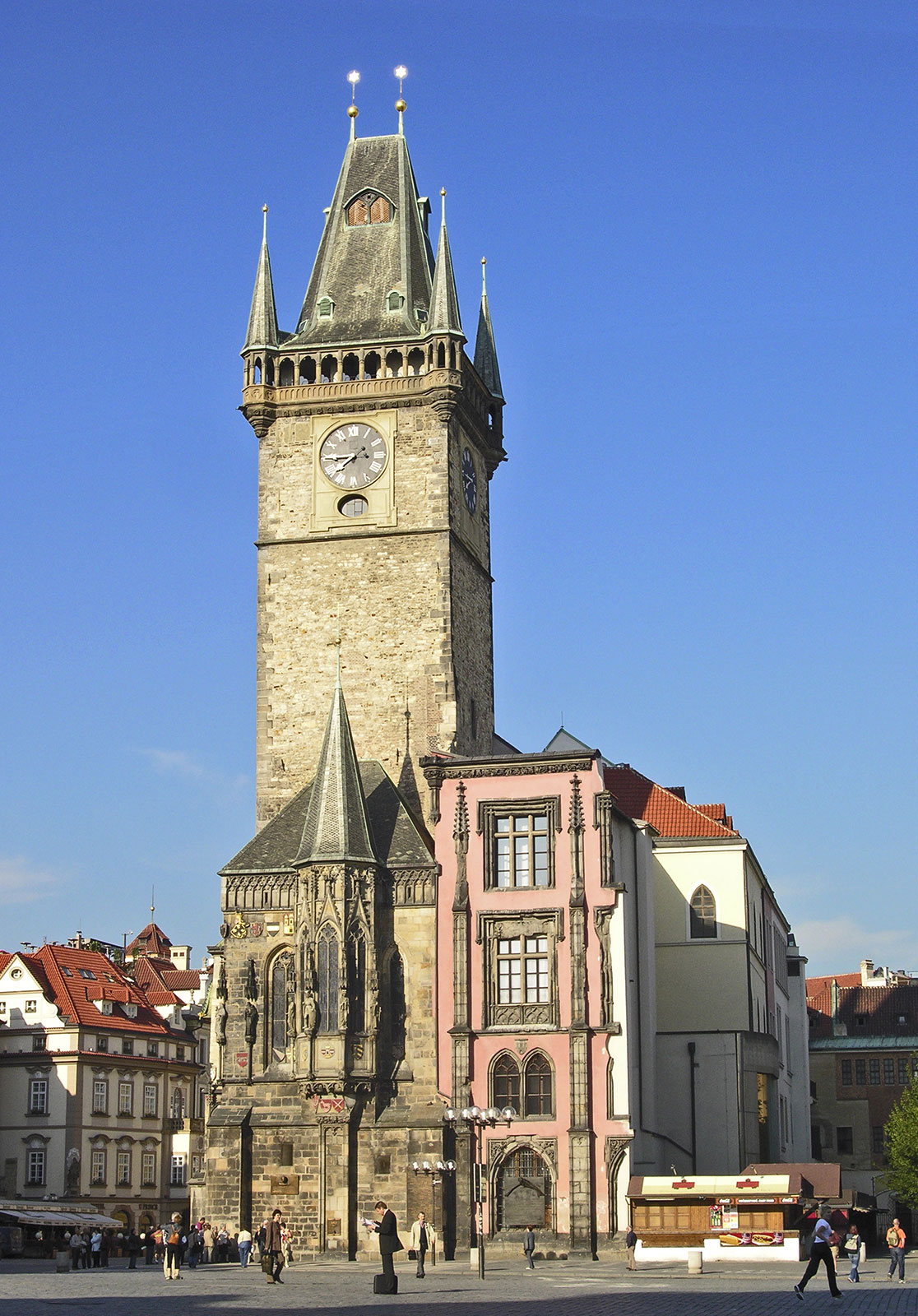
Photo: Hans Peter Schaefer, http://www.reserv-a-rt.de · CC BY-SA 3.0 · Wikimedia Commons
Old Town Hall is a historical building in the Czech Republic. It is in Prague, Czechia. Town halls traditionally faced the main market square. The free Lokali audio guide runs 7 minutes.
✓ Published October 2026 · how we write these guides
Visitor facts
| Lokali audio guide | 7 min · free |
|---|---|
| Type | Museum |
| Location | Prague, Czechia |
| Coordinates | 50.0871, 14.4206 |
| Official website | prague.eu |
| Languages | 50+, in the Lokali app |
The story
Stand still for a moment on the square. Feel the stones under your shoes. They are uneven and rounded at the edges, polished by countless feet. Now look up at the building in front of you. Its windows face the square the way they have for generations. Somewhere above, a clock face or a bell may mark the hour. This is the Old Town Hall. For a very long time, this building was the place where the town decided how it would live.
A quick word before we walk on. Many historic towns have an Old Town Hall, and each one has its own dates, builders, and stories. Rather than give you numbers that might belong to a different building, this guide will focus on what you can see and feel right here. Think of it as a companion for your eyes. The plaques, carved dates, and signs around you will add the local details. Together, they will tell you this building's own story.
In medieval and early modern Europe, a town hall was a statement. Kings had castles. Bishops had cathedrals. Townspeople wanted a building of their own. These were merchants, craftsmen, and members of guilds, which were associations of people in the same trade. A town hall showed that the town could govern itself, collect its own taxes, and settle its own disputes. Often, a town earned that right only after it won special privileges from a ruler. So the building in front of you is, in a sense, a symbol of local self-government.
Inside halls like this, many jobs happened under one roof. The council met in a large chamber, usually on an upper floor. Judges heard cases. Clerks kept records, contracts, and charters in locked rooms. In some towns, the ground floor held market stalls or a place to weigh goods. Some buildings even had a small cell for prisoners. Civic life, trade, and justice all shared the same walls. It was government, courthouse, and marketplace — all at once.
Turn around now and look at the square itself. Town halls were almost always built facing the main market. This was not an accident. The market was where money moved, and the council wanted to watch it. Fairs, announcements, celebrations, and sometimes public punishments all took place on this open ground. When you stand here, you are standing on the town's old stage. In many towns, the tall houses around the edge belonged to the wealthiest merchant families.
Look closely at the front of the building. Many old town halls grew in stages over several centuries. A medieval core might sit behind a later front. A Gothic window might stand beside a Baroque doorway. Gothic is the pointed-arch style of the late Middle Ages. Baroque is the curving, richly decorated style that followed in the seventeenth and eighteenth centuries. See if you can spot changes in the stone or brick, or windows that do not quite match. Each change marks a different generation.
If this hall has a tower, let your eyes travel up it. Towers had practical jobs. A watchman could look out for fire, the greatest fear in any crowded town of timber roofs. Bells called citizens to meetings or warned them of danger. A clock told merchants when the market opened and closed. Before people carried watches, the town hall clock was the shared time of the whole community. In many places, it is still the clock people check without thinking.
Here is a detail many visitors miss. Look near the entrance, or on a wall facing the square, for an old measuring mark. It might be a metal bar, a notch, or a carved line. Some town halls displayed official lengths for cloth and other goods, so buyers could check a seller's measure. Not every hall has one. But if you find it, you are looking at an early form of consumer protection — fairness, fixed in iron or stone.
Another surprise often lies below your feet. Many town halls have deep cellars, and some cellars are older than the building above them. In parts of Central Europe, the council cellar worked as a tavern. The town licensed it, and the profits went into the town's purse. If this building has a restaurant or café below ground, take a look at the walls and the vaulted ceiling. You may be sitting in a room that has served drinks for a very long time.
Old town halls also carry scars. Fire, war, and time hit civic buildings hard, because they stood at the centre of everything. Some were rebuilt several times. Others were carefully reconstructed after the wars of the twentieth century, using old drawings and photographs. If the stone here looks unusually clean, or the carved edges unusually sharp, you might be looking at restoration work. A plaque by the door, or the local museum, can tell you what happened to this particular building.
What happens inside today? In many towns, the Old Town Hall still hosts ceremonies, weddings, and exhibitions. Some house a city museum or a visitor information office. In others, the council still gathers here for important occasions, even if daily work has moved to newer offices. Check the signs by the door. If the doors are open, step inside. Look at the staircase and the ceilings. Painted beams, vaulted rooms, and old portraits of mayors and councillors are common sights.
Now pause and listen. The square has its own soundtrack. Footsteps on stone. Pigeons lifting off the ledges. The clink of cups from a café terrace. Perhaps the clock striking, or a tour group passing by. Watch how the light moves across the front of the hall. In the morning, one side glows. By evening, the colours often turn warmer, and the carved details throw longer shadows. The building looks a little different every hour of the day.
Before you leave, take one more look. Find the clock, or the tower, or the highest window. Think about all the people who have stood where you are standing. Traders waiting for the bell. Families watching a festival. Citizens hearing news read aloud from these steps. This hall was built to be seen from this square. As you walk away, glance back once over your shoulder... That view, the hall framed by its square, is the one the town always wanted you to remember.
Key facts
What to look for
Practical tips
Common questions
Is there a free audio guide to Old Town Hall?
Yes — the Lokali app narrates Old Town Hall free of charge in 50+ languages. The guide runs about 7 minutes, covers the history, what to look for on site and practical tips, and works offline once downloaded.
Where is Old Town Hall?
Old Town Hall is in Prague, Czechia, at 50.0871, 14.4206. Tap the map link on this page for directions from where you are.
What is Old Town Hall known for?
Town halls traditionally faced the main market square. Councils, courts, and archives often shared one civic building.
What should you look for at Old Town Hall?
Mismatched windows from different building phases. A carved coat of arms near the main door. Metal bars or notches once used as official measures.
What should you know before visiting Old Town Hall?
Read the plaques near the entrance for local dates. Stand across the square to frame the whole facade.
When is the best time to visit Old Town Hall?
Return in late afternoon for warmer light on stone.
On the map
Opens directions to Old Town Hall from your location.
More to see in Prague



Hear Old Town Hall in your language
The full story, narrated, in 50+ languages. Download it before you go and it plays offline, at your own pace, with no ticket and no tour group.