
Prague Astronomical Clock
50.0870° N · 14.4207° E · Tower
Photo: Steve Collis from Melbourne, Australia · CC BY 2.0 · Wikimedia Commons
Prague Astronomical Clock is an Astronomical Clock in Prague, Czech Republic. The oldest parts of the clock date from 1410. The free Lokali audio guide runs 8 minutes.
✓ Published October 2026 · how we write these guides
Visitor facts
| Lokali audio guide | 8 min · free |
|---|---|
| Type | Tower |
| Location | Prague, Czechia |
| Coordinates | 50.0870, 14.4207 |
| Official website | orloj600let.cz |
| Languages | 50+, in the Lokali app |
The story
Stand on the cobbles of Old Town Square, just below the tall stone tower of the Old Town Hall. Around you, a crowd gathers. Phones rise, and faces turn upward. Listen. As the minute hand nears the top of the hour, the voices around you grow quieter. Above you, set into a grey Gothic wall, two large painted dials shine with gold, blue and black. This is the Prague Astronomical Clock, which locals call the Orloj. It has kept time over this square for more than six hundred years.
The oldest parts of the clock date from 1410. That makes it one of the oldest astronomical clocks in the world, and the oldest one that still works today. A clockmaker known as Mikuláš of Kadaň built the original mechanism. The astronomy and mathematics behind it are credited to Jan Šindel, a scholar who taught at Prague's university. Think about that for a moment. These gears were already turning above this square decades before Columbus sailed west across the Atlantic.
For centuries, though, Prague told a darker story about the clock. According to a popular legend, the clock was the work of a master named Hanuš. The city councillors feared he would build an even finer clock for another city. So, the story goes, they had him blinded. In revenge, Hanuš reached into the mechanism and stopped it, and nobody could repair it for years. It is a good tale — but it is only a tale. A clockmaker named Hanuš did work on the clock later, in the fifteenth century. There is no evidence that anyone blinded him.
Now look closely at the upper dial. It is not a simple clock face. It is a model of the sky as people understood it in the Middle Ages, with the Earth at the centre of everything. The blue circle in the middle stands for the sky above the horizon during the day. The dark lower part is the night. Bands of orange and reddish brown mark dawn and dusk. A golden sun travels around the dial on one hand. A small moon moves on its own track.
Here is a detail many visitors miss. That little moon is a sphere, half silver and half dark. As the weeks pass, it slowly turns to show the phase of the real moon in the sky. And the clock shows several kinds of time at once. The outer ring, with gold Gothic numerals on a black band, counts Old Bohemian time. In that old system, the new day began at sunset. So the ring shifts gently through the year, following the seasons.
Inside that ring, golden Roman numerals show the hours we use today. Thin curved black lines across the blue mark a much older idea of time. In the ancient world, daylight was always divided into twelve equal parts, whatever the season. A summer hour was long, and a winter hour was short. Finally, look for the smaller ring set off-centre on the dial. It carries the signs of the zodiac, and it tracks the sun's position against the stars.
Now look to either side of the upper dial. Four small statues stand there. On the left, one figure holds a mirror. He represents Vanity. Beside him, a man clutches a bag of money. He represents Greed. On the right stands Death, shown as a skeleton. Next to Death is a figure with a lute, often read as Pleasure or Earthly Desire. Together, they show the things medieval people believed could distract a soul. And they all wait for the hour.
When the hour comes, Death moves first. The skeleton pulls a cord, rings a small bell, and turns an hourglass. The other figures shake their heads, as if to refuse their fate. Above the dial, two little windows open. The twelve Apostles pass by, one after another, and look down on the square. Then a golden rooster above them flaps and crows, and the bell in the tower strikes the hour. The whole show lasts less than a minute. Many visitors laugh in surprise when it ends — and that is part of the ritual.
The Apostles are not medieval. They were added in the nineteenth century, during a major repair of the clock. And the Apostles you see today are newer still. In May 1945, in the final days of the Second World War, fighting during the Prague Uprising set the Old Town Hall on fire. The clock was badly damaged, and the wooden Apostles burned. The woodcarver Vojtěch Sucharda carved a new set. After careful repairs, the clock began to run again in the years after the war.
Now lower your eyes to the second dial, below the first. This is the calendar dial. The Czech painter Josef Mánes created its paintings in the 1860s. Twelve round pictures show a year of country life, one scene for each month. You can see sowing, harvest, and work in the fields and vineyards. Around the edge, small writing marks the days of the year and their saints. A pointer at the top shows today's date. The panel here is a copy. The original painting is kept in the City of Prague Museum.
The stonework around the dials is just as rich. Look for carved Gothic details, small faces, and more figures beside the calendar dial, including an angel and a chronicler with a book. Behind all of this, wheels and gears still drive the display. A small team of specialists cares for the clock. In 2018, a long restoration finished. It cleaned the dials and figures and repaired the mechanism. That is why the colours look so fresh today, even on stone that is six centuries old.
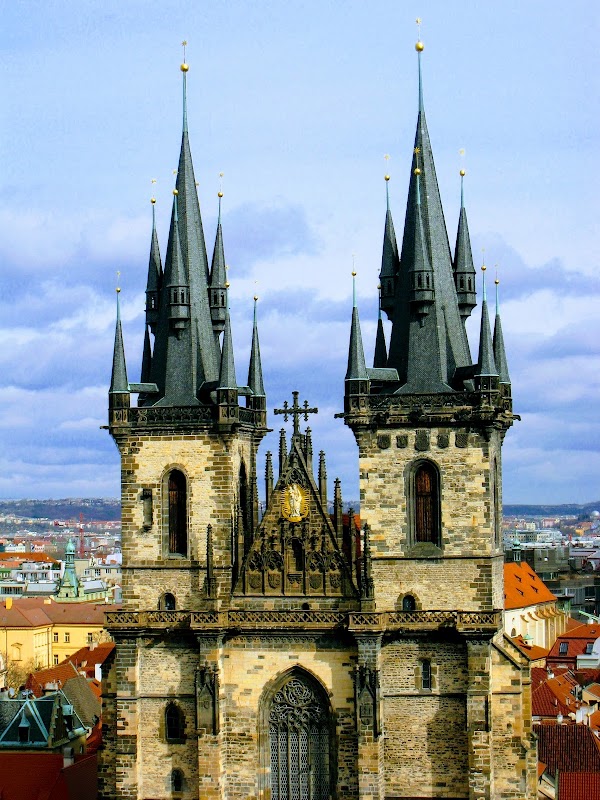
Before you leave this spot, look down at the pavement near the Old Town Hall. You will find twenty-seven white crosses set into the cobbles. They mark the execution of twenty-seven Bohemian leaders in 1621, after a failed rebellion against Habsburg rule. This square has seen markets, coronation processions, protests and executions. Then turn around. Across the square rise the dark twin spires of the Týn Church. In the centre stands the large monument to Jan Hus, a religious reformer who was burned for his beliefs in the fifteenth century.
If you want a different view, you can climb the Old Town Hall tower, right above the clock. It needs a separate ticket. From the gallery at the top, the square opens up below you. The red roofs and pastel facades spread out in every direction, and the crowd at the clock looks very small. If you stay down here for the hourly show, keep your bag close. Pickpockets know exactly when everyone looks up.
When the crowd moves on, take one more look at the upper dial. The golden sun has moved a little since you arrived. The moon is still turning, so slowly that you cannot see it move. People have stood on this same spot and watched these same hands for more than six hundred years. As you walk away across the cobbles, listen for the next hour. Somewhere behind you, Death will ring its little bell again.
Key facts
What to look for
Practical tips
Common questions
Is there a free audio guide to Prague Astronomical Clock?
Yes — the Lokali app narrates Prague Astronomical Clock free of charge in 50+ languages. The guide runs about 8 minutes, covers the history, what to look for on site and practical tips, and works offline once downloaded.
Where is Prague Astronomical Clock?
Prague Astronomical Clock is in Prague, Czechia, at 50.0870, 14.4207. Tap the map link on this page for directions from where you are.
What is Prague Astronomical Clock known for?
The oldest parts of the clock date from 1410. Clockmaker Mikuláš of Kadaň built the original mechanism.
What should you look for at Prague Astronomical Clock?
The skeleton of Death ringing its small bell. The half-silver moon sphere showing the lunar phase. Gold Gothic numerals on the black outer ring.
What should you know before visiting Prague Astronomical Clock?
Arrive a few minutes early for a clear view. Watch from the side edges to avoid the thickest crowd.
When is the best time to visit Prague Astronomical Clock?
Arrive a few minutes early for a clear view.
On the map
Opens directions to Prague Astronomical Clock from your location.
More to see in Prague


Hear Prague Astronomical Clock in your language
The full story, narrated, in 50+ languages. Download it before you go and it plays offline, at your own pace, with no ticket and no tour group.