
Photo: Wikimedia Commons contributor · CC0 · Wikimedia Commons
Sirkap is an archaeological site near Taxila, Punjab, Pakistan. Founded by Indo-Greek rulers in the second century BCE. The free Lokali audio guide runs 6 minutes.
✓ Published October 2026 · how we write these guides
Visitor facts
| Lokali audio guide | 6 min · free |
|---|---|
| Type | Archaeological Site |
| Location | Punjab, Pakistan |
| Coordinates | 33.7561, 72.8292 |
| Languages | 50+, in the Lokali app |
The story
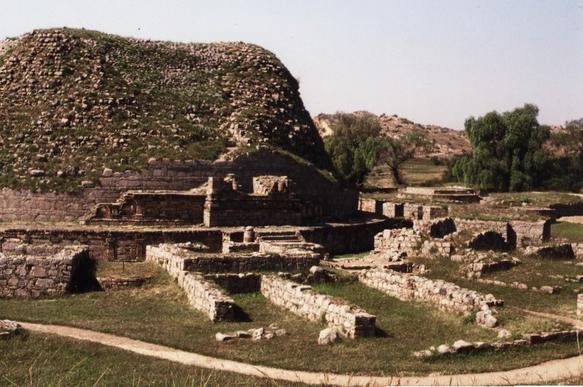
Under your feet, the ground is dry and gritty. Low walls of grey stone rise only to knee or waist height on either side of a long, straight street. Wind moves across the open plain, and somewhere a bird calls from the scrub. This is Sirkap, near the town of Taxila in Pakistan's Punjab. It is quiet now. Once it was a crowded city of shops, homes, and shrines, at a crossroads between Central Asia and the plains of India.
Start with the street itself. Look how straight it runs. Most ancient towns in this region grew slowly and their lanes curved. Sirkap is different. It was laid out on a grid, with a main street running roughly north to south and smaller lanes crossing it at right angles. This orderly plan is a Greek idea. It tells you who first shaped this city... people with roots far to the west.
Those people were the Indo-Greeks. After Alexander the Great passed through this region in the fourth century before Christ, Greek-speaking kingdoms took hold in Bactria, an area roughly in today's northern Afghanistan. In the second century before Christ, these Greco-Bactrian rulers pushed south across the Hindu Kush mountains. Historians generally link the founding of Sirkap to them. Taxila was already an old and important place by then. Sirkap became one of its cities.
Here is the first surprise. Taxila is not one ancient site. It is a cluster of several cities from different eras, spread across this valley. The older settlement, called the Bhir Mound, lies nearby. Sirkap came later. And after Sirkap, another city called Sirsukh was built a short distance away. So when people say "ancient Taxila", they mean a whole sequence of cities, each one replacing the last.
The Greeks did not hold Sirkap for long. Waves of new rulers came. First came the Scythians, nomadic peoples from the Central Asian steppe, known in this region as the Sakas. Then came the Parthians, from the Iranian world. Each group left its mark here. Much of what you see at street level today belongs to the later phases, after the city was rebuilt. The layers sit on top of one another.
Look closely at the walls. Many are built of rough, uneven stones packed together with smaller pieces in between. Archaeologists working here noticed changes in building styles from one layer to the next. Those changes helped them read the city's timeline. A simple pile of rubble masonry, to a trained eye, can show which century it belongs to. The city was also protected by a long stone defensive wall, and parts of it still trace the edges of the site.
Much of what we know comes from the excavations led by Sir John Marshall, the British archaeologist who directed digging at Taxila in the early twentieth century. His team worked here over many seasons. They uncovered streets, houses, temples, coins, jewellery, and household objects. Many of these finds are now in the Taxila Museum, not far from here. If you visit it, the coins and ornaments make the empty streets feel inhabited again.
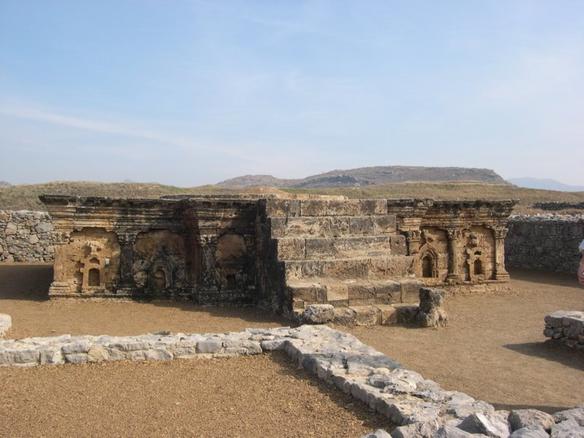
Now walk along the main street and look for the shrine known as the Double-Headed Eagle Stupa. A stupa is a Buddhist monument, usually a dome or mound holding sacred relics. Only the square base survives here. But its front is decorated with a remarkable mix of styles. You can see columns in a Greek manner. You can see arched niches in an Indian style. And above one niche sits a carved bird with two heads, facing in two directions.
This is the second surprise. That double-headed eagle is a symbol found in many cultures, from the ancient Near East to later European empires. Seeing it here, on a Buddhist shrine in Punjab, shows how many traditions met in this city. Greek, Indian, Iranian, and steppe influences all passed through Sirkap. The shrine is small. Yet it carries a whole world of trade and belief on one stone face.
Further along, you will find the remains of a large building with a rounded end, often called the Apsidal Temple. An apse is a semicircular end to a hall, a shape you may know from churches. Here it belongs to a Buddhist sanctuary. Around it, look at the small square rooms that line the street. Many were likely shops on the street front, with living spaces behind them. Imagine merchants, cloth, metalwork, and the noise of carts.
Sirkap also appears in older stories. A Greek writer named Philostratus wrote about the philosopher Apollonius of Tyana visiting Taxila, and some scholars connect his description with this city. There is also a Christian tradition that the apostle Saint Thomas came to the court of an Indo-Parthian king named Gondophares, who ruled in this region. These accounts are part legend, part history. Historians still debate how much of them is true. But they show how far Taxila's name travelled.
In time, the Kushans, another powerful dynasty from Central Asia, took control of the region. They built the new city at Sirsukh, and Sirkap slowly faded. Today the whole Taxila area is a UNESCO World Heritage Site. The valley around you also holds Buddhist monasteries on the nearby hills, such as Jaulian and Dharmarajika. If you have time, they make a natural next stop, and together they complete the story of this valley.
Before you leave, stand still for a moment on the main street. Look north along its straight line, then turn and look toward the low hills to the south. The same sky, the same dust, the same distant ridges were here when Greek, Saka, and Parthian voices filled these lanes. Now there is only wind and birdsong. As you walk back, notice each doorway you pass. Every one of them was once someone's home, or someone's shop.
Key facts
What to look for
Practical tips
Common questions
Is there a free audio guide to Sirkap?
Yes — the Lokali app narrates Sirkap free of charge in 50+ languages. The guide runs about 6 minutes, covers the history, what to look for on site and practical tips, and works offline once downloaded.
Where is Sirkap?
Sirkap is in Punjab, Pakistan, at 33.7561, 72.8292. Tap the map link on this page for directions from where you are.
What is Sirkap known for?
Founded by Indo-Greek rulers in the second century BCE. Laid out on a Greek-style grid of streets.
What should you look for at Sirkap?
The two-headed eagle carved above a shrine niche. Greek-style columns beside Indian arches on one stupa. The long, straight main street running north to south.
What should you know before visiting Sirkap?
Visit early morning to avoid the strong midday heat. Bring water and a hat; there is little shade.
When is the best time to visit Sirkap?
Visit early morning to avoid the strong midday heat.
On the map
Opens directions to Sirkap from your location.
More to see near Sirkap


Hear Sirkap in your language
The full story, narrated, in 50+ languages. Download it before you go and it plays offline, at your own pace, with no ticket and no tour group.