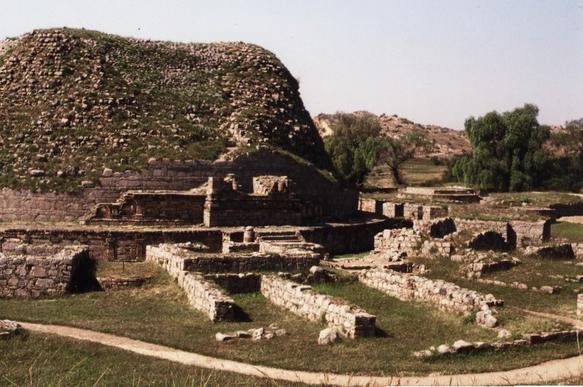
Dharmarajika Stupa
33.7447° N · 72.8419° E · Archaeological Site
Photo: not stated · CC BY-SA 1.0 · Wikimedia Commons
Dharmarajika Stupa is an archaeological site in Punjab, Pakistan. Name refers to Ashoka, the righteous king. The free Lokali audio guide runs 7 minutes.
✓ Published October 2026 · how we write these guides
Visitor facts
| Lokali audio guide | 7 min · free |
|---|---|
| Type | Archaeological Site |
| Location | Taxila Tehsil, Pakistan |
| Coordinates | 33.7447, 72.8419 |
| Languages | 50+, in the Lokali app |
The story
Feel the ground first. Underfoot, the path is dust and old stone, warm in the sun. Around you, low walls of grey and brown rubble rise and fall like the outline of a sleeping town. In front of you sits a great round mound of masonry, worn soft at the edges. The air is quiet here. You may hear a bird in the trees, or wind moving through dry grass. This is the Dharmarajika Stupa, one of the oldest Buddhist monuments in the Taxila valley.
A stupa is a sacred mound built over relics. In Buddhist tradition, these relics may be fragments of bone, ash, or objects linked to the Buddha or to revered teachers. Pilgrims do not enter a stupa. Instead, they walk around it, always clockwise, keeping the sacred centre on their right. As you stand here, imagine that same slow circle repeated by monks and travellers for many centuries. The worn paths around this mound are the record of their feet.
The name carries a story. Dharmarajika comes from Dharmaraja, meaning the righteous king or the king of the law. This was a title linked to Ashoka, the Mauryan emperor who ruled much of South Asia in the third century before Christ. Ashoka turned to Buddhism after a bloody war, according to his own inscriptions. Tradition says he sent relics of the Buddha across his empire. Many scholars believe the first stupa here belongs to his era.
Taxila itself was an important place long before and after Ashoka. It sat on old trade routes that linked the plains of India with Central Asia and the lands further west. Merchants, soldiers, scholars and pilgrims all passed through this valley. Persian, Greek, Central Asian and Indian rulers controlled it at different times. Each group left something behind. This mix of cultures shaped the art you can still see in fragments across the site and in the nearby museum.
Look closely at the walls around you. They are not all built the same way. Some are rough stacks of rubble. Others show a neat pattern of large stones with small stones packed between them, a style archaeologists call diaper masonry. Later walls use more carefully cut blocks. The archaeologist Sir John Marshall, who excavated at Taxila in the early twentieth century, used these differences to help date the buildings. So the walls themselves work like a calendar in stone.
Now look at the great dome. You may notice a deep cut running into its side. Locals have long called this monument Chir Tope, which means the split stupa. The cut is not part of the design. It was made by earlier diggers searching for treasure inside the mound. It is a damaged spot, but it is also a strange window. It shows how the stupa was built in layers, one shell over another, as later builders enlarged the older core.
That layering is important. A stupa was rarely finished once and left alone. Donors and communities added new casings, new steps, new decoration. Over centuries, the monument grew larger and grander. Damage also played a part. Historians believe an earthquake in the early centuries of the common era hit this region hard, and much rebuilding followed. When you look at the mound today, you are seeing the result of many hands across many generations.
Here is a detail many visitors miss. Excavations at the site found a relic deposit with a small inscription written on a silver scroll. It was written in Kharoshthi, an old script used in this northwestern region and written from right to left. The inscription records the placing of relics in a chapel here by a donor. It is a rare and personal voice from the distant past — one devout person, marking a gift in silver.
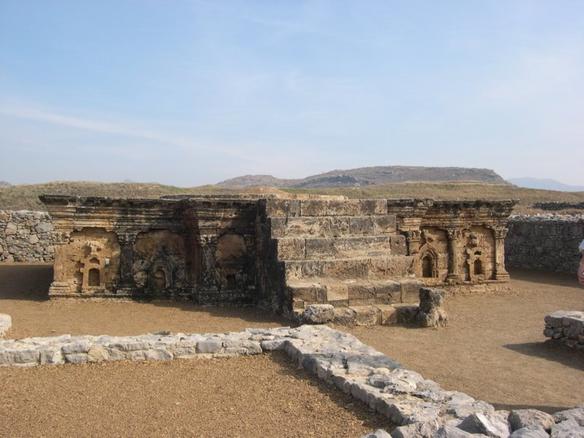
Around the main stupa, you will see a ring of small chapels and smaller stupas. These were votive offerings. Wealthy families, merchants and monks paid for them to gain religious merit. Some chapels once held statues of the Buddha, made of stone or stucco, a kind of plaster that can be shaped into fine detail. Many of these figures are now in museums. Standing in the ring, you are surrounded by the hopes of people whose names are mostly lost.
Beyond the stupa ring, the ruins extend into a monastery. Here monks lived, studied and prayed. Look for the outlines of small square rooms arranged around open courtyards. Each room was a cell for a monk. Life was simple: sleep, meditation, study, shared meals. Taxila had a reputation as a centre of learning in the ancient world. Places like this were part of that tradition, where teaching passed from older monks to younger ones by voice and memory.
The religious life of the site did not last forever. In later centuries, the Buddhist communities of the Taxila valley declined. Many historians link this decline, at least in part, to invasions by Central Asian groups often called the White Huns, around the fifth century of the common era. Trade routes shifted, patrons disappeared, and the monasteries emptied. Earth and grass slowly covered the walls. For a long time, these mounds were simply part of the landscape.
Today, the Dharmarajika complex forms part of the Taxila archaeological sites, listed by UNESCO as a World Heritage Site. It is a quiet place compared to busy city monuments. Families picnic nearby, school groups visit with their teachers, and occasional pilgrims from Buddhist countries come to pray. Some still walk around the stupa in the old clockwise direction. If you see this, give them space. You are watching a ritual that has returned to this hill after a very long absence.
Before you leave, take a slow walk around the great mound yourself. Notice how the light changes the colour of the stone, from pale grey to warm gold. Notice the small stupas at your feet, and the cut in the dome above you. Listen to the quiet. As you walk back down the path, you are following the same route that pilgrims took toward this place, long ago — only now, you are walking away from it, carrying a little of its stillness with you.
Key facts
What to look for
Practical tips
Common questions
Is there a free audio guide to Dharmarajika Stupa?
Yes — the Lokali app narrates Dharmarajika Stupa free of charge in 50+ languages. The guide runs about 7 minutes, covers the history, what to look for on site and practical tips, and works offline once downloaded.
Where is Dharmarajika Stupa?
Dharmarajika Stupa is near Taxila Tehsil, Pakistan, at 33.7447, 72.8419. Tap the map link on this page for directions from where you are.
What is Dharmarajika Stupa known for?
Name refers to Ashoka, the righteous king. Tradition links the first stupa to the third century before Christ.
What should you look for at Dharmarajika Stupa?
The deep treasure hunters' cut in the dome's side. Diaper masonry: large stones packed with small stones. Ring of small votive stupas around the main mound.
What should you know before visiting Dharmarajika Stupa?
Walk around the stupa clockwise, as pilgrims traditionally do. Visit early morning to avoid the strongest midday heat.
When is the best time to visit Dharmarajika Stupa?
Visit early morning to avoid the strongest midday heat.
On the map
Opens directions to Dharmarajika Stupa from your location.
More to see near Dharmarajika Stupa



Hear Dharmarajika Stupa in your language
The full story, narrated, in 50+ languages. Download it before you go and it plays offline, at your own pace, with no ticket and no tour group.