
Cathedral Basilica of Notre-Dame de Québec
46.8139° N · 71.2066° W · Church
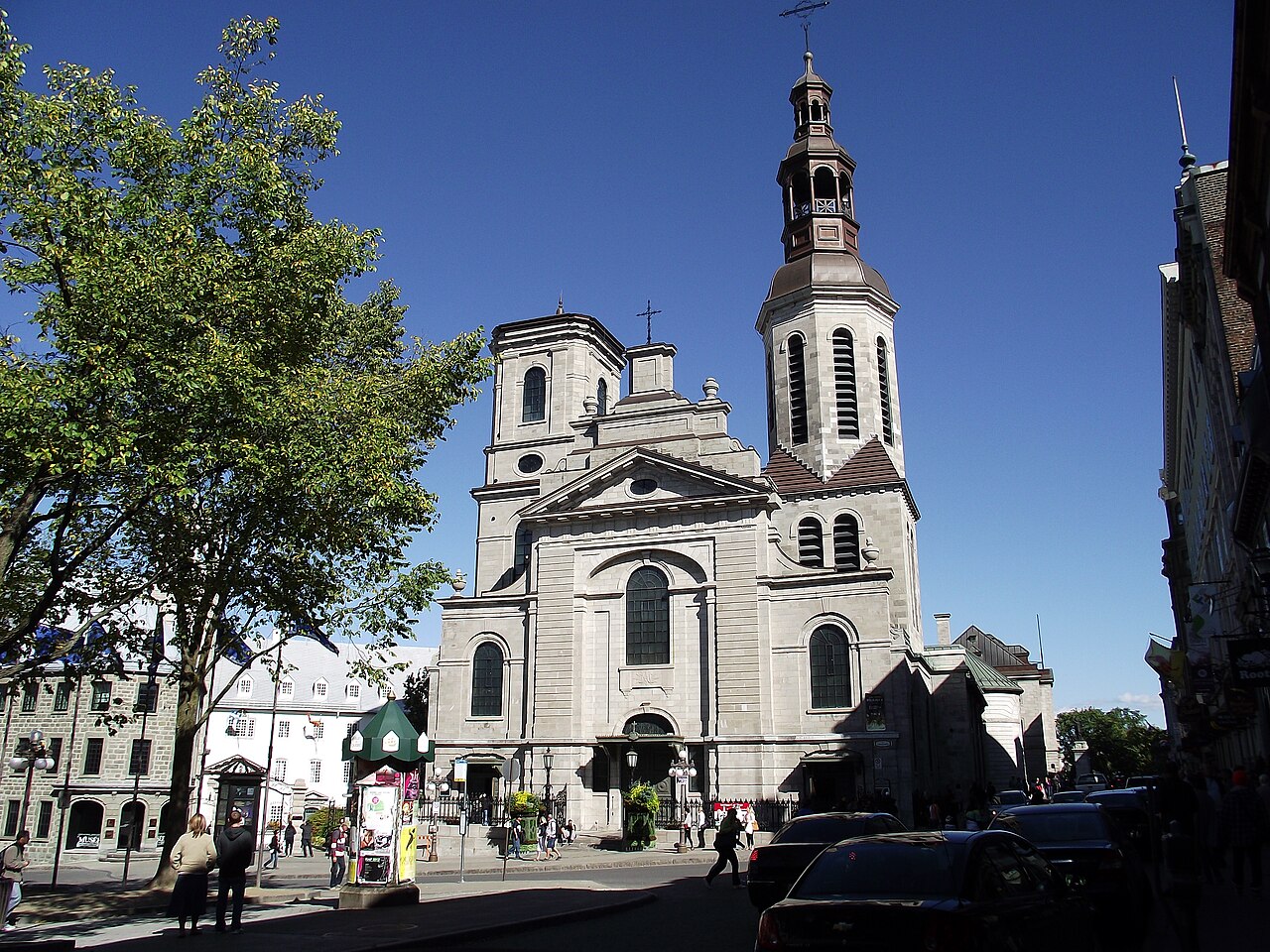
Photo: Pierre-Olivier Fortin · CC BY-SA 3.0 · Wikimedia Commons
Cathedral Basilica of Notre-Dame de Québec is a catholic basilica-cathedral in Quebec City, Quebec, Canada. Parish founded in 1664, oldest north of Mexico. The free Lokali audio guide runs 6 minutes.
✓ Published October 2026 · how we write these guides
Visitor facts
| Lokali audio guide | 6 min · free |
|---|---|
| Type | Church |
| Location | Quebec, Canada |
| Coordinates | 46.8139, -71.2066 |
| Official website | nddq.org |
| Languages | 50+, in the Lokali app |
The story
Stand still for a moment on the cobblestones of the Upper Town. Listen to the bells, the clatter of carriage wheels, the mix of French and English voices around you. In front of you rises a pale stone façade. Its two towers do not quite match. Inside, gold leaf catches the candlelight. This is the Cathedral Basilica of Notre-Dame de Québec, and its story goes back almost to the founding of the city itself.
This spot has held a church for nearly four centuries. Samuel de Champlain, the French explorer who founded Québec in 1608, built a small chapel close to here in the 1630s. That chapel burned. In 1647, a new stone church went up on this site, dedicated to Our Lady of Peace. Every church that followed has stood on those same foundations. It is a place built and rebuilt, again and again, by people who refused to let it go.
Here is the first thing most visitors miss. The parish of Notre-Dame de Québec was created in 1664. That makes it the oldest Catholic parish in North America north of Mexico. A decade later, Québec became the seat of the first Catholic diocese in that same vast territory. For a time, the bishop in this church held spiritual authority over an enormous region. It stretched from the Saint Lawrence River deep into the continent, all the way toward the Gulf of Mexico.
The first bishop was François de Laval, a French priest who arrived in the colony in 1659. He shaped the early Church here and founded the seminary just beside the cathedral. Laval was declared a saint in 2014. Today his tomb rests in a funerary chapel inside the basilica. Many visitors come specifically to see it. Others simply notice a quiet corner where people stop, light a candle, and stand for a while.
The building has suffered more than most churches on the continent. In 1759, during the Seven Years' War, British forces besieged Québec. Their cannons fired across the river from the opposite shore. The cathedral was struck and largely destroyed by fire. A few weeks later, the city fell to Britain. Québec's French and Catholic population then faced a new question. How would they keep their faith and identity under a Protestant crown?
One answer was this church. The people of Québec rebuilt it after the siege, working from the old walls and the old plan. Through the late eighteenth and nineteenth centuries, the work continued in stages. A local family of architects and craftsmen, the Baillairgés, shaped much of the interior and the classical façade you see today. Their work gave the cathedral a style that is French in spirit, yet made by people born in Québec.
Then, in 1922, fire struck again. Flames gutted the interior and much of the decoration was lost. Once more, the parish rebuilt. The interior you walk through today is largely a careful reconstruction from the years that followed. So when you look at the gilded details, you are seeing a faithful twentieth century recreation of an older vision. It is the same idea, carried forward by a new generation of hands.
Now step inside, if you can. Let your eyes adjust to the warm light. The walls and ceiling are pale, almost creamy. Against them, gold shines from every direction. Above the main altar stands a large baldachin. A baldachin is a canopy raised on columns over an altar, a tradition borrowed from great churches in Rome. Here it is richly gilded, and angels seem to hold it aloft. Notice how the whole nave draws your eye forward toward it.
In 1874, Pope Pius the Ninth gave the church the rank of minor basilica. That is an honorary title. The Vatican grants it to churches of special historical or spiritual importance. It is why the full name contains both words, cathedral and basilica. Cathedral means it is the seat of a bishop. Basilica means Rome has singled it out. Few churches in North America carry both titles, and fewer still with this much history behind them.
Here is the second surprise. In 2013, the parish celebrated its 350th anniversary. For that occasion, the cathedral received a Holy Door. In Catholic tradition, a Holy Door is a special entrance opened only in jubilee years, and walking through it is a sign of renewal. Before this, such doors existed only in Europe, mostly in Rome. This was the first Holy Door in the Americas. Look for it near the main entrance, with its bronze panels.
Back outside, take a moment to look at the square. The basilica faces an open plaza with City Hall on one side. The old seminary buildings stand behind and beside the church. Narrow streets slope away toward the edge of the cliff and the Lower Town below. All of this sits inside the Historic District of Old Québec, which UNESCO listed as a World Heritage Site in 1985. It is one of very few walled cities left in North America.
As you stand here, think about the layers under your feet. A small chapel. A seventeenth century stone church. Cannon fire in 1759. Rebuilding by local craftsmen. Fire again in 1922. And still, every week, people come here for Mass, for weddings, for funerals, and for quiet prayer. This is not a museum frozen in one moment. It is a working parish that has simply kept going, through war, fire, and a change of empire.
Before you walk on, look up once more at those two mismatched towers. Listen for the bells. Notice the worn steps, smoothed by centuries of footsteps. Then turn toward the river, and let the narrow streets carry you down toward the water. Somewhere behind you, the candles inside are still burning... just as they have, in one form or another, for nearly four hundred years.
Key facts
What to look for
Practical tips
Common questions
Is there a free audio guide to Cathedral Basilica of Notre-Dame de Québec?
Yes — the Lokali app narrates Cathedral Basilica of Notre-Dame de Québec free of charge in 50+ languages. The guide runs about 6 minutes, covers the history, what to look for on site and practical tips, and works offline once downloaded.
Where is Cathedral Basilica of Notre-Dame de Québec?
Cathedral Basilica of Notre-Dame de Québec is in Quebec, Canada, at 46.8139, -71.2066. Tap the map link on this page for directions from where you are.
What is Cathedral Basilica of Notre-Dame de Québec known for?
Parish founded in 1664, oldest north of Mexico. First Catholic diocese seat north of Mexico.
What should you look for at Cathedral Basilica of Notre-Dame de Québec?
Gilded baldachin canopy rising above the main altar. Bronze panels of the Holy Door near the entrance. Saint François de Laval's funerary chapel and tomb.
What should you know before visiting Cathedral Basilica of Notre-Dame de Québec?
Dress modestly and keep voices low during services. Check for Mass or events before planning your visit.
On the map
Opens directions to Cathedral Basilica of Notre-Dame de Québec from your location.
More to see in Quebec


Hear Cathedral Basilica of Notre-Dame de Québec in your language
The full story, narrated, in 50+ languages. Download it before you go and it plays offline, at your own pace, with no ticket and no tour group.