
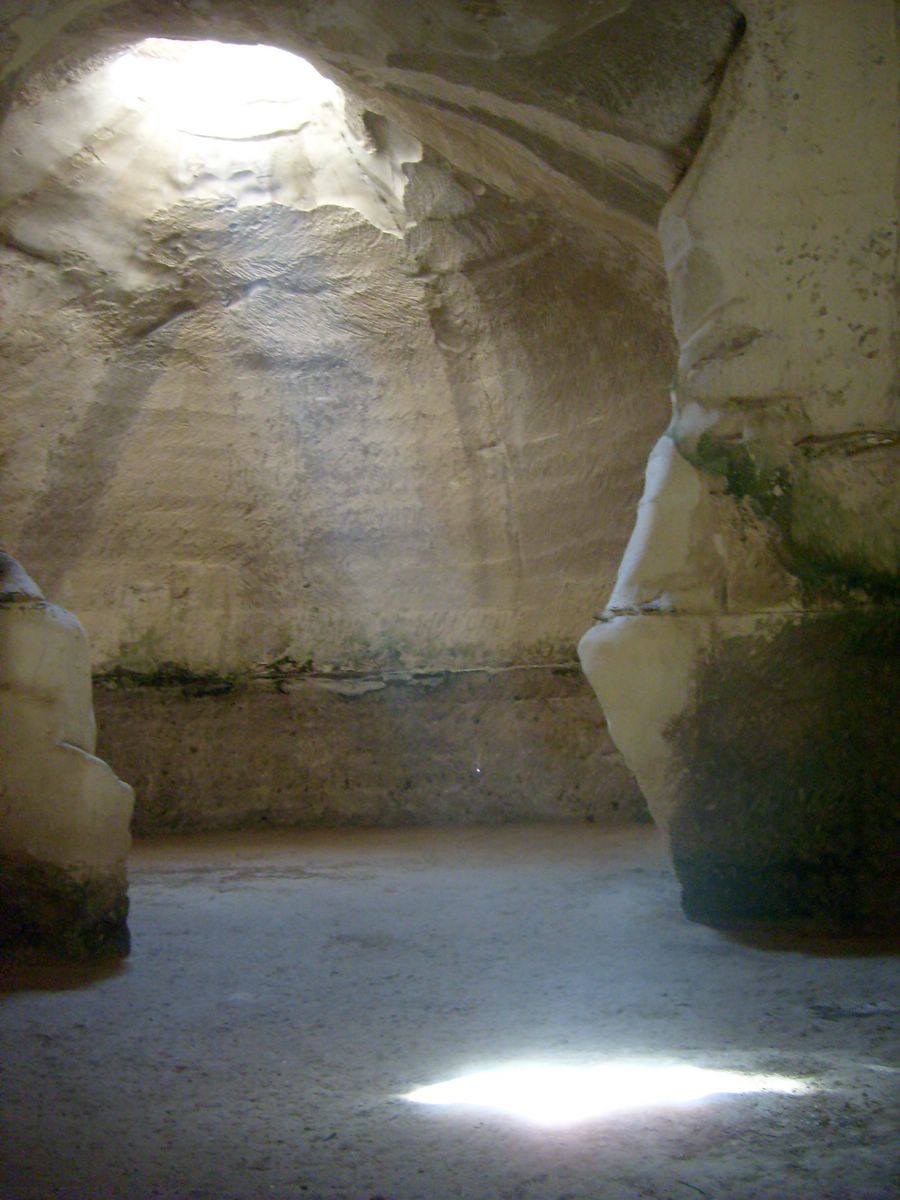
Photo: אבישי טייכר · CC BY 2.5 · Wikimedia Commons
Ekron is an archaeological site in Israel. Ekron was one of five major Philistine cities. The free Lokali audio guide runs 6 minutes.
✓ Published October 2026 · how we write these guides
Visitor facts
| Lokali audio guide | 6 min · free |
|---|---|
| Type | Archaeological Site |
| Location | Rehovot, Israel |
| Coordinates | 31.7789, 34.8511 |
| Languages | 50+, in the Lokali app |
The story
Feel the ground under your feet. It is soft, pale soil, the kind that turns to fine dust in summer and to heavy mud after winter rain. Around you, the inner coastal plain stretches low and open. Fields, orchards and the hum of distant roads fill the space. It looks quiet and ordinary... yet the name Ekron carries more than three thousand years of story.
Ekron was one of the great cities of the Philistines. The Hebrew Bible names five of them: Gaza, Ashkelon, Ashdod, Gath, and Ekron. Together, scholars often call them the Philistine Pentapolis, which simply means five cities. Ekron sat furthest inland and closest to the hills of Judah. That position made it a frontier town, a place where two very different cultures met, traded and often fought.
For a long time, nobody knew exactly where Ekron stood. Scholars debated several mounds in this region. Today the ancient city is identified with a large mound called Tel Miqne. A tel is an artificial hill, built slowly by one settlement rising on the ruins of the last. Tel Miqne lies a short drive from Rehovot, near Kibbutz Revadim. From a distance, it looks like a gentle rise in the farmland.
Who were the Philistines? Most historians connect them with the so-called Sea Peoples. These were groups who moved across the eastern Mediterranean around the twelfth century before Christ, a time when older empires were collapsing. Their pottery tells the story clearly. Early Philistine vessels look strikingly similar to pottery from the Aegean world, the region of Greece and its islands. The newcomers brought their own tastes, their own kitchens and their own gods.
Archaeology made this connection visible. From the early 1980s into the 1990s, a long excavation project worked at the site. It was led by Trude Dothan of the Hebrew University and Seymour Gitin of the Albright Institute in Jerusalem. Season after season, teams of diggers and volunteers peeled back the layers. They uncovered city walls, houses, workshops and temples. Slowly, a city that had existed mostly in old texts became solid stone again.
Here is the first surprise. In its later centuries, Ekron was not mainly a military stronghold. It became one of the largest olive oil production centres known from the ancient Near East. Excavators found more than a hundred olive presses inside the city. Picture heavy stone crushing basins, weights, and the thick smell of pressed olives. Oil was the fuel, the medicine and the cooking fat of the ancient world. Ekron produced it on an industrial scale.
That boom had a political background. In the seventh century before Christ, the Assyrian Empire, a powerful state based in what is now northern Iraq, dominated this whole region. Ekron became a vassal city, loyal to Assyria and paying tribute. Assyrian records mention a king of Ekron named Padi. Under Assyrian control, trade routes opened, and Ekron turned its olive groves into wealth. Peace under an empire, it seems, was good for business.
Now the second surprise, and perhaps the most important find of all. In 1996, near the end of the excavations, archaeologists uncovered a stone inscription inside a temple. It is a royal dedication. It names Achish, son of Padi, as ruler of Ekron, and it records that he built the temple for a goddess. Crucially, the inscription names the city itself. In one line of carved letters, the long debate about Ekron's location was settled.
That discovery also connects to the Bible in a striking way. The name Achish appears in biblical stories as the name of a Philistine king of Gath. Scholars see this as a royal name used among the Philistines. The inscription also shows something subtle. By this time, the descendants of Aegean newcomers were writing in a local Semitic script. Over centuries, the Philistines had adopted much of the language and culture around them.
Ekron also appears in famous biblical episodes. In the Book of Samuel, the captured Ark of the Covenant is carried from city to city among the Philistines, and Ekron is one of its stops. The text says the people of Ekron begged for it to be sent away. The Book of Kings mentions Baal-Zebub, called the god of Ekron. These are religious narratives, not excavation reports, but they show how deeply this city lived in memory.
Ekron's prosperity did not last. When Assyrian power collapsed, a new empire rose in Babylon. Near the end of the seventh century before Christ, the Babylonians campaigned along this coast, and Ekron was destroyed. Archaeologists found the signs: burned layers, collapsed buildings, and objects left where they fell. After that, the great Philistine city never truly recovered. Its olive presses fell silent, and the fields slowly took the mound back.
The name, however, did not disappear. When Jewish settlers founded a farming village near Rehovot in 1883, they first called it Ekron, after the ancient city. The village was later renamed Mazkeret Batya, in honour of the mother of Baron Edmond de Rothschild, who supported the settlement. So the word Ekron travelled across nearly three thousand years, from a Philistine capital to a modern farming community. If you want to see the actual finds, a small museum at Kibbutz Revadim displays objects from the excavations.
Take a last look around you. Notice the light on the fields, the low line of the hills to the east, the wind moving through the dry grass. This is the same landscape that Philistine farmers, Assyrian officials and Judean neighbours once crossed. The olive trees nearby are not ancient survivors, but they grow in the same soil. As you walk away, listen for the quiet. Somewhere under these fields, a city of oil, temples and kings still lies in layers.
Key facts
What to look for
Practical tips
Common questions
Is there a free audio guide to Ekron?
Yes — the Lokali app narrates Ekron free of charge in 50+ languages. The guide runs about 6 minutes, covers the history, what to look for on site and practical tips, and works offline once downloaded.
Where is Ekron?
Ekron is near Rehovot, Israel, at 31.7789, 34.8511. Tap the map link on this page for directions from where you are.
What is Ekron known for?
Ekron was one of five major Philistine cities. Ancient Ekron is identified with the mound Tel Miqne.
What should you look for at Ekron?
The gentle artificial rise of the tel above flat fields. Pale coastal-plain soil that shows layers of settlement. Olive trees growing in the surrounding farmland.
What should you know before visiting Ekron?
Visit the Ekron museum at Kibbutz Revadim for excavation finds. Come in early morning to avoid strong midday heat.
When is the best time to visit Ekron?
Come in early morning to avoid strong midday heat.
On the map
Opens directions to Ekron from your location.
More to see near Ekron


Hear Ekron in your language
The full story, narrated, in 50+ languages. Download it before you go and it plays offline, at your own pace, with no ticket and no tour group.