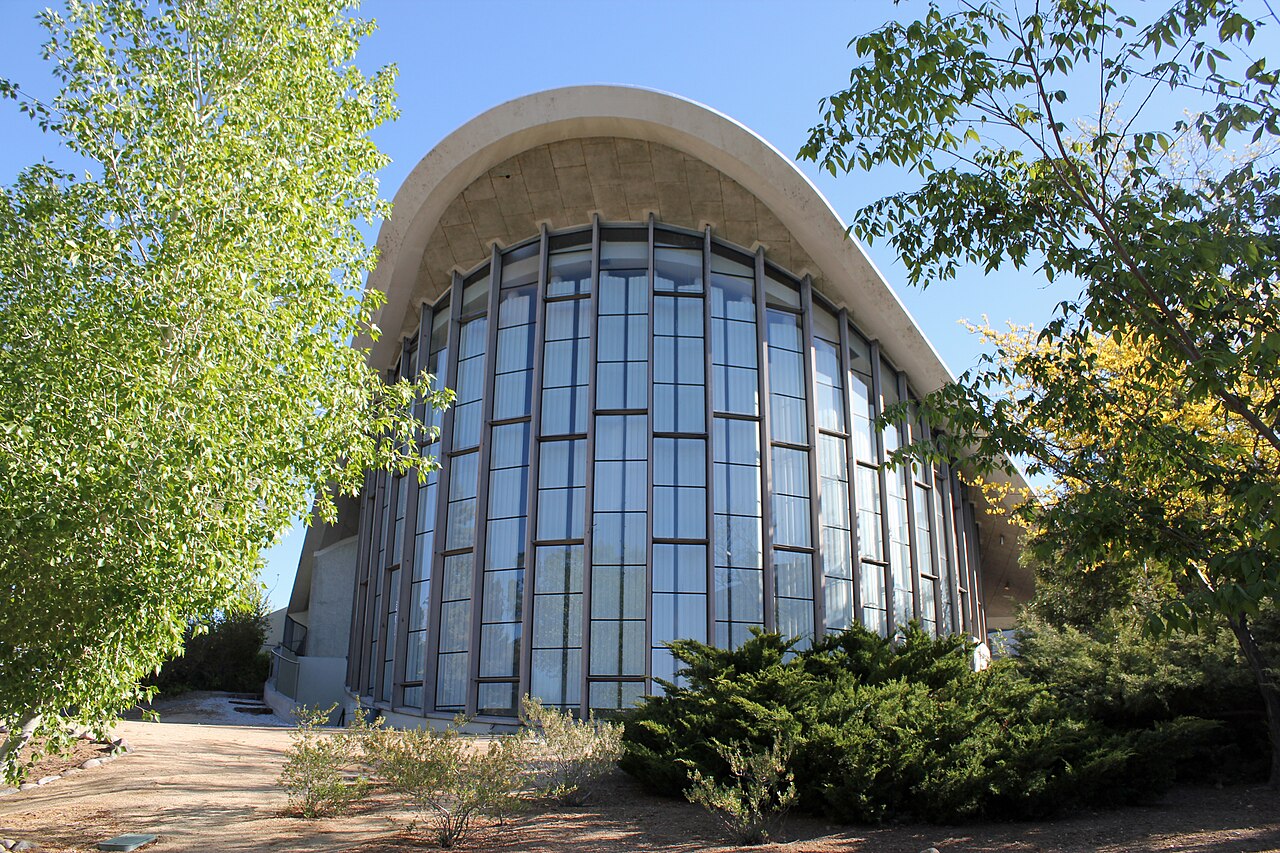
Fleischmann Planetarium is a museum in Reno, United States. University of Nevada's public planetarium featuring full-dome digital shows, an interactive science museum, and exhibits on astronomy and space exploration. Most visitors spend 1–2 hours here. The free Lokali audio guide runs 5 minutes.
✓ Verified August 2026 · how we write these guides
Visitor facts
| Time needed | 1–2 hours |
|---|---|
| Lokali audio guide | 5 min · free |
| Type | Museum |
| Best for | Family |
| Location | Reno, United States |
| Coordinates | 39.5407, -119.8180 |
| Languages | 45, in the Lokali app |
The story
Look at the roof before anything else. It sweeps up at two corners and down at the others, like a sheet caught mid-fold or a thin slice of a saddle. It is made of concrete, yet it seems light, almost in motion. This is the Fleischmann Planetarium, and its roof has drawn eyes on the University of Nevada campus since the building opened.
The planetarium opened in 1963, during the years when the United States and the Soviet Union were racing to reach space. Its shape is a form that engineers call a hyperbolic paraboloid, a surface that curves in two directions at once. The whole concrete roof rests on only two points, though it weighs around 180 tons. Stand near it and look at how little is holding all that weight.
The building carries the name Fleischmann, after a foundation that gave generously to science and education across Nevada. Their gift helped bring this center to the university, where it has taught generations of students and visitors about the sky above the high desert. The name is a quiet reminder that places like this often rest on the generosity of a few who believe knowledge should be shared.
Step inside, and the center of the building is the dome theater. Here a projector throws stars onto a curved ceiling above you. The room goes dark. Slowly the points of light appear, far more than you can ever see from a lit city street. Lean your head back and let your eyes adjust. The night sky returns, indoors.
When it opened, this planetarium was known for something new. It was billed as the world's first atmospherium, able to show not just fixed stars but the moving sky itself, clouds, weather, and the turning of a whole day pressed into a few minutes. It was an early attempt to bring the living, changing heavens inside a building, not just a frozen map of constellations.
Settle in for a show if one is running. The seats lean back so your view is filled by the dome. A guide or a recording will walk you through what you are seeing, the planets, the constellations, the slow drift of the stars across the seasons. It is a rare chance to be taught the sky by someone pointing right at it.
Reno sits at high elevation, ringed by mountains and open desert. On clear nights, away from the city lights, the real sky here is very dark and very full. The planetarium is a kind of rehearsal for that. What you learn under the dome you can carry outside and find again in the actual stars over Nevada.
Around the theater you will usually find hands-on exhibits. These change over time, but they tend to invite touching, turning, and trying. This is a teaching building first. Children move quickly from one display to the next while adults linger over the explanations. Let yourself be a beginner here. The questions a child asks about space are often the hard ones.
The building itself has had to be defended. Over the years there were plans that would have torn it down, and people who loved its strange roof spoke up to save it. That is worth remembering as you stand here. The shapes a city chooses to keep say a great deal about what it values. This one was kept because it is both useful and unlike anything else.
Walk back outside and look at the roof again, now that you have been within it. That thin concrete shell is doing real work, holding open the dark room where you just watched the stars. The shape is not only unusual to look at. It is the reason the space inside could be so wide and clear.
On some evenings, the center hosts telescope viewing. Staff set up instruments and point them at the moon, the planets, or a distant cluster of stars. If your visit lines up with one of these nights, stay for it. There is a particular thrill in seeing the real thing with your own eye after watching it modeled on the dome.
Think about how long people have studied this sky. Long before telescopes, the people who lived in this region watched the same stars wheel overhead and used them to mark time and direction. A planetarium is a modern tool for a very old human habit, looking up and trying to understand.
Step out from under that curved roof into the open air. If it is daytime, the stars you just saw are still there, hidden behind the blue. If it is night, look up. The sky over Reno is waiting, and you now know a little more about how to read it.
Key facts
What to look for
Practical tips
Common questions
How long do you need at Fleischmann Planetarium?
Plan 1–2 hours. That is the time most visitors spend at Fleischmann Planetarium. The free Lokali audio guide adds about 5 minutes of narration you can listen to as you walk, so it fits inside your visit rather than adding to it.
Is there a free audio guide to Fleischmann Planetarium?
Yes — the Lokali app narrates Fleischmann Planetarium free of charge in 50+ languages. It covers the history, what to look for on site and practical tips, and it works offline once downloaded.
Where is Fleischmann Planetarium?
Fleischmann Planetarium is in Reno, United States, at 39.5407, -119.8180. Tap the map link on this page for directions from where you are.
What should you know before visiting Fleischmann Planetarium?
Check the show schedule and arrive before it starts.
What is Fleischmann Planetarium known for?
The planetarium opened on the Reno campus in 1963.
What is the best time to visit Fleischmann Planetarium?
The laser light shows in the dome are genuinely immersive — sit in the center rows for the best effect.
On the map
Opens directions to Fleischmann Planetarium from your location.
More to see in Reno


Hear Fleischmann Planetarium in your language
The full story, narrated, in 50+ languages. Download it before you go and it plays offline, at your own pace, with no ticket and no tour group.