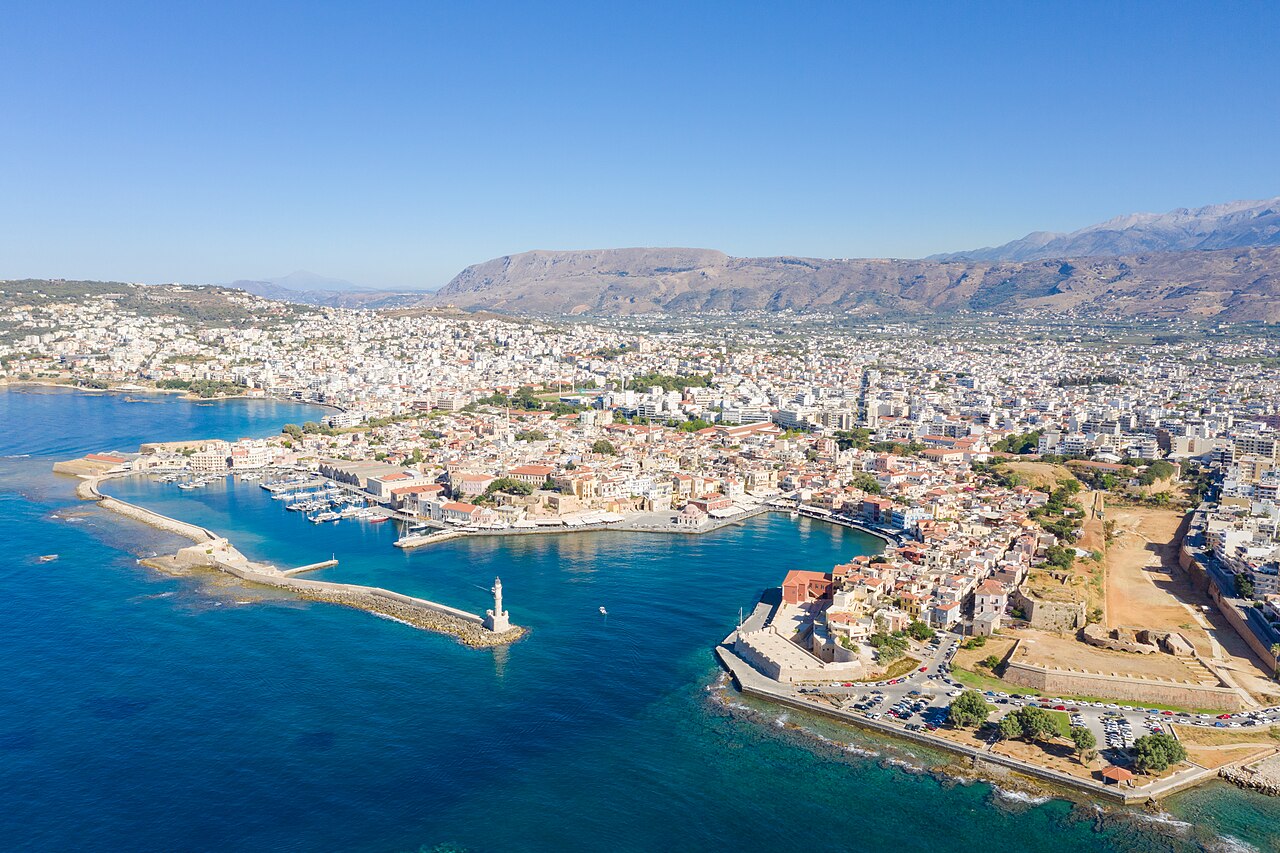
Venetian Harbour, Chania is the heart of Chania's Old Town, enclosed by Venetian walls and a 16th-century lighthouse. It is in Rethymno, Greece. Most visitors spend 45–60 min here. The free Lokali audio guide runs 9 minutes.
✓ Verified August 2026 · how we write these guides
Visitor facts
| Time needed | 45–60 min |
|---|---|
| Lokali audio guide | 9 min · free |
| Type | Landmark |
| Best for | Photography |
| Location | Rethymno, Greece |
| Languages | 45, in the Lokali app |
The story
Stand at the harbour's edge and listen — the slap of water against stone, the creak of mooring ropes, the low hum of conversation from the cafés behind you. The light here is different from the rest of Crete, softer somehow, filtered through salt air and the pale ochre of old Venetian walls that curve around the water like protective arms.
This harbour has been working for more than two thousand years. The Minoans traded here, the Romans deepened it, but the shape you see now — the long outer mole, the lighthouse at its tip, the vaulted arsenals lining the eastern quay — that is Venice's doing. In the early thirteenth century, after the Fourth Crusade carved up the Byzantine Empire, Crete fell to Venetian merchants. They rebuilt Chania as La Canea, a fortified port to control the eastern Mediterranean grain and wine routes. For four centuries, galleys loaded with Cretan wheat and Malvasia wine left this harbour for Venice, Constantinople, Alexandria.
Walk along the western quay and you will pass beneath buildings that still wear their Venetian bones — tall narrow facades with arched doorways, stone lintels carved with the winged lion of Saint Mark, though many have been plastered over and painted in shades of rose and honey and faded terracotta. The Ottomans took Chania in sixteen fifty-five after a two-month siege, and they left their own marks — a minaret rising behind the harbour, a domed mosque at the eastern corner of the quay, Turkish wooden balconies overhanging the water. The layers sit together without fighting.
The lighthouse is the harbour's anchor point, a slender tower of honey-coloured stone standing at the end of the long breakwater. It was built by the Venetians, rebuilt by the Egyptians in the eighteen-thirties during their brief occupation of Crete, and restored again in the late twentieth century. The walk out to it takes fifteen minutes along the broad stone mole, and the view back toward the town — the curve of the old quarter rising in tiers, the White Mountains behind — is one of the finest in the eastern Mediterranean. Go at sunset if you can. The light turns the limestone gold, and the water between the breakwaters goes flat and mirror-still.
On the eastern side of the harbour, a long row of vaulted stone sheds runs parallel to the water. These are the Venetian arsenals, shipyards where galleys were built and repaired under cover. Chania had more than twenty of them at the height of Venetian power. A few have been restored and now house exhibitions and workshops, but most are shuttered, their interiors dim and cool, smelling of old stone and seawater. The arches are perfect semicircles, each one wide enough to shelter a galley's hull. Stand inside one and the acoustics change — your footsteps echo, voices carry strangely, the noise of the harbour outside becomes muffled and distant.
The harbour is still a working port, though the cargo now is mostly tourists and day-trippers rather than grain and wine. Fishing boats tie up along the inner quay in the early morning, and by mid-morning the catch is sold. Small ferries run to Agia Marina and Stavros. The water is clean enough that you will see fish darting in the shallows near the quay wall, and sometimes an octopus clinging to the stones just below the surface. The Cretans have fished these waters for three thousand years, and they still do.
In summer the harbour is crowded, the waterfront restaurants full from noon until midnight, but the early morning and late evening are quieter. The best light for photographs is in the first hour after sunrise, when the eastern quay is in shadow and the western side glows. The stone changes colour as the day moves — pale grey at dawn, warm honey at midday, deep amber at dusk. If you are here in winter, the harbour empties of tourists and you will have the breakwater almost to yourself. The wind is sharper, the light harder, but the bones of the place show more clearly.
The neighbourhood behind the harbour — the old town, the Kastelli district — is a maze of narrow lanes and small squares, Turkish fountains and Venetian doorways, bougainvillea spilling over whitewashed walls. It is easy to lose yourself in it, and worth doing. The harbour is the postcard view, but the streets behind it are where the city still lives.
Before you leave, walk out onto the breakwater one more time. Feel the stone under your feet, worn smooth by centuries of footsteps. Look back at the town rising in layers from the water — Minoan, Roman, Venetian, Ottoman, Greek. The harbour has outlasted all of them, and it is still here, still working, still beautiful. That is what makes a place worth remembering.
Key facts
What to look for
Practical tips
Common questions
How long do you need at Venetian Harbour, Chania?
Plan 45–60 min. That is the time most visitors spend at Venetian Harbour, Chania. The free Lokali audio guide adds about 9 minutes of narration you can listen to as you walk, so it fits inside your visit rather than adding to it.
Is there a free audio guide to Venetian Harbour, Chania?
Yes — the Lokali app narrates Venetian Harbour, Chania free of charge in 50+ languages. It covers the history, what to look for on site and practical tips, and it works offline once downloaded.
What should you know before visiting Venetian Harbour, Chania?
Walk to the lighthouse at sunset for the best views.
What is Venetian Harbour, Chania known for?
Venetians controlled Chania for four centuries after twelve-oh-four.
What is the best time to visit Venetian Harbour, Chania?
The lighthouse's red-and-white paint is iconic in postcards.
More to see in Rethymno


Hear Venetian Harbour, Chania in your language
The full story, narrated, in 50+ languages. Download it before you go and it plays offline, at your own pace, with no ticket and no tour group.