
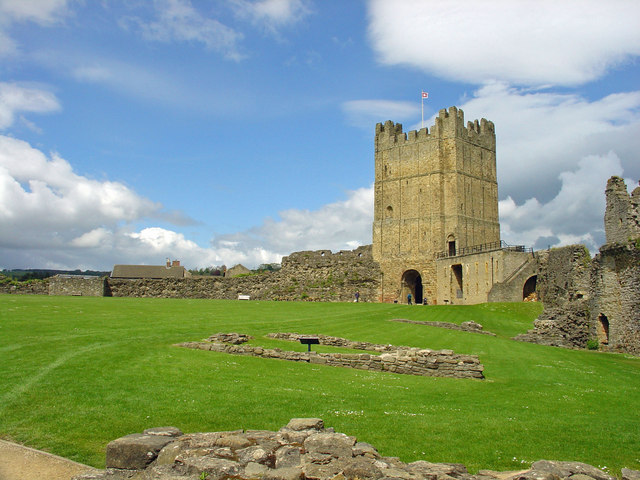
Photo: CJW · Attribution · Wikimedia Commons
Middleham Castle is a castle in Middleham, North Yorkshire, England, UK. Stone castle begun in the late twelfth century. The free Lokali audio guide runs 6 minutes.
✓ Published October 2026 · how we write these guides
Visitor facts
| Lokali audio guide | 6 min · free |
|---|---|
| Type | Castle |
| Location | Richmond, United Kingdom |
| Coordinates | 54.2840, -1.8069 |
| Official website | english-heritage.org.uk |
| Languages | 50+, in the Lokali app |
The story
Listen first. The wind moves across Wensleydale and catches in the broken windows high above you. Underfoot, the grass is soft and the old stone is cool to the touch. Somewhere beyond the walls, you may hear hooves on the road, because this small town still trains racehorses. Rooks call from the trees. Then you look up, and the walls of Middleham Castle rise in front of you, grey and gold, open to the sky.
You are a short drive southwest of Richmond, in the Yorkshire Dales. Middleham sits on a slope above the meeting of two rivers, the Ure and the Cover. That position is no accident. From here, the lords of the castle could watch the routes through the dale. Whoever held this hill held a key point in the north of England. The town grew up around the castle gate, and it still feels close to it today.
But this was not the first castle here. Walk a few hundred metres to the southwest, and you will find a grassy mound called William's Hill. It is the earthwork of an earlier castle, built soon after the Norman Conquest of 1066. That first castle was a motte and bailey, which means a timber tower on a raised mound, with a fenced yard below. Most visitors never go and see it. It is worth the short walk.
The stone castle you see now began in the late twelfth century. Its builder was Robert Fitz Randolph, a local Norman lord. At its heart he placed the great keep, the large rectangular block in the centre. This keep is one of the largest in England. Its walls are very thick, and they were designed to hold out against attack. Over the following centuries, other owners added the outer walls and towers around it.
In 1270, the castle passed by marriage to the Neville family. The Nevilles became one of the most powerful families in northern England. They turned Middleham from a fortress into a grand household. They added more rooms, more comfort, and more space for guests and servants. A great lord in the Middle Ages travelled with a large company, and he needed a home that could feed and house them all.
The most famous Neville was Richard Neville, Earl of Warwick. History remembers him as the Kingmaker. During the Wars of the Roses, the long civil war between the houses of York and Lancaster, he helped to place kings on the throne and to remove them. Here is a surprise. In 1469, Warwick held King Edward the Fourth as a prisoner, for a short time, inside these walls. The king of England was a captive in this quiet dale.
And here is a second surprise. A boy who later became one of England's most debated kings grew up partly here. Richard, Duke of Gloucester, younger brother of Edward the Fourth, came to Middleham as a youth. He trained in the household of the Earl of Warwick. He learned to ride, to fight, and to behave as a nobleman. Years later, he married Warwick's daughter, Anne Neville, and made Middleham one of his main homes.
That boy became King Richard the Third in 1483. His only legitimate son, Edward of Middleham, is believed to have been born here. Edward died in 1484, still a child, and the castle is linked with that loss. The next year, Richard died at the Battle of Bosworth. After that, the castle belonged to the Crown. Slowly, it lost its importance, and by the seventeenth century it had fallen into ruin.
Now stand in the centre of the keep. Look at the walls and try to picture the floors that are missing. The main hall stood on the upper level, above storerooms and kitchens. You can still see the openings of windows, the lines of fireplaces, and the slots where wooden beams once rested. A viewing platform lets you climb up and look down into the shell. From there, the plan of the building becomes much easier to read.
Move out into the space between the keep and the outer walls. This narrow area was once crowded with life. Around the edges stood lodgings, a bakehouse, a brewhouse, and private rooms for the family and their officers. Look for the small stone chutes in the walls. These were latrines, the medieval toilets. They are a reminder that this was a home where people ate, slept, and lived every day, and not only a place of war.
The stone itself is worth a close look. It is local sandstone and limestone, and it changes colour as the light moves. On a dull day it looks grey and hard. In late afternoon sun it turns warm, almost honey coloured. You can see patches of different stone where walls were repaired or rebuilt. You can also see places where people took stone away for other buildings after the castle fell out of use.
When you leave, walk through the town. Middleham has two small market squares. In one of them stands an old stone monument called the Swine Cross. Its carving is badly worn. Locals often say it shows a boar, the white boar badge of Richard the Third, but no one can be fully sure. Early in the morning, you may also see strings of racehorses walking up toward the gallops on the moor.
Before you go, turn back for one more look. The keep stands without a roof, and the sky fills the spaces where the great hall once was. Kings and children, servants and soldiers, all walked across this same patch of ground. Now there is wind, grass, birdsong, and the sound of your own footsteps on the stone. Take a moment here. Then walk out into the dale, and let the castle stay behind you on its hill.
Key facts
What to look for
Practical tips
Common questions
Is there a free audio guide to Middleham Castle?
Yes — the Lokali app narrates Middleham Castle free of charge in 50+ languages. The guide runs about 6 minutes, covers the history, what to look for on site and practical tips, and works offline once downloaded.
Where is Middleham Castle?
Middleham Castle is near Richmond, United Kingdom, at 54.2840, -1.8069. Tap the map link on this page for directions from where you are.
What is Middleham Castle known for?
Stone castle begun in the late twelfth century. Builder was the Norman lord Robert Fitz Randolph.
What should you look for at Middleham Castle?
Empty window openings high in the keep's walls. Stone latrine chutes built into the outer walls. Beam slots marking where lost floors once stood.
What should you know before visiting Middleham Castle?
Walk southwest to William's Hill to see the earlier castle. Climb the viewing platform to read the keep's layout.
When is the best time to visit Middleham Castle?
Come in late afternoon for warm light on the stone.
On the map
Opens directions to Middleham Castle from your location.
More to see near Middleham Castle



Hear Middleham Castle in your language
The full story, narrated, in 50+ languages. Download it before you go and it plays offline, at your own pace, with no ticket and no tour group.