
Photo: Bob Weyker · CC BY-SA 3.0 · Wikimedia Commons
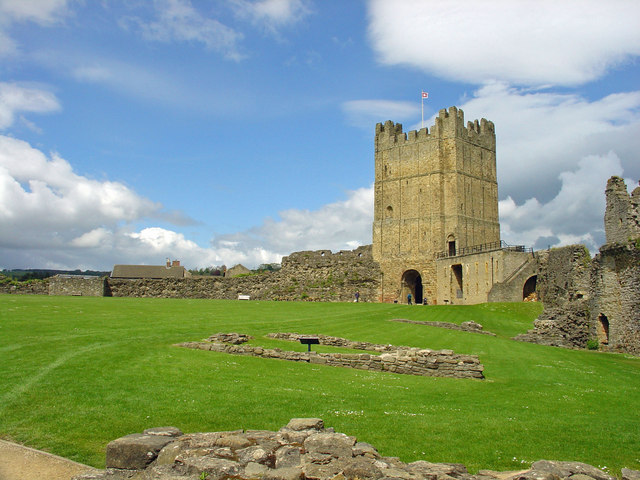
Bolton Castle is a 14th-century castle located near Wensleydale, Yorkshire, England. Sir Richard le Scrope received a licence to fortify in 1379. The free Lokali audio guide runs 7 minutes.
✓ Published October 2026 · how we write these guides
Visitor facts
| Lokali audio guide | 7 min · free |
|---|---|
| Type | Museum |
| Location | Castle Bolton with East and West Bolton, United Kingdom |
| Coordinates | 54.3221, -1.9499 |
| Official website | boltoncastle.co.uk |
| Languages | 50+, in the Lokali app |
The story
Stand still for a moment and listen. Wind moves across the open fields of Wensleydale, and somewhere a sheep calls from the hillside. In front of you, grey stone walls rise straight out of the grass. The stone is rough under the hand, cool even on a bright day. This is Bolton Castle, and it has watched over this valley for more than six hundred years.
The castle sits at the edge of a small village, also called Castle Bolton. The village is little more than a single street of stone cottages with a long strip of green between them. Many of them were built for people who worked for the castle and its estate. So the castle and the village grew up together, and they still share the same quiet hillside above the dale.
The man behind all this was Sir Richard le Scrope. He was a soldier and a powerful royal official in the late fourteenth century. He served as Lord Chancellor of England under King Richard the Second, one of the highest offices in the land. In 1379 he received a royal licence to fortify his manor here. That licence was official permission to build battlements, and it was a mark of real status.
The work took close to twenty years. By the end of the fourteenth century the castle was finished. Records connect the building to a master mason named John Lewyn, who worked on other great buildings across northern England. What he produced was a new kind of castle for its time. It was not a round keep on a mound, but a strong, comfortable rectangle built around a courtyard.
Look at the shape in front of you. There are four tall corner towers, linked by long ranges of rooms. Together they enclose a central courtyard. Historians call this a quadrangular castle. It was built to look strong, but it was also built for living. Inside there were halls, kitchens, private chambers, a chapel and storerooms, all arranged so that a great household could run smoothly.
Here is a detail many visitors miss. The Tudor traveller John Leland visited in the sixteenth century and wrote about the chimneys. He noted that smoke from the fires was carried away through passages inside the thick walls, rather than simply drifting through the rooms. For a medieval building, that was a sign of real comfort. A lord who could keep his hall clear of smoke was a lord with money and ambition.
The most famous guest at Bolton Castle did not come willingly. In 1568, Mary, Queen of Scots, fled from Scotland into England. Her cousin, Queen Elizabeth the First, did not trust her. Mary was moved from Carlisle to Bolton and held here for about six months. She arrived with servants and ladies, and the household had to borrow furniture and hangings to make the rooms fit for a queen.
Local people still tell a story about her stay. Legend has it that Mary climbed out of a window and slipped away across the moor. According to the tale, she was caught on the hillside near Leyburn, at a spot locals call the Queen's Gap. There is no firm evidence that this escape really happened. But the story has lasted for centuries, and you can see why. Look out at that wide, open country and imagine trying to run across it.
The castle's next great test came in the seventeenth century, during the English Civil War. The war split the country between supporters of King Charles the First and supporters of Parliament. Bolton Castle held out for the King. Parliamentary forces besieged it for many months, and the garrison inside slowly ran short of food. In 1645 the defenders finally surrendered. After the war, the castle was deliberately damaged so that it could never be used as a fortress again.
That damage explains much of what you see today. Walk around the outside and you will notice that the castle is not complete. Part of the north-east tower is missing. That tower had already been weakened, and it finally collapsed during a storm in the eighteenth century. The broken edge is still clear in the stone. It is a reminder that this building has lived through war, weather and long years of neglect.
And yet, here is the second surprise. Bolton Castle has never been sold out of the family. It still belongs to descendants of Richard le Scrope, more than six centuries after he began building. Very few castles in England can say that. The family have kept it open and cared for, and many rooms have been restored so that visitors can see how they were once used.
Inside, you can climb narrow stone stairs and walk through rooms on several levels. Look for the deep window seats cut into the walls, and for the worn steps where countless feet have passed. From the upper floors and the battlements, the views open out across Wensleydale. On a clear day you can follow the valley for miles, with its patchwork of fields, dry stone walls and scattered barns.
The castle grounds add another layer to a visit. There are gardens laid out below the walls, and on some days there are displays and activities for families. The castle has also appeared as a film and television location, because so much of its medieval fabric survives. Next to the castle stands the small parish church of Saint Oswald, simple and quiet, and worth a few minutes on your way past.
Before you leave, turn and look at the castle once more. Notice how the colour of the stone changes as clouds pass overhead, from silver to brown to almost green. Listen again to the wind and the sheep. This same view greeted a captive queen, a besieged garrison and generations of the same family. Now it greets you. As you walk back down the village street, the castle will stay in sight behind you for a long time.
Key facts
What to look for
Practical tips
Common questions
Is there a free audio guide to Bolton Castle?
Yes — the Lokali app narrates Bolton Castle free of charge in 50+ languages. The guide runs about 7 minutes, covers the history, what to look for on site and practical tips, and works offline once downloaded.
Where is Bolton Castle?
Bolton Castle is near Castle Bolton with East and West Bolton, United Kingdom, at 54.3221, -1.9499. Tap the map link on this page for directions from where you are.
What is Bolton Castle known for?
Sir Richard le Scrope received a licence to fortify in 1379. Builder served as Lord Chancellor under King Richard the Second.
What should you look for at Bolton Castle?
Missing section of the collapsed north-east corner tower. Deep window seats cut into the thick stone walls. Worn stone steps on the narrow spiral staircases.
What should you know before visiting Bolton Castle?
Climb to the upper floors for long views over Wensleydale. Wear sturdy shoes for narrow, uneven medieval stone stairs.
On the map
Opens directions to Bolton Castle from your location.
More to see near Bolton Castle



Hear Bolton Castle in your language
The full story, narrated, in 50+ languages. Download it before you go and it plays offline, at your own pace, with no ticket and no tour group.