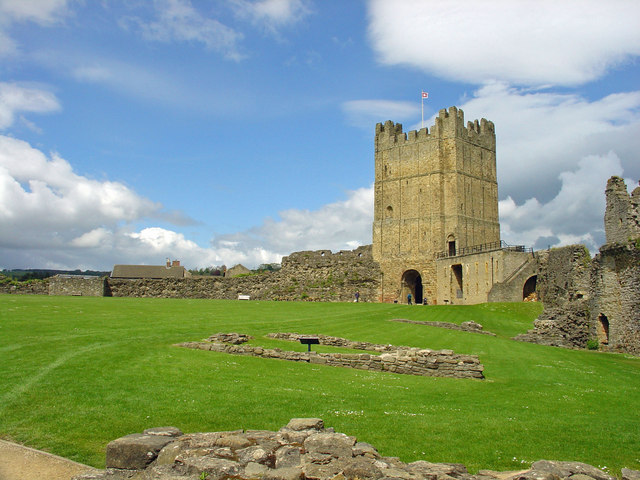
Richmond Castle
54.4022° N · 1.7375° W · Archaeological Site
Photo: Dylan Moore · CC BY-SA 2.0 · Wikimedia Commons
Richmond Castle is an eleventh-century castle built in Richmond, North Yorkshire, England, UK. Founded by the Breton lord Alan Rufus after 1066. The free Lokali audio guide runs 7 minutes.
✓ Published October 2026 · how we write these guides
Visitor facts
| Lokali audio guide | 7 min · free |
|---|---|
| Type | Archaeological Site |
| Location | Richmond, United Kingdom |
| Coordinates | 54.4022, -1.7375 |
| Official website | english-heritage.org.uk |
| Languages | 50+, in the Lokali app |
The story
Stand still for a moment and listen. Far below the curtain wall, the River Swale runs fast over its stony bed, and the sound rises up the cliff to meet you. Underfoot, the grass is soft, but the stones around you are hard, grey, and cold to the touch. Wind comes in from the open hills. This is Richmond Castle, high on a rock above a North Yorkshire market town, and it has watched this valley for more than nine hundred years.
The story begins with the Norman Conquest. After 1066, William the Conqueror gave huge stretches of northern England to his loyal followers. One of them was Alan Rufus, a Breton nobleman whose name means Alan the Red. He chose this triangular spur of rock for his new stronghold. The river and the steep drop protected two sides. He only had to build hard defences on the third. Work started in the decades soon after the Conquest, in the late eleventh century.
Here is the first surprise. Most early Norman castles were built of earth and timber, with wooden towers on raised mounds. Alan Rufus built in stone from the very beginning. That makes Richmond one of the earliest stone castles in England. Look at the long curtain walls around you. Much of that masonry belongs to this first phase. You are touching work laid by builders who could remember the world before the Normans arrived.
This was also a statement of power. Northern England was not peaceful in those years. The local population had risen against Norman rule, and the king had answered with brutal force across the region. A stone fortress on a high rock sent a clear message to everyone in the valley below. The new lords had come to stay. They did not plan to leave.
Now walk toward the southeast corner of the enclosure. Here you will find the remains of Scolland's Hall. It takes its name from Scolland, a man who served the lords of Richmond in the early years. The hall is one of the oldest surviving domestic buildings of its kind in England. Imagine it with a roof, a fire, long tables, and the noise of a household eating together. This was where the castle lived, not only where it fought.
Turn now to the great tower, the keep. It rises above everything else, square and heavy, and it is the shape most people picture when they think of Richmond. It was added in the twelfth century, long after Alan Rufus had gone. And here is the second surprise. The builders did not start from nothing. They raised the keep over the original eleventh-century gateway. If you look closely at the base, you can find the old entrance arch inside the later tower.
That means the keep blocked the castle's first main door. A new entrance had to be made beside it. This kind of rebuilding was common in medieval castles. Lords changed their plans as threats changed, as fashions changed, and as money came and went. Richmond carries those layers openly. Older stone sits under newer stone, and the joins are still visible to a patient eye.
If the keep is open during your visit, climb it. The stairs are narrow, and the walls are thick. At the top, the whole valley opens below you. You can see the river curving through woodland, the rooftops of the town, and the hills rolling away to the west into the Yorkshire Dales. On a clear day, the view runs for many kilometres. You understand at once why a Norman lord wanted this spot.
The castle also gave its name far beyond Yorkshire. The lords of this place held the title Earl of Richmond. In the fifteenth century, that title passed to Henry Tudor, who became King Henry the Seventh. He rebuilt a royal palace beside the Thames near London and called it Richmond, after his old earldom. The London Richmond grew from that palace. Later, other Richmonds around the world followed. Many of them trace their name, in a long chain, back to this rock.
Over the centuries, the fortress slowly lost its purpose. By the late Middle Ages, much of it was falling into ruin. Then, in the nineteenth century, painters and travellers discovered its romantic outline above the river. Artists, including the painter Turner, came to sketch the town and the tower. Later still, the army used the site again, and a barracks and a cell block were added inside the old walls.
That cell block holds one of the most moving stories here. During the First World War, a group of conscientious objectors was held at the castle. These were men who refused to fight on grounds of conscience. They became known as the Richmond Sixteen. While they were locked in the cells, prisoners wrote and drew on the plaster walls. Names, messages, drawings, and words of faith still survive there. The site has been carefully conserved, and it is one of the most human places in the whole castle.
The castle has its folklore too. Legend has it that King Arthur and his knights lie asleep in a cave beneath the rock. According to one tale, a local man named Potter Thompson found them, panicked, and ran, and so the knights still sleep. Locals also tell of a drummer boy sent into a tunnel under the castle. People above followed his drumming until it suddenly stopped. These are stories, not history, but people in Richmond have told them for generations.
Before you leave, walk out to the edge of the walls above the river and look down. The town spreads below, with its wide cobbled market place close to the castle gate. The town grew up around this fortress. The castle protected it, and the market fed it. Today the relationship is gentler. Visitors walk up from the cafés and shops, and the castle gives the town its outline against the sky.
Take one more look around. The grey stones are still here, the river is still running, and the wind still comes in off the hills. Notice the different shades of stone in the walls, the patches of repair, and the old arch inside the keep. When you walk back down into Richmond, turn around once at the bottom of the slope. You will see what travellers have seen for nine centuries — the tower on its rock above the Swale.
Key facts
What to look for
Practical tips
Common questions
Is there a free audio guide to Richmond Castle?
Yes — the Lokali app narrates Richmond Castle free of charge in 50+ languages. The guide runs about 7 minutes, covers the history, what to look for on site and practical tips, and works offline once downloaded.
Where is Richmond Castle?
Richmond Castle is in Richmond, United Kingdom, at 54.4022, -1.7375. Tap the map link on this page for directions from where you are.
What is Richmond Castle known for?
Founded by the Breton lord Alan Rufus after 1066. Among England's earliest castles built in stone from the start.
What should you look for at Richmond Castle?
The old eleventh-century arch at the base of the keep. Faded graffiti on the plaster walls of the cell block. The roofless walls of Scolland's Hall in the southeast corner.
What should you know before visiting Richmond Castle?
Climb the keep for the widest views over the Swale valley. Visit the cell block to see the prisoners' wall graffiti.
On the map
Opens directions to Richmond Castle from your location.
More to see near Richmond Castle


Hear Richmond Castle in your language
The full story, narrated, in 50+ languages. Download it before you go and it plays offline, at your own pace, with no ticket and no tour group.