
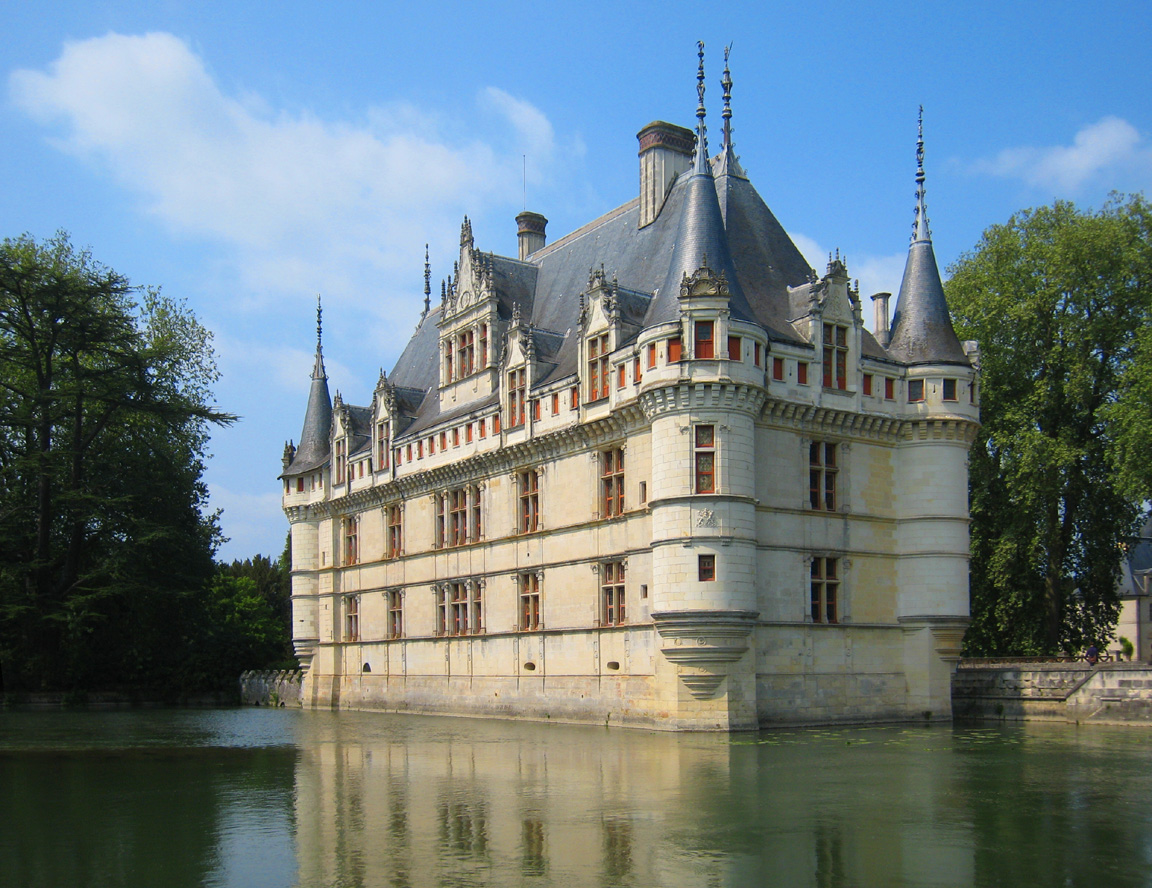
Photo: Carsten Steger · CC BY-SA 4.0 · Wikimedia Commons
Château d'Ussé is a château in France. Tradition links the château to Perrault's Sleeping Beauty. The free Lokali audio guide runs 7 minutes.
✓ Published October 2026 · how we write these guides
Visitor facts
| Lokali audio guide | 7 min · free |
|---|---|
| Type | Chateau |
| Location | Rigny-Ussé, France |
| Coordinates | 47.2497, 0.2911 |
| Languages | 50+, in the Lokali app |
The story
Listen first. Somewhere behind you, the Indre River slides past in a slow, green ribbon. Ahead, the ground rises in terraces. Then the château appears: pale stone, slate roofs the colour of wet charcoal, and a crowd of turrets and pointed towers. Behind it, the dark trees of the Chinon forest climb the slope. The white walls stand out sharply against that green. Many visitors stop here without thinking. They stop because the building looks exactly like the castle they pictured as children.
That feeling has a famous source. Tradition holds that this château inspired the castle in Charles Perrault's version of Sleeping Beauty. Perrault was a seventeenth-century French writer who collected and polished old folk tales. Locals say he stayed in the area and saw these towers above the river. No document proves the link beyond doubt. The château itself welcomes the story. Today it calls itself the Sleeping Beauty castle, and the tale follows you through the visit.
Before the fairy tale, there was a fortress. This hillside has held defences since the Middle Ages, because the position is useful. It sits where the forest meets the valley, near the meeting of the Indre and the Loire. In the fifteenth century the Bueil family rebuilt the castle. Look at the older parts of the building. You can still see the heavy round towers and the machicolations, the overhanging stone galleries that defenders once used to drop missiles on attackers.
Now look at the other side of the château. The mood changes. Over the following generations, owners softened the fortress. Wide windows replaced narrow slits. Dormers with carved stone frames appeared in the roofs. This is the story of many Loire châteaux. As royal power grew stronger, a lord no longer needed walls against his neighbours. He needed a home that showed taste and wealth. Ussé carries both purposes in one building.
One side of the original enclosure is gone. Owners in the seventeenth century removed the north wing to open the courtyard toward the valley. The change matters for the view. Instead of a closed square of walls, the courtyard now looks out over the terraces, the river, and the flat land beyond. Stand in the courtyard and turn toward the open side. You are looking at a decision to choose a view over protection. That choice tells you a great deal about a changing age.
Here is a detail that many visitors miss. The château has a link to Vauban, the great military engineer of Louis the Fourteenth. Vauban designed fortresses all across France. His daughter married into the family that owned Ussé, and he is said to have spent time here. Some accounts connect him with the design of the terraces. So a man famous for star-shaped citadels may have left his mark on a garden made for pleasure.
The terraced gardens step down toward the water in formal lines. They follow the French style, with clipped hedges, gravel paths and geometric beds. Tradition credits the plan to André Le Nôtre, the gardener of Versailles. Historians treat that attribution with some caution, so take it as part of the château's lore. Whoever drew the plan, the effect works best from below. From the river side, the terraces lift the château upward, like a stage set raised above the audience.
Inside, the rooms show the life of a noble house across several centuries. You will pass tapestries, carved furniture, paintings and arms. The rooms change in style as you move through them, from older, darker spaces to lighter, more refined ones. This mix is honest. A family lived here for generations, and each one added and replaced things. The château is still privately owned, and that private character is part of the experience. It feels lived in, not frozen.
Then comes the part that children remember. Climb toward the rampart walk at the top of the towers. Along the way, small rooms hold scenes from Sleeping Beauty, built with costumed wax figures. You will find the princess asleep, the wicked fairy, the prince arriving through the thorns. Adults sometimes smile at the old-fashioned staging. Children usually press close to the glass. Either way, the walk also gives you narrow views through windows across the roofs and the valley.
Take a moment on that high walk to look at the roofs themselves. Up close, the slate is not one flat grey. It shifts between blue, silver and black as the light moves. The chimneys, lanterns and small turrets crowd together at different heights. From the ground they look like a fairy-tale skyline. From here you can see how complicated they are, and how much work it takes to keep water out of a building like this.
After the château, walk out into the park to find the chapel. It stands apart among the trees, built in the sixteenth century. Its style sits between two worlds. The overall shape is still Gothic, with pointed forms, but the decoration at the entrance belongs to the Renaissance, the new Italian taste that reached the Loire valley at that time. Look carefully at the carved stonework around the door. Inside, the chapel holds a glazed terracotta Virgin attributed to the Italian workshop of Luca della Robbia.
Why does Ussé look so complete? Partly because it is still a family home, and partly because of its setting. The village of Rigny-Ussé is small and quiet. There are no high buildings nearby to break the view. The forest behind the château has stayed forest. So the scene you see today is close to the scene a traveller on the river road might have seen centuries ago. That continuity is rare, and it is easy to take for granted.
Before you leave, cross back toward the river and turn around one more time. Notice how the towers catch the light differently from this distance. Notice the sound of the water and the birds in the trees. The fairy tale may or may not have started here. Either way, the building has spent centuries growing into the role. As you walk away, look back once more. The château looks like a story, and you have just walked through it.
Key facts
What to look for
Practical tips
Common questions
Is there a free audio guide to Château d'Ussé?
Yes — the Lokali app narrates Château d'Ussé free of charge in 50+ languages. The guide runs about 7 minutes, covers the history, what to look for on site and practical tips, and works offline once downloaded.
Where is Château d'Ussé?
Château d'Ussé is near Rigny-Ussé, France, at 47.2497, 0.2911. Tap the map link on this page for directions from where you are.
What is Château d'Ussé known for?
Tradition links the château to Perrault's Sleeping Beauty. The Bueil family rebuilt the fortress in the fifteenth century.
What should you look for at Château d'Ussé?
Machicolations projecting below the oldest round towers. The open courtyard side where the north wing stood. Carved Renaissance doorway on the Gothic park chapel.
What should you know before visiting Château d'Ussé?
View the château from the riverbank before going inside. Allow extra time for the separate walk to the chapel.
When is the best time to visit Château d'Ussé?
Climb the rampart walk early to avoid narrow-stair crowds.
On the map
Opens directions to Château d'Ussé from your location.
More to see near Château d'Ussé



Hear Château d'Ussé in your language
The full story, narrated, in 50+ languages. Download it before you go and it plays offline, at your own pace, with no ticket and no tour group.