
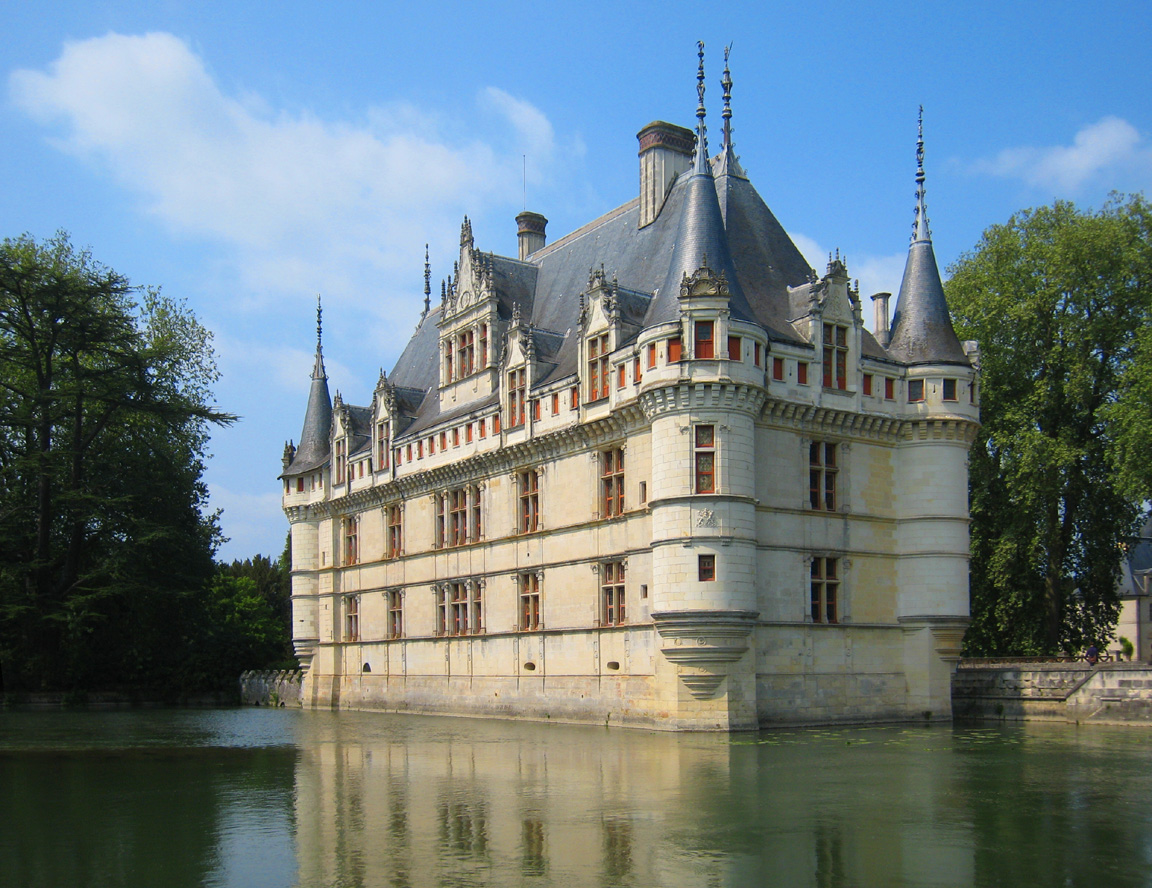
Photo: Carsten Steger · CC BY-SA 4.0 · Wikimedia Commons
Château de Langeais is a castle. It is in Langeais, France. Ruined keep linked to Fulk Nerra, around the year 1000. The free Lokali audio guide runs 7 minutes.
✓ Published October 2026 · how we write these guides
Visitor facts
| Lokali audio guide | 7 min · free |
|---|---|
| Type | Chateau |
| Location | Langeais, France |
| Coordinates | 47.3248, 0.4061 |
| Official website | chateau-de-langeais.com |
| Languages | 50+, in the Lokali app |
The story
Stand in the small square and look up. The walls rise straight out of the town, pale stone above grey slate, with almost no space between the château and the houses around it. You hear footsteps on the cobbles, a café door, perhaps a bicycle bell. Then you see the drawbridge, the two round towers, and the row of stone brackets near the top of the wall. This castle does not sit apart on a hill. It stands in the middle of daily life in Langeais.
Welcome to Château de Langeais, on the north bank of the Loire, west of Tours. Many Loire châteaux are elegant country houses with gardens and wide views. This one is different. From the street side, it still looks like a fortress, built to hold a gate and control a river crossing. But inside, as you will see, it holds one of the most important royal weddings in French history.
The story starts long before these towers. Behind the main building, in the park, stand the ruins of a much older stone keep. It is usually linked to Fulk Nerra, a count of Anjou who lived around the year 1000. His nickname means "Fulk the Black". He was famous for his violent temper and for building strongholds across the region. The ruined keep at Langeais is often described as one of the oldest stone keeps in France.
Think about what that means. Around the year 1000, most castles in western Europe were made of earth and timber. Wood burns, and wood rots. A stone tower was a strong statement of power. Fulk Nerra was at war with the counts of Blois, his neighbours to the east, and Langeais was part of a chain of positions he used against them. Today only parts of the walls survive, but you can still see how thick they were.
Now turn back to the building in front of you. The château you see today is much younger. It was built in the fifteenth century, in the reign of King Louis XI, during the 1460s. The work was led by Jean Bourré, one of the king's most trusted officials. At that time, France was coming out of the long Hundred Years' War against England. The Loire Valley was a frontier of royal power, and the king wanted strong and modern defences along the river.
Look carefully at the top of the walls. You can see a covered walkway running along the edge, with stone brackets underneath. These openings between the brackets are called machicolations. Defenders could drop stones or other projectiles on anyone below. Here is a detail many visitors miss: the walkway at Langeais is unusually long and well preserved. On a guided route you can often walk along part of it and look down onto the rooftops of the town.
Then there is the drawbridge. It is not only decoration. The bridge is still a working mechanism, and it is still the way you enter. As you cross it, look down at the chains and the timber, and listen to the hollow sound under your feet. For a few seconds you follow the same route as soldiers, servants and royal guests five centuries ago.
Inside the walls, the mood changes. The courtyard side of the château is softer, with larger windows and the feeling of a residence. This was typical of its time. On the outside, a castle showed strength. On the inside, it offered comfort. Langeais stands at that moment of change, between the medieval fortress and the more open palaces that the Loire would become famous for in the next century.
And now, the wedding. In December 1491, King Charles VIII of France married Anne, Duchess of Brittany, here at Langeais. Anne was very young, and Brittany was still an independent duchy with its own rulers. This marriage was a political agreement more than a romance. Through Anne and her later marriages, Brittany was drawn step by step into the kingdom of France. A quiet ceremony in this small town helped shape the map of modern France.
Inside the château, one room shows this wedding with life-size figures in period costume. Children often stop and stare at the faces. Adults tend to look at the details: the rich fabrics, the jewels, the way the guests stand around the young couple. It is a reconstruction, of course, not an exact record. But it helps you picture the people behind the political decision, in the same building where it took place.
Here is a second surprise. Much of what you see inside comes from a much later chapter. In the late nineteenth century, the château was bought by Jacques Siegfried, a wealthy businessman. He spent years restoring it and filling it with furniture and tapestries from the late Middle Ages and the Renaissance. He wanted to show how a great house looked in the time of Charles VIII and Anne. In the early twentieth century, he gave the château and its collections to the Institut de France, a national cultural institution that still owns it.
So walk slowly through the rooms. Notice the large tapestries on the walls. They were decoration, but they also kept the stone rooms warmer and quieter. Look at the heavy wooden chests, the high beds, and the tall fireplaces. Look also at the windows and their deep stone seats, where people sat to catch the light. The rooms feel lived in, because Siegfried arranged them that way on purpose.
When you leave, pause again in the square outside. Look at the drawbridge, the towers and the long covered walkway above them. Then turn around and look at the houses that face the château, only a few steps away. A thousand years of building stand in this small space, from Fulk Nerra's broken keep to the café tables at your back. As you walk toward the Loire, listen to the town around you. The fortress was built to hold this place, and the town still lives right at its gate.
Key facts
What to look for
Practical tips
Common questions
Is there a free audio guide to Château de Langeais?
Yes — the Lokali app narrates Château de Langeais free of charge in 50+ languages. The guide runs about 7 minutes, covers the history, what to look for on site and practical tips, and works offline once downloaded.
Where is Château de Langeais?
Château de Langeais is in Langeais, France, at 47.3248, 0.4061. Tap the map link on this page for directions from where you are.
What is Château de Langeais known for?
Ruined keep linked to Fulk Nerra, around the year 1000. Main château built under Louis XI in the 1460s.
What should you look for at Château de Langeais?
Stone brackets of machicolations along the top of walls. The working drawbridge chains and timber deck. Life-size figures recreating the 1491 royal wedding.
What should you know before visiting Château de Langeais?
Walk the covered wall-walk for views over Langeais rooftops. Visit the park to see the ruined medieval keep.
On the map
Opens directions to Château de Langeais from your location.
More to see near Château de Langeais



Hear Château de Langeais in your language
The full story, narrated, in 50+ languages. Download it before you go and it plays offline, at your own pace, with no ticket and no tour group.