
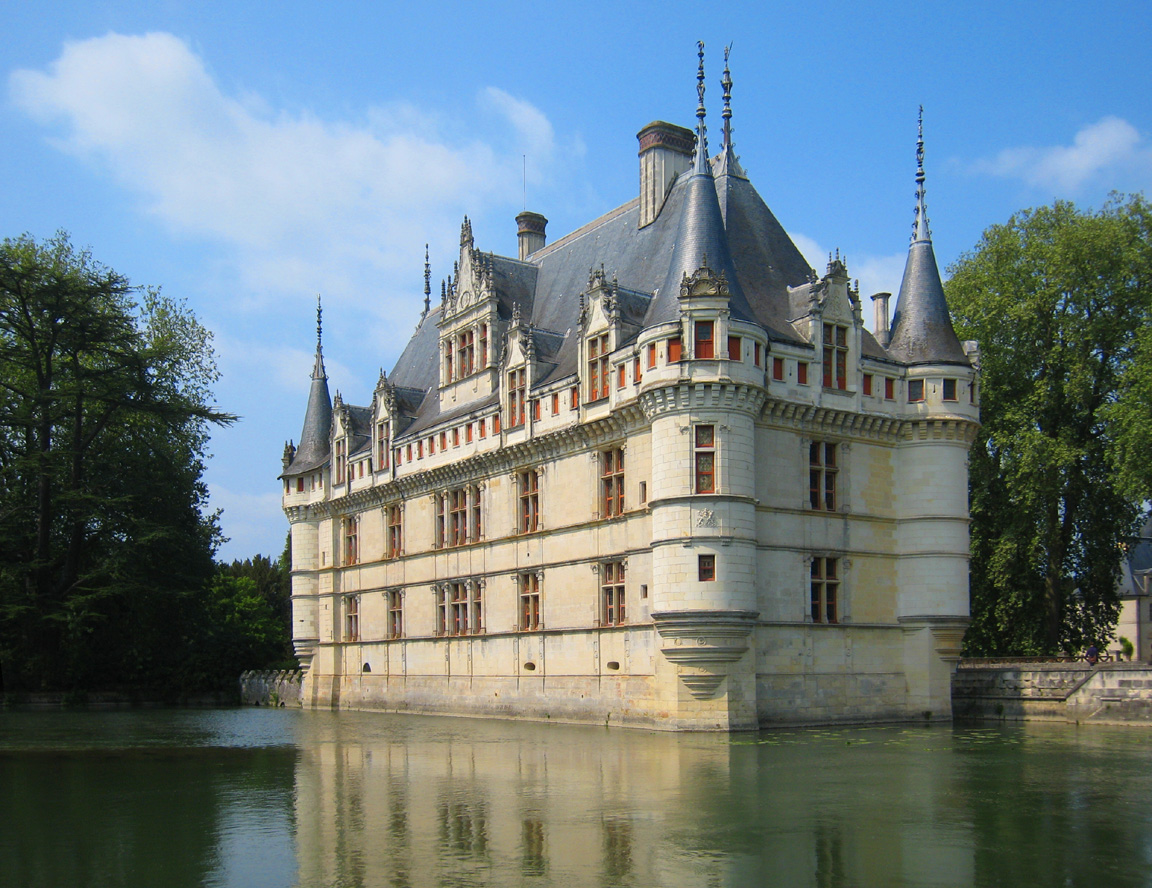
Photo: No machine-readable author provided. LonganimE assumed (based on copyright claims). · CC BY-SA 2.5 · Wikimedia Commons
Château de Villandry is a French Renaissance castle in the Loire Valley. Built around 1536 by finance minister Jean Le Breton. The free Lokali audio guide runs 7 minutes.
✓ Published October 2026 · how we write these guides
Visitor facts
| Lokali audio guide | 7 min · free |
|---|---|
| Type | Chateau |
| Location | Tours, France |
| Coordinates | 47.3405, 0.5145 |
| Official website | chateauvillandry.fr |
| Languages | 50+, in the Lokali app |
The story
Listen first to the gravel. It crunches softly under your shoes, and behind that sound there is almost nothing. A bee, perhaps. A gardener's rake scraping somewhere out of sight. Around you, low hedges of box run in sharp, clean lines. Rows of cabbages sit in blue-green and deep purple. The air smells faintly of cut leaves and damp earth. You are standing in one of the most carefully drawn gardens in France. And yet much of it is only about a century old.
Villandry sits a short drive west of Tours, close to where the Cher river meets the Loire. This stretch of the Loire Valley is famous for its châteaux. Kings and ministers built country houses here during the French Renaissance, the period when Italian ideas about art, order and beauty swept north into France. In 2000, the wider Loire Valley in this area was added to the UNESCO World Heritage list. Villandry is one of its quieter treasures. Its fame comes less from royal drama and more from what grows outside its walls.
The château itself was built around 1536 by Jean Le Breton. He was a finance minister in the service of King Francis the First, the monarch who did so much to bring the Renaissance to France. Le Breton had spent time in Italy, and you can see that influence here. The building is calm and symmetrical. It wraps around a courtyard that opens toward the valley. Pale limestone walls rise beneath steep slate roofs, with tall dormer windows lining the top floor.
Now look for something that does not quite fit. One square tower stands apart from the rest — heavier, plainer, older. This is the keep of a medieval fortress that stood here before Le Breton arrived. He tore down most of the old castle but kept this tower. Perhaps it was cheaper. Perhaps he liked the link to the past. Either way, it is the oldest part of the estate. If the tower is open during your visit, the view from the top is the best way to understand the gardens below.
And those gardens are the real story. Here is the first surprise most visitors miss. For much of the nineteenth century, the formal Renaissance gardens were gone. Owners had replaced them with an English-style landscape park, full of winding paths and natural-looking lawns. That was the fashion of the time. The geometric beds you see today did not survive the centuries. They were rebuilt, almost from scratch, in the early twentieth century.
The man behind that rebuilding was Joachim Carvallo. He was a Spanish-born doctor and scientist who had worked in Paris. In 1906 he bought Villandry with his wife, Ann Coleman, an American heiress. Together they gave up much of their old life to restore the estate. Carvallo studied old drawings and books of Renaissance garden design. He then recreated the spirit of those gardens, rather than an exact copy. The family still owns and runs the château today, more than a century later.
Start with the most famous part — the ornamental kitchen garden, or potager. It is laid out as nine large squares of equal size. Each square holds its own geometric pattern of vegetables and herbs, framed by low box hedges. Leeks, beets, carrots, lettuces and cabbages are chosen for their colours as much as their taste. The idea comes from the gardens of medieval monasteries, where monks grew food in neat, ordered beds. Here, the humble vegetable is treated like a painter's colour.
Notice the small rose trees standing at the corners of the beds. According to a popular explanation, each one represents a monk bending over his plot. It is a charming image, though it is more tradition than recorded fact. What is certain is the hard work behind the beauty. The kitchen garden is replanted twice a year, once for spring and once for autumn. So the patterns and colours change with the seasons. If you came back in another season, you would see a different garden.
Climb a little higher, and you reach the ornamental gardens beside the château. Here the box hedges form shapes with a hidden meaning. One section is often described as the garden of love. Its patterns stand for different kinds of love — tender love, passionate love, fickle love and tragic love. Look for hearts, flames, and shapes that suggest fans or folded letters. Flowers fill the spaces between the hedges, and their colours shift through the year.
Here is a second detail that surprises many people. These gardens were designed to be seen from above. Standing among them, you see only hedges and paths. From a terrace, a window or the tower, the full patterns snap into focus. Renaissance designers thought this way. A garden was a picture, meant to be viewed from the house. So take a moment to find higher ground. The difference is like seeing a carpet from the floor and then from a ladder.
Higher again, you find the water garden. A large pond sits in a frame of lawns and clipped trees. It is sometimes called the mirror, because on a still day it holds a clear reflection of the sky. Water from this pond once fed the moats and the gardens below. Nearby, a maze of hedges invites you to get a little lost. There is also a herb garden, a garden of medicinal plants, and a more recent sun garden with softer, freer planting.
Inside the château, the rooms show the life of the family who saved it. Carvallo brought his Spanish roots with him. One room holds a painted and carved wooden ceiling in the Mudéjar style, a Spanish tradition that blends Islamic and Christian design. It was brought from Spain and installed here. Look up and follow its small geometric panels. It feels far from the Loire, yet it fits the Carvallo story perfectly — a Spanish doctor rebuilding a French dream.
Before you leave, pause on a terrace and look back over the whole estate. The pale stone, the slate roofs, the old tower, the green and purple squares below. Listen again to the gravel, the bees, the quiet work of the gardeners. Everything here is kept in balance by constant care. As you walk away, notice how the straight lines slowly give way to the softer shapes of the village and the river valley beyond.
Key facts
What to look for
Practical tips
Common questions
Is there a free audio guide to Château de Villandry?
Yes — the Lokali app narrates Château de Villandry free of charge in 50+ languages. The guide runs about 7 minutes, covers the history, what to look for on site and practical tips, and works offline once downloaded.
Where is Château de Villandry?
Château de Villandry is near Tours, France, at 47.3405, 0.5145. Tap the map link on this page for directions from where you are.
What is Château de Villandry known for?
Built around 1536 by finance minister Jean Le Breton. Le Breton served King Francis the First.
What should you look for at Château de Villandry?
Nine equal squares of colourful vegetables in the potager. Small rose trees standing at the corners of beds. Heart and flame shapes in the box hedges.
What should you know before visiting Château de Villandry?
Climb to a terrace for the full view of garden patterns. Visit in spring or autumn to see fresh plantings.
When is the best time to visit Château de Villandry?
Visit in spring or autumn to see fresh plantings.
On the map
Opens directions to Château de Villandry from your location.
More to see near Château de Villandry



Hear Château de Villandry in your language
The full story, narrated, in 50+ languages. Download it before you go and it plays offline, at your own pace, with no ticket and no tour group.