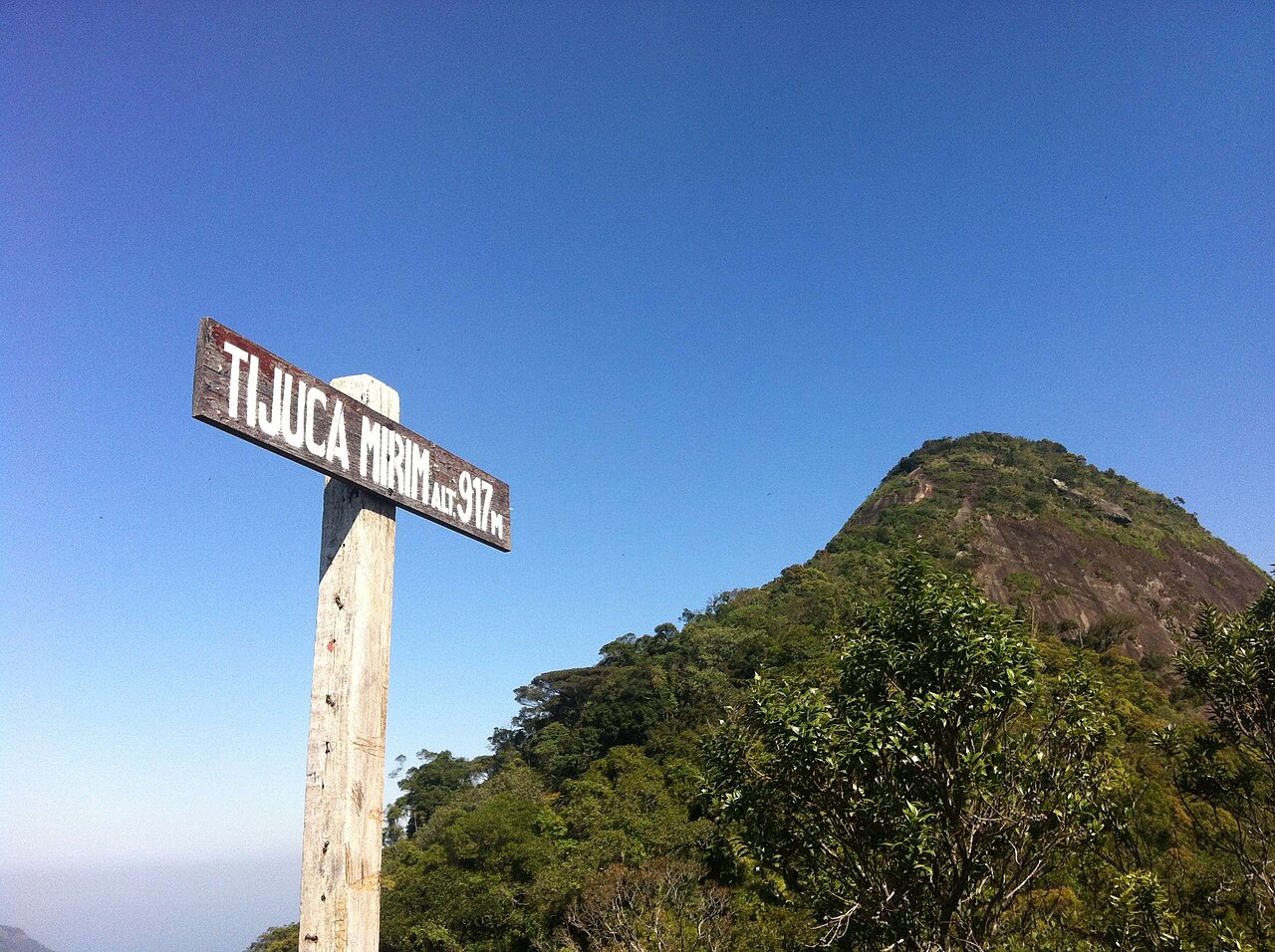
Pico da Tijuca is the highest point within Tijuca Forest at 1,021 metres, offering 360-degree views of Rio, the surrounding mountains, and the coast. It is in Rio de Janeiro, Brazil. Most visitors spend 3–4 hours here. The free Lokali audio guide runs 5 minutes.
✓ Verified August 2026 · how we write these guides
Visitor facts
| Time needed | 3–4 hours |
|---|---|
| Lokali audio guide | 5 min · free |
| Type | Peak |
| Best for | Editors' pick |
| Location | Rio de Janeiro, Brazil |
| Coordinates | -22.9830, -43.3433 |
| Languages | 45, in the Lokali app |
The story
Birdsong surrounds you before the climb begins. The air under the trees is damp and green, and the light arrives in patches where the canopy breaks. You are standing at the foot of a trail that leads to the highest summit in the Tijuca Forest, a little over a thousand meters above the sea. The path ahead climbs steadily through the woods. Take a breath of the cool, wet air, and start up.
This whole mountain is covered in forest, and the forest has a story worth knowing. Much of it was replanted by hand in the nineteenth century, after the original trees were cleared for coffee farms. Workers set seedlings into the bare slopes over many years. What grows around you now is the result of that long effort, a forest brought back on purpose.
The trail rises in switchbacks, crossing small streams and passing over roots worn smooth by countless feet. In places the ground is rocky and uneven, so watch your step. The sounds change as you climb. Traffic fades. Insects and birds take over. Now and then the trees open and you catch a quick view of the city far below, a reminder of how high you are going.
You may not be alone on this path. Small monkeys move through the branches overhead, and brightly colored birds dart between the trees. Lizards rest on warm rocks. None of this is arranged for visitors. It is simply the life of the forest, going on around you as you pass through it. Listen for rustling in the leaves above and movement at the edge of the trail. The animals here are used to walkers but keep their distance. Give them room, and they will carry on as if you were not there.
As you near the top, the trail grows steeper and the trees grow shorter. The air feels lighter and the wind picks up. You begin to sense the open sky just ahead, beyond the last rise. This is where the walk becomes a climb, and where the final stretch waits.
The last section is the part people remember. A long staircase has been cut directly into the granite of the mountain, climbing the bare rock toward the summit. Metal handrails and chains are fixed alongside to steady you. Take these steps slowly. The stone can be slick when wet, and there is no need to rush the final minutes of a long walk.
Then the steps end, and the trees are gone, and you are standing on open rock with sky on every side. The summit is small and exposed. The wind moves freely here. After the closed green world of the forest, the sudden openness can be startling. Find your footing, and then look around.
From the top the city lies spread below in every direction. You can pick out beaches, the wide bay, distant hills, and the ocean stretching to the horizon. On a clear day you may see the figure of Christ the Redeemer standing on its own peak across the forest, smaller from here than you might expect. The whole landscape of Rio arranges itself beneath you.
Take your time naming what you see. The long curve of water, the dense green of the park you just climbed through, the gray spread of the city at the forest's edge. From this height the boundary between wild land and built land is easy to read. The forest holds the high ground; the city fills the flat land below.
It is worth remembering that everyone on this summit walked up to reach it. There is no railway and no road to the top of this peak. That effort is part of what makes the place feel quiet. The crowds that gather at easier viewpoints do not reach here, and the summit keeps a stillness because of it.
Soon you will turn and start back down, and the descent asks for as much care as the climb. The same steps that lifted you up will need slow feet on the way down. But for now there is no hurry. The view is yours for as long as your legs want to rest.
Sit for a while on the warm rock before you go. The wind, the height, the long green slopes falling away below, all of it earned one step at a time. Some views are handed to you at the end of a short ride. This one you carried yourself, all the way up, and it feels different for that.
Key facts
What to look for
Practical tips
Common questions
How long do you need at Pico da Tijuca?
Plan 3–4 hours. That is the time most visitors spend at Pico da Tijuca. The free Lokali audio guide adds about 5 minutes of narration you can listen to as you walk, so it fits inside your visit rather than adding to it.
Is there a free audio guide to Pico da Tijuca?
Yes — the Lokali app narrates Pico da Tijuca free of charge in 50+ languages. It covers the history, what to look for on site and practical tips, and it works offline once downloaded.
Where is Pico da Tijuca?
Pico da Tijuca is in Rio de Janeiro, Brazil, at -22.9830, -43.3433. Tap the map link on this page for directions from where you are.
What should you know before visiting Pico da Tijuca?
Wear shoes with grip for slick rock steps.
What is Pico da Tijuca known for?
Highest summit in the Tijuca Forest, just over 1,000 meters.
What is the best time to visit Pico da Tijuca?
The final ascent is steep and rocky.
On the map
Opens directions to Pico da Tijuca from your location.
More to see in Rio de Janeiro


Hear Pico da Tijuca in your language
The full story, narrated, in 50+ languages. Download it before you go and it plays offline, at your own pace, with no ticket and no tour group.