
Basilica of Neptune
41.8983° N · 12.4771° E · Archaeological Site
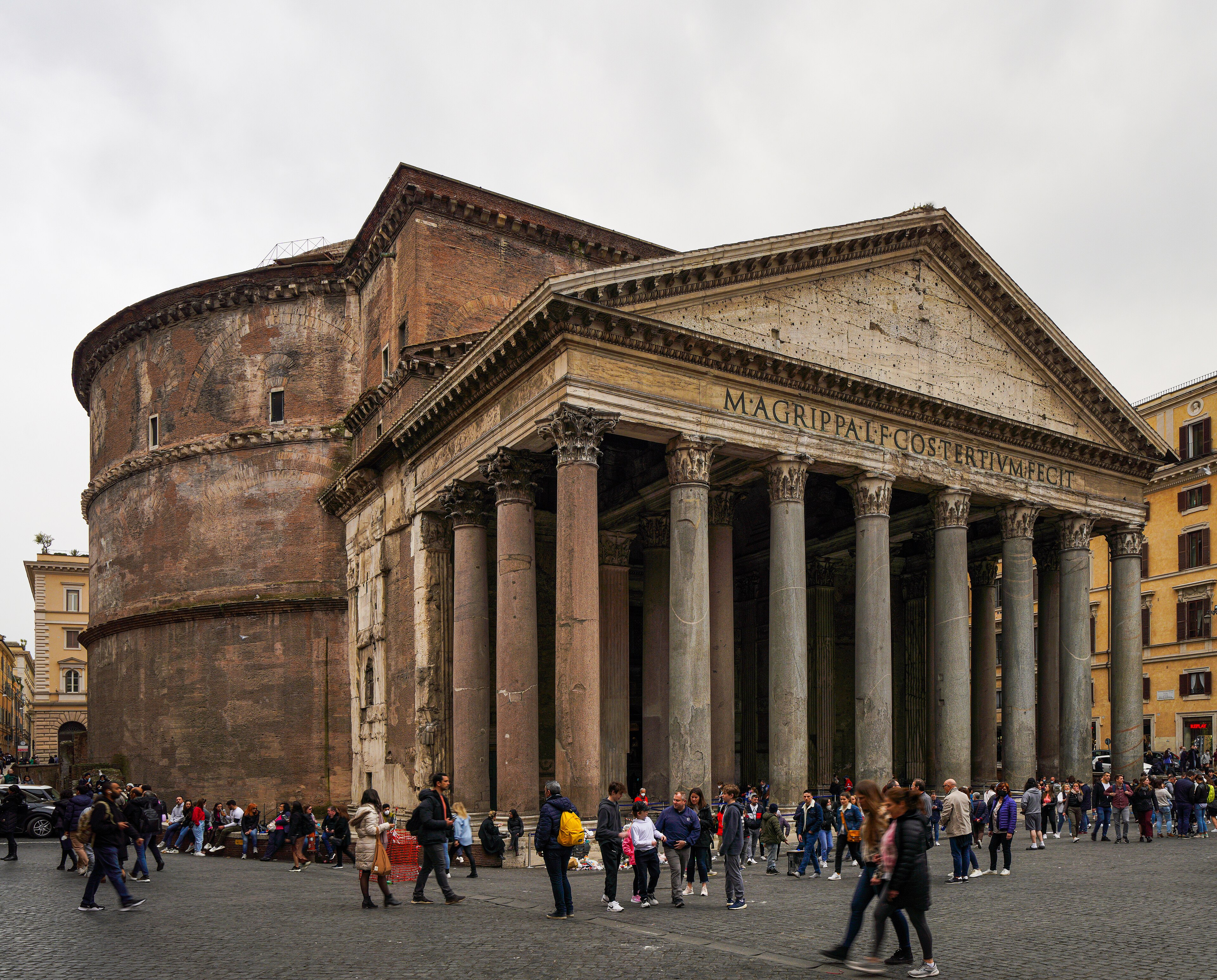
Photo: Remi Jouan · CC BY-SA 3.0 · Wikimedia Commons
Basilica of Neptune is a roman basilica in honour of Neptune. It is in Rome, Italy. Original Neptune building linked to Marcus Agrippa, Augustus's admiral. The free Lokali audio guide runs 7 minutes.
✓ Published October 2026 · how we write these guides
Visitor facts
| Lokali audio guide | 7 min · free |
|---|---|
| Type | Archaeological Site |
| Location | Rome, Italy |
| Coordinates | 41.8983, 12.4771 |
| Languages | 50+, in the Lokali app |
The story
Stand still for a moment behind the Pantheon. The noise of Piazza della Rotonda fades into a narrow lane of cobblestones. Here the air is cooler and shaded. In front of you, below the level of the modern street, rises a wall of old Roman brick. It is warm orange in some places and almost brown in others. Look up along that wall, and you will see a band of pale marble. It carries carved dolphins, tridents and shells.
This is the Basilica of Neptune, or what remains of it. Most people walk past without a second look. They have just seen the great dome of the Pantheon, and their eyes are still full of it. But this quiet fragment belongs to the same story. In fact, it was part of the same ancient neighbourhood of temples, baths and public halls. That neighbourhood grew up on the open plain the Romans called the Campus Martius, the Field of Mars.
To understand why a hall in the middle of Rome was named for the god of the sea, we need to meet one man. His name was Marcus Agrippa. He was the closest friend and the most trusted general of Augustus, the first Roman emperor. Agrippa commanded the fleet that won the naval battle of Actium in 31 BC. That victory made Augustus the master of the Roman world.
Agrippa did not forget the sea that had made his name. In the years after Actium, he transformed this part of the Campus Martius. He built public baths, gardens, an artificial lake and the first Pantheon. Ancient writers also mention a building connected to Neptune among his projects. The ancient name points to the sea as the source of Rome's new peace.
Now look again at the brick wall in front of you. Here comes the first surprise. This is almost certainly not Agrippa's building. Fire swept through the Campus Martius in the year 80, and many of these structures were damaged. In the early second century, the emperor Hadrian rebuilt the area on a grand scale. The wall you see today belongs to that Hadrianic reconstruction.
Hadrian was a great builder, and he was also a modest one in an unusual way. When he rebuilt the Pantheon, he kept Agrippa's name in the inscription on the front, not his own. Walk around to the portico later and you can still read it in large bronze letters. The same spirit seems to run through this whole quarter. Hadrian rebuilt Agrippa's world and kept Agrippa's memory alive.
The word basilica can confuse modern visitors. Today we hear it and think of a church. For the ancient Romans, a basilica was simply a large covered hall. It was a public space for meetings, business, and sometimes law courts. The Christian churches of later centuries borrowed this shape, and they borrowed the name too. So this building was never a church. It was a grand indoor public room.
Scholars believe the interior was a single wide hall. Its walls held deep niches, and a heavy vaulted ceiling covered the space. Those niches may once have held statues. The brick you see was probably faced with marble when the building was new. Imagine the surfaces polished and pale, with light falling from high windows. The rough orange wall is the skeleton. The skin of marble has gone.
Now for the detail that rewards a careful eye. Find that band of carved marble near the top of the surviving wall. This is the frieze, a decorated strip that runs along the top of a building. Follow it slowly from left to right. You will see dolphins with curled tails. You will see the three-pronged trident of Neptune. And you will see the ribbed fan of scallop shells, repeated in rhythm.
These carvings are the second surprise. They are the clearest sign of the building's dedication to the sea. Even after nearly two thousand years, the dolphins still look playful. The carvers worked with confidence, and the stone still shows sharp edges in places. Above the frieze, look for a projecting cornice. A cornice is a ledge of moulded stone that crowns a wall. Its deep shadows change through the day.
Notice also how far below you the ancient ground lies. Rome has risen over the centuries. Floods from the Tiber River, collapsed buildings and new construction all added layers of earth. The city you walk on today sits several metres above the Rome of Hadrian. This is why the ruin appears to sink into the ground. You are not looking down into a pit. You are looking down into an earlier city.
Look around at the buildings that press against the ruin. Later Romans did not clear these ancient walls away. They built on top of them and beside them. Over the centuries, homes, workshops and palaces leaned on Roman brick. The lane around you shows this layering clearly. The ancient wall is not set apart like a museum object. It is still part of the street, part of the everyday life of the city.
If you have a few more minutes, walk slowly along the railing. The wall changes as you move. The brick courses show patches and repairs from different periods. Some sections look smooth. Others are broken and open. Behind this ruin lay the Baths of Agrippa, and some scattered remains of that complex survive in the streets nearby. The whole quarter is full of these broken pieces of one large ancient plan.
Before you go, look one more time at the dolphins on the frieze. Behind you, tourists gather under the Pantheon's dome. In front of you, a quiet wall stands with marble sea creatures above the noise of the modern city. As you walk back toward the piazza, listen to your footsteps on the cobblestones. Somewhere far below them, the floor of Hadrian's hall still rests in the dark.
Key facts
What to look for
Practical tips
Common questions
Is there a free audio guide to Basilica of Neptune?
Yes — the Lokali app narrates Basilica of Neptune free of charge in 50+ languages. The guide runs about 7 minutes, covers the history, what to look for on site and practical tips, and works offline once downloaded.
Where is Basilica of Neptune?
Basilica of Neptune is in Rome, Italy, at 41.8983, 12.4771. Tap the map link on this page for directions from where you are.
What is Basilica of Neptune known for?
Original Neptune building linked to Marcus Agrippa, Augustus's admiral. Agrippa's fleet won the naval battle of Actium, 31 BCE.
What should you look for at Basilica of Neptune?
Carved dolphins with curled tails along the marble frieze. Neptune's three-pronged trident repeated in the carving. Ribbed scallop shells set between the dolphins.
What should you know before visiting Basilica of Neptune?
Walk behind the Pantheon to Via della Palombella to find it. Visit after the Pantheon to connect both buildings' stories.
When is the best time to visit Basilica of Neptune?
Come in morning shade for softer light on the brick.
On the map
Opens directions to Basilica of Neptune from your location.
More to see in Rome


Hear Basilica of Neptune in your language
The full story, narrated, in 50+ languages. Download it before you go and it plays offline, at your own pace, with no ticket and no tour group.