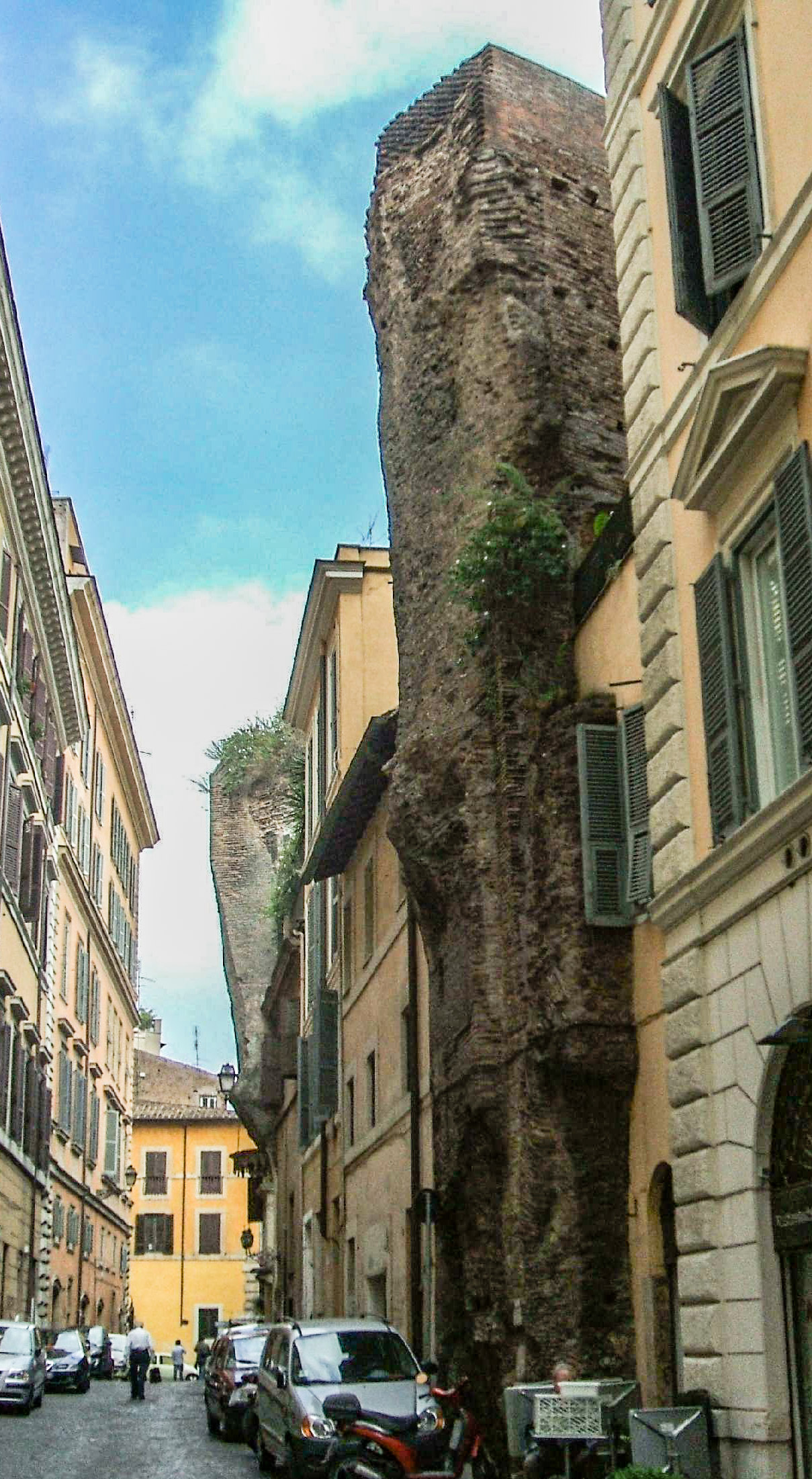
Baths of Agrippa
41.8969° N · 12.4770° E · Archaeological Site
Photo: SkiDragon · CC BY-SA 2.5 · Wikimedia Commons
Baths of Agrippa is an architectural structure in Rome. Built by Marcus Agrippa, friend and son-in-law of Augustus. The free Lokali audio guide runs 7 minutes.
✓ Published October 2026 · how we write these guides
Visitor facts
| Lokali audio guide | 7 min · free |
|---|---|
| Type | Archaeological Site |
| Location | Rome, Italy |
| Coordinates | 41.8969, 12.4770 |
| Languages | 50+, in the Lokali app |
The story
Stand still for a moment on this narrow lane and look up. Above the parked scooters and the shuttered doorways, a great curve of old brick bends through the modern buildings. It is a little like a giant bracelet, half buried in plaster and window frames. The air here is cool and slightly damp, and the sound of footsteps bounces off the walls. This curve is almost all that remains of the Baths of Agrippa, the first great public baths of ancient Rome.
Locals have their own name for it. They call it the Arco della Ciambella, which means the Arch of the Ring Cake. A ciambella is a round, ring-shaped pastry, and from the street the curved ruin looks a bit like one, sliced in half. The street itself takes the name, Via dell'Arco della Ciambella. It is a modest, everyday title for a fragment of one of the most generous gifts a Roman ever gave to his city.
The man behind that gift was Marcus Vipsanius Agrippa. He was the closest friend, top general, and later the son-in-law of Augustus, Rome's first emperor. Agrippa won Augustus his decisive naval victory at Actium. Then, in peacetime, he turned to building. He shaped much of this district, which the Romans called the Campus Martius, or Field of Mars. It was once open ground beside the river, used for military drills and gatherings.
Agrippa began his baths in the twenties before the common era, during the early years of Augustus's rule. Before this, Romans washed in smaller, private bathhouses that charged a fee. Agrippa's complex was different in scale and in spirit. It was a public building on a grand plan, with heated rooms, cooling halls, and space to exercise and talk. In many ways it set the model for the enormous imperial baths that later emperors would build.
A bath needs water, and a great deal of it. So Agrippa built an aqueduct, the Aqua Virgo, completed in 19 before the common era. Its channel carried fresh water into the city from springs to the east. Here is a surprise that most visitors miss. That same ancient water line still feeds the Trevi Fountain today. When you see crowds tossing coins into the Trevi, they are standing at the end of Agrippa's bathwater.
The water did more than fill hot pools. Next to the baths, Agrippa created a large artificial lake, known as the Stagnum Agrippae, the Pool of Agrippa. A canal carried water from it towards the river. The Roman historian Tacitus describes a famous party held on this lake in the time of the emperor Nero. Guests feasted on a floating platform, towed across the water by boats. The lake is long gone now, covered by streets and houses.
When Agrippa died in 12 before the common era, he left the baths to the people of Rome in his will. This mattered a great deal. It meant the bathing complex belonged to the public, not to one family. For a Roman of modest means, this was a place to get clean, to stay warm in winter, and to meet friends. Bathing in Rome was not a private chore. It was a social ritual, part of the rhythm of the day.
The baths were also a place to see art. According to the writer Pliny the Elder, a celebrated bronze statue stood in front of them. It showed an athlete scraping oil and dust from his skin, a work by the Greek sculptor Lysippos. Pliny tells us that the emperor Tiberius liked it so much that he moved it into his own bedroom. The people protested loudly in the theatre, and Tiberius gave the statue back.
Over the centuries, the complex had a long and troubled life. A great fire swept through this part of the city in the first century of the common era, and the baths were damaged. Later emperors repaired and rebuilt them more than once. The brick curve you see today most likely comes from one of these later rebuildings, rather than from Agrippa's own first walls. Rome often works like this. Each age patches the work of the one before.
Scholars think this curved wall once enclosed a large, round hall, probably covered by a dome. Try to picture it complete. Imagine a full circle of wall, much taller than the buildings around you now, with light falling from above onto warm, steaming air. When the ancient city declined, people took stone and marble from the baths for new buildings. Houses then grew right into the old shell, which is why the ruin looks swallowed today.
Now turn your thoughts a short walk away, to the Pantheon. Agrippa built the first temple on that site too. The building standing there now is a later rebuilding, made under the emperor Hadrian. Yet across its porch, in large bronze letters, the inscription still names Agrippa as the builder. Hadrian kept the old dedication. So the two works sit close together, and this neighbourhood still carries the name of one man in its stone.
The streets around this spot are worth a slow wander. To one side lies the Pantheon. To the other, a few minutes on foot, you reach Largo di Torre Argentina, a sunken square of temple ruins from the Roman Republic. Between them, the lanes are narrow and shaded, lined with small cafés, church facades, and old palace doorways. Notice how the modern street often follows the bend of buried ancient walls. The past shapes the paths you walk.
Before you leave, look once more at the curve above you. Follow the line of the brick with your eyes, from one end to the other, and imagine it closing into a full ring. Somewhere beneath your feet, water once ran in channels towards heated pools. Now there is only the hum of traffic, a café radio, and the quiet weight of old brick. As you walk on towards the Pantheon, you are walking through Agrippa's neighbourhood still.
Key facts
What to look for
Practical tips
Common questions
Is there a free audio guide to Baths of Agrippa?
Yes — the Lokali app narrates Baths of Agrippa free of charge in 50+ languages. The guide runs about 7 minutes, covers the history, what to look for on site and practical tips, and works offline once downloaded.
Where is Baths of Agrippa?
Baths of Agrippa is in Rome, Italy, at 41.8969, 12.4770. Tap the map link on this page for directions from where you are.
What is Baths of Agrippa known for?
Built by Marcus Agrippa, friend and son-in-law of Augustus. Rome's first great public bathing complex, begun in the 20s BCE.
What should you look for at Baths of Agrippa?
The curved brick wall threaded through modern apartment buildings. Windows and shutters set directly into the ancient masonry. The street sign reading Via dell'Arco della Ciambella.
What should you know before visiting Baths of Agrippa?
Combine this stop with a visit to the nearby Pantheon. Walk on to Largo di Torre Argentina to see Republican temples.
When is the best time to visit Baths of Agrippa?
Visit in early morning when the narrow lane is quiet.
On the map
Opens directions to Baths of Agrippa from your location.
More to see in Rome


Hear Baths of Agrippa in your language
The full story, narrated, in 50+ languages. Download it before you go and it plays offline, at your own pace, with no ticket and no tour group.