
Baths of Nero
41.8987° N · 12.4758° E · Archaeological Site
Photo: Lalupa · CC BY-SA 3.0 · Wikimedia Commons
Baths of Nero is a historical ancient structure in Rome. Emperor Nero built these baths in the early 60s. The free Lokali audio guide runs 7 minutes.
✓ Published October 2026 · how we write these guides
Visitor facts
| Lokali audio guide | 7 min · free |
|---|---|
| Type | Archaeological Site |
| Location | Rome, Italy |
| Coordinates | 41.8987, 12.4758 |
| Languages | 50+, in the Lokali app |
The story
Stand still for a moment on this narrow street and listen. Scooters buzz over the cobblestones. Cups clink in a coffee bar nearby. Footsteps echo between tall ochre walls. In front of you, two granite columns stand on the edge of the pavement. They hold up no roof. They frame no doorway. They seem almost out of place, like guests who arrived at the wrong party. These columns are among the last visible traces of one of ancient Rome's great public bathhouses, the Baths of Nero.
Almost two thousand years ago, this part of the city looked very different. It belonged to the Campus Martius, the Field of Mars, a wide plain inside the bend of the River Tiber. In early Rome, soldiers trained and voters gathered here. Over time, emperors and wealthy families filled this open land with temples, theatres, porticoes and monuments. The street plan you walk through today still follows many of those ancient lines. When you turn a corner here, you often follow a wall that has been buried for centuries.
The emperor Nero built his baths here in the early 60s of the first century. It was not the first great bath in the neighbourhood. Agrippa, the trusted friend and general of Augustus, had already built a bath complex close by. Nero's project was larger and more ambitious. Roman baths were not simply places to wash. They were social centres, where people exercised, gossiped, made business deals, read, and passed long afternoons. For many Romans, the baths were the living room of the city.
Nero is remembered as one of the worst emperors in Roman history. Ancient writers accused him of cruelty, extravagance and even murder within his own family. So it is a small surprise that his baths kept a good reputation long after his death. The poet Martial, writing a few decades later, made a famous joke about it. He asked: what is worse than Nero? And then: what is better than Nero's baths? The building outlived the bad name of the man who built it.
Imagine walking into the complex as an ordinary Roman. You might begin in an exercise yard, with wrestling and ball games under the open sky. Then you would move through a sequence of rooms. There was usually a warm room, a hot room full of steam, and a cold plunge pool at the end. Underneath the floors, furnaces pushed hot air through hollow spaces and up through the walls. Slaves kept the fires burning all day. The whole building ran like a great machine of water, fire and stone.
In the third century, the emperor Severus Alexander rebuilt and enlarged the baths. After this work, the complex was often called the Baths of Alexander. This kind of renaming was common in Rome. Emperors liked to restore older buildings and attach their own name to the result. It was a way to show generosity to the people, and also a way to write themselves into the city's memory. So the stones around you carry two imperial stories, one layered on top of the other.
As the Western Roman Empire declined, the great baths slowly fell out of use. The aqueducts that carried water into the city were damaged or neglected. Without a steady supply of water, a bathhouse cannot work. Over the following centuries, people took bricks, marble and columns for new buildings. Houses, churches and palaces rose over the ruins. The baths did not vanish in one dramatic moment. They dissolved, piece by piece, into the medieval and Renaissance city that grew on top of them.
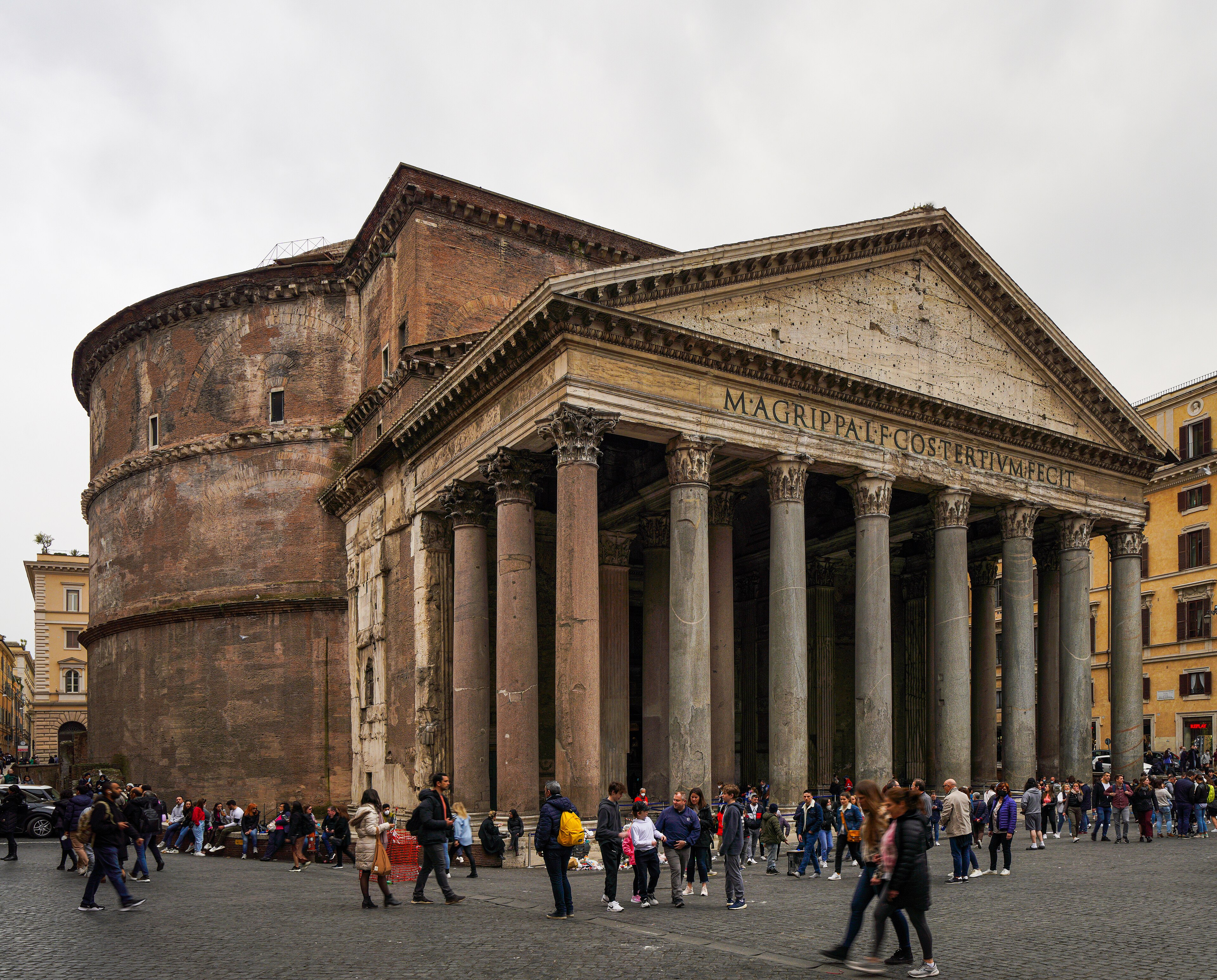
Here is a detail that most visitors miss. Some of the most famous columns in Rome may have a link to these baths. In the seventeenth century, workers repaired the front porch of the nearby Pantheon, where some original columns were missing. They used ancient granite columns found in this area, which many scholars connect to the Baths of Nero. So when you stand under the Pantheon's portico, you may be looking at stone that once framed Roman bathers.
The two columns in front of you have their own modern story. They were found during excavation work in the twentieth century and set upright here in the street. They are not in their exact original positions. Instead, they act like a signpost, a reminder of what lies beneath your feet. Look at their surface. Granite is a very hard stone, and it carries the scratches, chips and stains of many centuries. Romans often brought granite from quarries in Egypt, at great cost and effort.
Other fragments of the baths survive inside the buildings around you, mostly out of sight. Palazzo Madama, the home of the Italian Senate, stands over part of the old complex. Remains have also been recorded beneath the church of San Luigi dei Francesi, the French national church in Rome. Inside that church hang famous paintings by Caravaggio. It is a strange thought. Visitors admire Renaissance art in the chapel, while Roman bath walls sit quietly in the ground below them.
This is one of the most rewarding ideas to carry with you through central Rome. The city is not a museum with neat labels. It is a living place built on top of itself, again and again. Nero's baths are mostly invisible, yet they still shape the city. They affect the direction of a street, the foundations of a palace, the columns of a temple porch. You are walking on a map of the ancient city, even when you cannot see it.
Take a moment to look around this small piazza and the streets that lead away from it. The Pantheon is only a few minutes away in one direction. Piazza Navona, which follows the shape of an ancient stadium, is just as close in another. Between these places, the Baths of Nero once filled a huge block of the city. Today, coffee bars, small shops and government offices occupy the same ground. The daily rhythm of conversation and errands has simply moved indoors.
Before you walk on, look once more at the two columns. Notice how people pass them without a second glance, carrying shopping bags or talking on their phones. Notice the light on the granite, and the way the modern street bends around them. Somewhere under the paving, the floors of the old bath rooms still lie in the dark. As you leave, listen again to the voices and footsteps around you. In a quieter way, this is still a place where Romans come together.
Key facts
What to look for
Practical tips
Common questions
Is there a free audio guide to Baths of Nero?
Yes — the Lokali app narrates Baths of Nero free of charge in 50+ languages. The guide runs about 7 minutes, covers the history, what to look for on site and practical tips, and works offline once downloaded.
Where is Baths of Nero?
Baths of Nero is in Rome, Italy, at 41.8987, 12.4758. Tap the map link on this page for directions from where you are.
What is Baths of Nero known for?
Emperor Nero built these baths in the early 60s. Severus Alexander rebuilt the complex in the third century.
What should you look for at Baths of Nero?
Two lone granite columns standing at the street's edge. Chips and scratches on the hard granite column surfaces. How the modern street curves around the ancient columns.
What should you know before visiting Baths of Nero?
Combine this stop with the Pantheon, a few minutes away. Walk on to Piazza Navona to see another ancient footprint.
When is the best time to visit Baths of Nero?
Come early morning when the narrow street is quiet.
On the map
Opens directions to Baths of Nero from your location.
More to see in Rome



Hear Baths of Nero in your language
The full story, narrated, in 50+ languages. Download it before you go and it plays offline, at your own pace, with no ticket and no tour group.