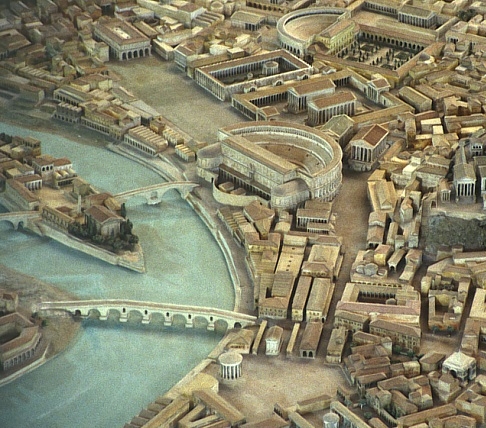
Circus Flaminius
41.8928° N · 12.4774° E · Archaeological Site
Photo: Alessandro57 · Public domain · Wikimedia Commons
Circus Flaminius is a field and plaza once used for horse races in ancient Rome and the surrounding district of ancient, medieval, and modern Rome. Built in 221 BCE by the censor Gaius Flaminius. The free Lokali audio guide runs 7 minutes.
✓ Published October 2026 · how we write these guides
Visitor facts
| Lokali audio guide | 7 min · free |
|---|---|
| Type | Archaeological Site |
| Location | Rome, Italy |
| Coordinates | 41.8928, 12.4774 |
| Languages | 50+, in the Lokali app |
The story
Stand still for a moment and listen. Scooters hum past on the cobbles. Somewhere a café spoon taps a cup. Above you, the travertine arches of the Theatre of Marcellus catch the light. Nothing here looks like an ancient arena, and that is exactly the puzzle. You are standing on the ground of the Circus Flaminius, one of the great public spaces of ancient Rome. Not a single wall of it stands today.
So let us build it together, in the mind. Imagine the modern streets around you gone. Imagine a long, open field running roughly parallel to the Tiber, here in the southern part of the Campus Martius. The Campus Martius was the Field of Mars, a flat floodplain outside the oldest city boundary. For centuries it was a place for armies to gather and for citizens to vote. In 221 BC, a politician named Gaius Flaminius gave part of this field a new and lasting shape.
Flaminius held the office of censor, a powerful role that oversaw public works and the citizen lists. His name lives on in two places. One is this circus. The other is the Via Flaminia, the great road he built north across Italy. Flaminius did not have a long life to enjoy his projects. A few years later he commanded a Roman army against Hannibal, the Carthaginian general, and he died in the disaster at Lake Trasimene in 217 BC.
Now here is the first surprise. The word circus makes most of us think of the Circus Maximus, with its long racetrack and towering stands. The Circus Flaminius was probably quite different. It seems to have been a broad open space, more like a large public square than a stadium. It likely had no grand permanent seating. People stood, crowded, and watched. Its value lay in its openness, a flat stage for the life of the city.
What happened on that stage? Games, for one. The Plebeian Games, a festival for the ordinary citizens of Rome, were held here. So were certain horse races connected with religious rites. But the most dramatic use was the triumph. When a victorious general returned to Rome, his procession often assembled in this area. Soldiers, captives, carts of treasure and painted images of conquered cities gathered here before the long march toward the Capitol.
That role shaped everything around the circus. Generals who won wars wanted to be remembered at the very place where their triumphs began. So they built temples along its edges, paid for with the spoils of war. Over time the open field became framed by sacred buildings. There was a temple to Bellona, the goddess of war. There was a temple to Apollo. There was a temple to Hercules of the Muses, linking strength with the arts.
Look toward the Theatre of Marcellus beside you. Just beside it, three tall columns of a temple still stand on a high base. These belong to the Temple of Apollo, rebuilt in the time of Augustus by a man named Sosius, which is why scholars call it the Temple of Apollo Sosianus. Those columns once looked out over the circus. They are one of the few direct physical links to the scene that surrounded this open ground.
Walk a little further along Via del Portico d'Ottavia and you meet another link. The great brick and marble entrance there belonged to the Portico of Octavia, a colonnaded enclosure named by Augustus for his sister. It replaced an earlier portico built by a general named Metellus. Inside such porticoes stood temples, libraries and famous works of Greek art. Romans could stroll in the shade between the river, the theatre and the circus.
Here is the second surprise, and it is a strange one. The historian Cassius Dio records that in 2 BC, during celebrations under Augustus, the Circus Flaminius was flooded with water. Crocodiles were brought in and killed before the crowd. Dio gives the number as thirty-six. It is a reminder that Roman spectacle was often cruel, and that this quiet corner once echoed with the shouts of thousands watching animals from the Nile.
Why did the circus vanish so completely? Partly because it was never a heavy stone stadium. An open space is easy to fill. Over the centuries, buildings crept in from its edges. In the Middle Ages and later, houses, workshops and churches rose over the old ground. The memory of the circus survived in some local names, but its exact position became uncertain. For a long time, scholars placed it in the wrong spot entirely.
The answer came from broken marble. In ancient times, a huge carved map of the city, the Severan Marble Plan, hung on a wall near the Forum. It survives only in fragments, like pieces of a giant jigsaw. In the twentieth century, researchers matched certain fragments to this neighbourhood. They showed that the circus lay further south than earlier experts believed, close to the river and the Theatre of Marcellus. A map in stone corrected centuries of guesswork.
The neighbourhood around you carries its own later history. These streets became the Jewish Ghetto of Rome in the sixteenth century, when the community was confined behind walls by papal order. The ghetto walls are gone now, but the community remains. You can smell it in the bakeries and the fried artichokes of the restaurants nearby. Ancient Rome, papal Rome and modern Rome all share this same small patch of ground.
As you walk on, keep the picture in your mind. Under the cobbles and cellars runs the shadow of a long open field. Generals once waited here with their armies. Crowds once pressed in to watch races and processions. Look again at the three columns of Apollo and the arches of the theatre. They are the last witnesses. Everything between them was once open sky and noise... and now it is a quiet Roman street, waiting for you to notice it.
Key facts
What to look for
Practical tips
Common questions
Is there a free audio guide to Circus Flaminius?
Yes — the Lokali app narrates Circus Flaminius free of charge in 50+ languages. The guide runs about 7 minutes, covers the history, what to look for on site and practical tips, and works offline once downloaded.
Where is Circus Flaminius?
Circus Flaminius is in Rome, Italy, at 41.8928, 12.4774. Tap the map link on this page for directions from where you are.
What is Circus Flaminius known for?
Built in 221 BCE by the censor Gaius Flaminius. Flaminius died fighting Hannibal at Lake Trasimene.
What should you look for at Circus Flaminius?
Three standing columns of the Temple of Apollo Sosianus. The arched travertine facade of the Theatre of Marcellus. The brick and marble gateway of the Portico of Octavia.
What should you know before visiting Circus Flaminius?
Start beside the Theatre of Marcellus to orient yourself. Walk Via del Portico d'Ottavia to trace the circus edge.
When is the best time to visit Circus Flaminius?
Visit in early morning when the streets are quietest.
On the map
Opens directions to Circus Flaminius from your location.
More to see in Rome


Hear Circus Flaminius in your language
The full story, narrated, in 50+ languages. Download it before you go and it plays offline, at your own pace, with no ticket and no tour group.