
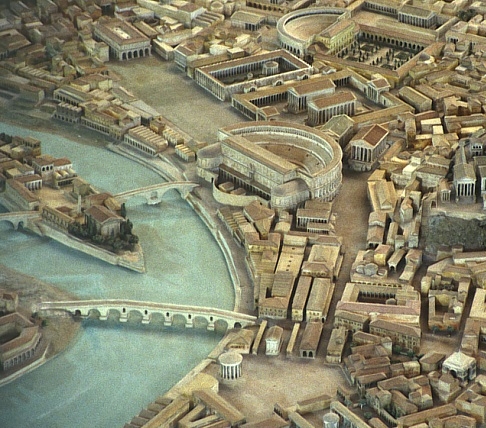
Porticus Octaviae
41.8924° N · 12.4785° E · Archaeological Site
Photo: Joris1919 · CC BY-SA 3.0 · Wikimedia Commons
Porticus Octaviae is an ancient structure in Rome. The colonnaded walks of the portico enclosed the temples of Jupiter Stator and Juno Regina. Augustus rebuilt the portico and dedicated it to sister Octavia. The free Lokali audio guide runs 7 minutes.
✓ Published October 2026 · how we write these guides
Visitor facts
| Lokali audio guide | 7 min · free |
|---|---|
| Type | Archaeological Site |
| Location | Rome, Italy |
| Coordinates | 41.8924, 12.4785 |
| Languages | 50+, in the Lokali app |
The story
Start with your feet. The pavement here is uneven, a patchwork of dark cobbles and pale stone. A few steps below the modern street, a raised walkway carries visitors over the ruins themselves. Look up, and you see the outline of a gateway: tall white columns, a heavy triangular pediment, and a wide arch of reddish brick. Scooters pass behind you. Someone is frying artichokes nearby. You are standing at the edge of one of the oldest surviving public spaces in Rome.
This is the Porticus Octaviae, the Portico of Octavia. Today you mostly see the entrance, the monumental gateway that led into a much larger enclosure. A portico, in the Roman sense, was a long covered colonnade. Here, the colonnades formed a great rectangle around an open square. Inside that square stood temples, works of art, and gardens. Picture a sheltered walking space where Romans could stroll, meet friends, and look at sculpture, safe from the sun and the rain.
The story begins before Octavia. In the second century before Christ, a Roman general named Quintus Caecilius Metellus came home victorious from Macedonia, in northern Greece. He built the first portico on this site, and it carried his name. According to the Roman writer Pliny, Metellus brought back a famous group of bronze horsemen. These statues were said to be the work of Lysippus, the court sculptor of Alexander the Great. Plunder from Greece became decoration for Rome.
The complex held two temples. One was dedicated to Juno Regina, Juno the Queen. The other honoured Jupiter Stator, the god who, in Roman belief, held soldiers firm in battle and stopped them from running. Some sources describe this temple as one of the first in Rome built entirely of marble. That was a statement. Marble was Greek, expensive, and new to Roman builders. Metellus wanted his city to look like the great cities he had conquered.
Then comes the name you see on the signs. Late in the first century before Christ, the emperor Augustus rebuilt the whole enclosure. He dedicated it to his sister, Octavia. She was one of the most respected women in Rome, and her life was marked by loss. Her son Marcellus, once seen as Augustus's heir, died young. Octavia founded a library inside the portico in his memory. There were collections in Greek and in Latin, side by side.
Here is a detail many visitors miss. Turn and look just beside you, at the curved stone wall with arches stacked on arches. That is the Theatre of Marcellus, named for the same young man. Mother and son are remembered on neighbouring monuments. The theatre was a place for crowds and noise. The portico, with its library and quiet colonnades, was a place for reading and walking. Together they formed a cultural quarter of the ancient city.
Now look closely at the gateway itself. Above the columns, a Latin inscription runs across the stone. It records a restoration under the emperors Septimius Severus and his son Caracalla, in the year 203. Rome had suffered a serious fire, and the portico needed rebuilding. So the gateway you see today is not purely the work of Augustus. It is a Roman monument repaired by later Romans, who carefully put their own names on it.
And that brick arch? It does not belong to the original design. Classical gateways like this one used rows of columns, not arches. At some point in late antiquity, some of the columns fell, possibly in an earthquake. Builders filled the gap with brick, the cheaper and more practical material of their time. It is a patch, and a visible one. You can read the life of the building in that contrast between white marble and red brick.
After the empire, the portico did not disappear. It changed use. In the early Middle Ages, a church was built into the ruins: Sant'Angelo in Pescheria, Saint Angelo in the Fish Market. You can see it rising directly behind the ancient columns. The name tells you what happened outside. For centuries, this gateway sheltered Rome's fish market. Traders laid their catch on marble slabs, some of them recycled from the ancient buildings around them.
Search the walls nearby for a stone plaque with Latin text. Locals still point it out. It set a rule for the fishmongers: any fish longer than the plaque had to be handed over to the city officials, the head especially. The head of a large fish was considered the finest part for soup. Imagine the arguments over a fish that was just a little too long. Even small rules of city life were carved in stone here.
This area carries a heavier history too. In 1555, Pope Paul the Fourth ordered the Jews of Rome to live within a walled district here, the Ghetto. The gates were locked at night. The street in front of you, Via del Portico d'Ottavia, became the main street of that community. The walls came down in the nineteenth century. But the Jewish community remained, and the neighbourhood is still its heart today.
In October 1943, during the German occupation, soldiers rounded up more than a thousand Jews from this neighbourhood and deported them. Very few came back. Nearby, plaques and small brass stones set into the pavement record the names of people taken from their homes. Watch the ground as you walk. These stones are easy to step past. Many visitors pause, read a name, and move on more slowly.
Today, this street is full of life again. Bakeries sell dense, dark pastries filled with dried fruit. Restaurants serve artichokes fried whole until the leaves open like a flower, a dish closely tied to Roman Jewish cooking. Children kick footballs against ancient stones. Recent excavations have opened the walkway beneath the gateway, so you can stand at the level of the old Roman pavement and look up at the columns from below.
Before you leave, stand still for a moment between the columns. Above you is marble from an emperor's restoration. Beside you is brick from a later repair. Behind you is a medieval church, and ahead is a street with two thousand years of neighbours. Rome rarely clears away its past. It builds on top of it, lives around it, and repairs it with whatever is at hand. As you walk on, notice how often you see the same thing again.
Key facts
What to look for
Practical tips
Common questions
Is there a free audio guide to Porticus Octaviae?
Yes — the Lokali app narrates Porticus Octaviae free of charge in 50+ languages. The guide runs about 7 minutes, covers the history, what to look for on site and practical tips, and works offline once downloaded.
Where is Porticus Octaviae?
Porticus Octaviae is in Rome, Italy, at 41.8924, 12.4785. Tap the map link on this page for directions from where you are.
What is Porticus Octaviae known for?
Augustus rebuilt the portico and dedicated it to sister Octavia. Earlier portico built by general Quintus Caecilius Metellus.
What should you look for at Porticus Octaviae?
Latin inscription across the gateway naming Severus and Caracalla. Red brick arch replacing fallen marble columns. Sant'Angelo in Pescheria church built into the ruins.
What should you know before visiting Porticus Octaviae?
Walk the raised walkway to see the Roman pavement level. Combine your visit with the neighbouring Theatre of Marcellus.
When is the best time to visit Porticus Octaviae?
Come early morning for quieter streets and softer light.
On the map
Opens directions to Porticus Octaviae from your location.
More to see in Rome


Hear Porticus Octaviae in your language
The full story, narrated, in 50+ languages. Download it before you go and it plays offline, at your own pace, with no ticket and no tour group.