
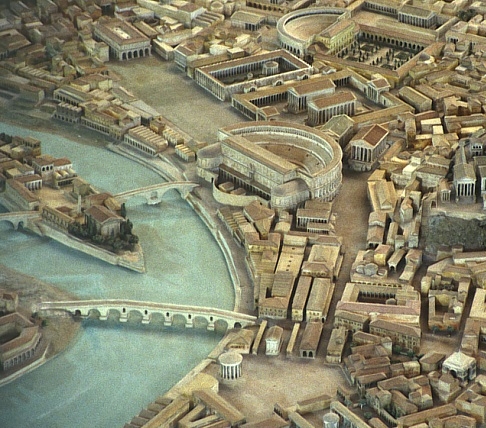
Photo: user:Lalupa · Public domain · Wikimedia Commons
Santa Maria in Campitelli is a church in Rome. Built after the 1656 plague as a votive thanksgiving church. The free Lokali audio guide runs 7 minutes.
✓ Published October 2026 · how we write these guides
Visitor facts
| Lokali audio guide | 7 min · free |
|---|---|
| Type | Church |
| Location | Rome, Italy |
| Coordinates | 41.8931, 12.4793 |
| Official website | santamariainportico.it |
| Languages | 50+, in the Lokali app |
The story
Stand for a moment in the small piazza and listen. A fountain splashes nearby, scooters hum along the cobbles, and somewhere a bell marks the hour. In front of you, a tall wall of pale travertine rises in layers of columns. In the afternoon the stone turns honey-coloured, and the shadows between the columns look deep enough to walk into. This is Santa Maria in Campitelli, one of the most theatrical church fronts in Rome.
The square is called Piazza di Campitelli. It sits at the edge of the old Sant'Angelo district, between the Capitoline Hill and the former Jewish Ghetto. The name Campitelli is older than the church. One popular explanation links it to the Capitolium, the sacred hill just above you. Scholars still debate the origin. Either way, the name ties this quiet square to the oldest heart of the ancient city.
The church exists because of fear, and because of hope. In 1656, plague swept through Rome. Thousands died, and the city lived under lockdown and quarantine. Romans turned to a small, much-loved image of the Virgin Mary, known as Our Lady in Portico. When the epidemic finally eased, many believed this image had saved them. The city and the pope, Alexander the Seventh, decided to build a grand new home for it, as a thank-you for survival.
The image itself carries a legend. According to tradition, it appeared miraculously to a Roman noblewoman, Saint Galla, many centuries earlier, in a house near the Portico of Octavia, a short walk from here. That story belongs to faith and folklore, not to the archive. What is documented is the devotion. For generations, Romans prayed before this image in times of crisis, and the new church was built to honour that habit of prayer.
The architect was Carlo Rainaldi, a rival and contemporary of Bernini and Borromini. Work began in the early 1660s. Rainaldi was not a radical. He liked order, symmetry, and clear lines. But look at this facade again and you see his special gift — depth. The columns do not sit flat against the wall. They stand forward in clusters, one in front of another, so the whole front seems to step out towards you.
Try this small experiment. Walk slowly from one side of the piazza to the other, keeping your eyes on the columns. Notice how they overlap and separate as you move, like stage scenery. This is the effect Rainaldi wanted. In Baroque Rome, a church front was a kind of theatre set for the street. It had to catch the eye of someone passing on foot or in a carriage, and pull them inside.
Now step through the doors. The first sensation is usually cool air and the faint smell of old stone and wax. Then comes the light. The interior is tall and mostly white, with grey and cream tones. Your eye runs straight down the long space towards the high altar. Rainaldi repeats the trick from outside — columns stand forward from the walls, framing the view like a series of open curtains.
The plan is unusual. The church feels like two spaces joined together. Near the entrance, side chapels open off a broad area that almost forms a cross. Further in, the space narrows and becomes a sanctuary under its own dome. Many visitors walk the full length without noticing this change. Pause in the middle, look back towards the door, then forward to the altar, and you can feel the shift in shape.
At the far end stands the reason for everything — the high altar. It is a large gilded composition, a golden burst of rays and clouds. In the centre, almost lost in all that gold, sits the small venerated image of the Virgin. This is the surprise for many first-time visitors. They expect a huge painting. Instead, the treasure is tiny, and the enormous church exists to frame it, like a jewel box around a single stone.
Take your time in the side chapels. They hold paintings and marble work by artists of the Baroque period, with dark backgrounds and figures lit as if by a single lamp. Look at the coloured marbles too. Reds, greens, and soft yellows were collected from ancient Roman ruins and reused here. In this part of Rome, almost every church carries pieces of older buildings inside its walls.
The church is also linked to a religious community called the Clerics Regular of the Mother of God. This order was founded in the late sixteenth century by Saint John Leonardi, a priest who worked on education and church reform. The order still cares for the church today. So this is not a museum. It is a working parish, and you may find people praying quietly or a service in progress. Lower your voice and move gently.
When you return outside, look at the fountain in the piazza. Its design is credited to Giacomo della Porta, who created several of the fountains in old Rome during the late sixteenth century. It is older than the church behind it. Water has run here for centuries, and neighbours once came to fill jugs from it. Today it gives the square its soft background sound.
From here, the ancient city is very close. A few steps away stand the arches of the Theatre of Marcellus and the columns of the Portico of Octavia. Beyond them lies the old Jewish quarter, with its bakeries and narrow lanes. This small church sits at a meeting point of layers: ancient Rome, medieval devotion, Baroque ambition, and the everyday life of a neighbourhood that still lives here.
Before you leave, turn once more towards the facade. Notice how the light moves across the columns while you stand still. Somewhere inside, a small image still rests in its golden frame, as it has since a frightened city chose to give thanks. As you walk away across the cobbles, listen for the fountain fading behind you... and carry that quiet with you into the streets of Rome.
Key facts
What to look for
Practical tips
Common questions
Is there a free audio guide to Santa Maria in Campitelli?
Yes — the Lokali app narrates Santa Maria in Campitelli free of charge in 50+ languages. The guide runs about 7 minutes, covers the history, what to look for on site and practical tips, and works offline once downloaded.
Where is Santa Maria in Campitelli?
Santa Maria in Campitelli is in Rome, Italy, at 41.8931, 12.4793. Tap the map link on this page for directions from where you are.
What is Santa Maria in Campitelli known for?
Built after the 1656 plague as a votive thanksgiving church. Designed by Baroque architect Carlo Rainaldi in the 1660s.
What should you look for at Santa Maria in Campitelli?
Clustered columns stepping forward across the travertine facade. The tiny Marian image at the centre of the golden altar. Change from cross-shaped nave to domed sanctuary inside.
What should you know before visiting Santa Maria in Campitelli?
Visit in late afternoon when the travertine facade glows warm. Walk across the piazza slowly to watch the columns shift.
When is the best time to visit Santa Maria in Campitelli?
Visit in late afternoon when the travertine facade glows warm.
On the map
Opens directions to Santa Maria in Campitelli from your location.
More to see in Rome



Hear Santa Maria in Campitelli in your language
The full story, narrated, in 50+ languages. Download it before you go and it plays offline, at your own pace, with no ticket and no tour group.