
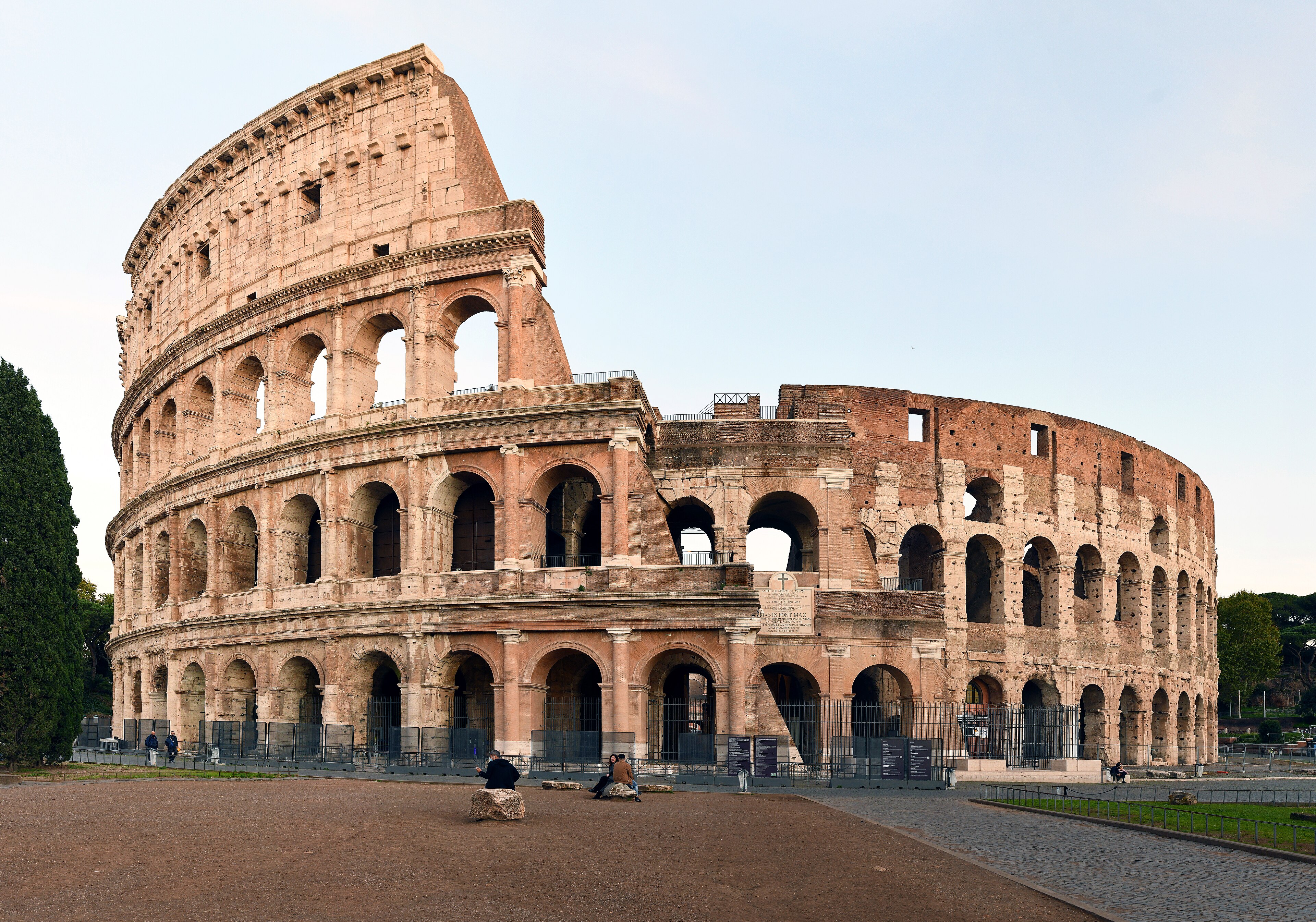
Photo: Jastrow · CC BY 2.5 · Wikimedia Commons
Lateran Palace is an ancient palace in Rome. Main papal residence for roughly a thousand years. The free Lokali audio guide runs 7 minutes.
✓ Published October 2026 · how we write these guides
Visitor facts
| Lokali audio guide | 7 min · free |
|---|---|
| Type | Palace |
| Location | Rome, Italy |
| Coordinates | 41.8867, 12.5053 |
| Languages | 50+, in the Lokali app |
The story
Stand in the open square and listen. Traffic moves around the edges, a tram bell rings somewhere behind you, and pigeons lift off the hot paving stones. In front of you rises a long, calm wall of warm brick and pale travertine stone. Rows of windows run across it in neat lines. At first glance it looks like many other Roman palaces. But this is the Lateran Palace, and for roughly a thousand years it was the home of the popes.
Most visitors walk straight past it on their way into the great basilica next door. That is the Archbasilica of Saint John Lateran, the cathedral of Rome. Many people are surprised to learn this, because they assume the cathedral is Saint Peter's. It is not. The Pope is the Bishop of Rome, and his cathedral is here. For most of the city's Christian history, the Pope lived right beside it, in a palace on this very spot.
The name itself comes from ancient Rome. This hill was once the property of a wealthy family called the Laterani. Their estate passed to the emperors. In the early fourth century, the emperor Constantine gave land and buildings here to the Bishop of Rome. Constantine was the first Roman emperor to support Christianity openly. His gift turned a private corner of the imperial city into the centre of the Western Church. The family name stayed, and it is still the name you hear today... Lateran.
Try to picture what stood here in the Middle Ages. It was not one tidy building like the one in front of you. It was a sprawling cluster of halls, chapels, towers and courtyards, added piece by piece over centuries. Popes ruled from here. They received kings, held great church councils, and governed lands across central Italy. Several of the major councils of the medieval Church carry this place in their name. Historians still call them the Lateran Councils.
Here is a detail that many people miss. During the Middle Ages, a bronze statue of a Roman emperor on horseback stood outside the old palace. People believed it showed Constantine, the Christian emperor. Because of that belief, nobody melted it down for metal, as happened to so many ancient bronzes. In fact, it showed Marcus Aurelius, a pagan emperor. A mistake saved it. In the sixteenth century it was moved to the Capitoline Hill, where the original now stands inside a museum.
Then the story turns. In the early fourteenth century, the popes left Rome and settled in Avignon, in southern France. They stayed there for most of the century. While they were gone, the old palace suffered. Fires damaged it badly, and parts fell into ruin. When the popes finally returned to Rome, they did not come back here. They moved across the river to the Vatican. The Lateran slowly faded from the centre of power.
The building you see now is a replacement. In the 1580s, Pope Sixtus the Fifth decided the medieval ruins had to go. He was an energetic pope who wanted to reshape the whole city with straight roads and grand monuments. His architect, Domenico Fontana, cleared most of the old palace away. In its place he built this new palace in the style of the late Renaissance. Look at the clean proportions, the strong corner stones and the heavy cornice along the roofline. It is orderly, almost severe.
Not everything old was lost. Just across the square stands a separate building that holds the Scala Sancta, the Holy Stairs. According to a long tradition, these are the steps that Jesus climbed in Pontius Pilate's house in Jerusalem, brought to Rome by Saint Helena, the mother of Constantine. That is a story of faith, not proven history. Still, pilgrims climb the central staircase on their knees to this day. At the top is the Sancta Sanctorum, the old private chapel of the medieval popes, one of the few real survivors of the original palace.
Near the Holy Stairs, look for a curved apse covered in gold mosaic, standing on its own like a stage set. It recalls a great dining hall built by Pope Leo the Third around the year 800. This was the pope who crowned Charlemagne as emperor in the West. What you see today is a later reconstruction from the eighteenth century, based on the old design. Even so, it gives you a sense of how this place once looked and felt.
Now turn toward the tall stone needle in the middle of the square. This is the Lateran obelisk, an ancient Egyptian monument. It was first raised in Egypt, at the temple complex of Karnak. A Roman emperor later shipped it to Rome and set it up in the Circus Maximus, the city's great chariot track. Over the centuries it fell and broke. Sixtus the Fifth and Fontana dug it out, repaired it and raised it here. It is the tallest ancient obelisk in Rome.
The palace returned to world history in the twentieth century. On 11 February 1929, representatives of the Holy See and the Kingdom of Italy signed an agreement inside these walls. It became known as the Lateran Treaty. For decades the popes and the Italian state had been in conflict over the loss of the papal lands. This treaty settled the dispute. It created the independent Vatican City State, the smallest country in the world. And the deal was signed here, not at the Vatican.
Today the palace still belongs to the Holy See, even though it sits outside Vatican City. It holds offices of the Diocese of Rome, the local church that the Pope leads as bishop. Part of the building also serves as a museum. Visitors can see richly decorated papal rooms, with painted ceilings and frescoes from the time of Sixtus the Fifth. Inside, the calm of the facade gives way to colour, gold and crowded scenes of saints and popes.
Before you move on, look once more at the brick wall in front of you. Notice how plain it is beside the white marble front of the basilica. It is a quiet building that has seen emperors, popes, councils and treaties pass through its doors. As you walk away, listen to the square again: the trams, the voices, the bells of the basilica. Rome has changed many times around this spot. The palace has simply kept its place.
Key facts
What to look for
Practical tips
Common questions
Is there a free audio guide to Lateran Palace?
Yes — the Lokali app narrates Lateran Palace free of charge in 50+ languages. The guide runs about 7 minutes, covers the history, what to look for on site and practical tips, and works offline once downloaded.
Where is Lateran Palace?
Lateran Palace is in Rome, Italy, at 41.8867, 12.5053. Tap the map link on this page for directions from where you are.
What is Lateran Palace known for?
Main papal residence for roughly a thousand years. Name comes from the ancient Roman Laterani family.
What should you look for at Lateran Palace?
Gold mosaic apse standing alone near the Holy Stairs. Strong travertine corner stones framing the brick facade. Egyptian hieroglyphs carved on the tall obelisk.
What should you know before visiting Lateran Palace?
Combine your visit with the basilica right next door. Check in advance whether the papal rooms require booking.
When is the best time to visit Lateran Palace?
Come early to enjoy the square before tour groups.
On the map
Opens directions to Lateran Palace from your location.
More to see in Rome



Hear Lateran Palace in your language
The full story, narrated, in 50+ languages. Download it before you go and it plays offline, at your own pace, with no ticket and no tour group.