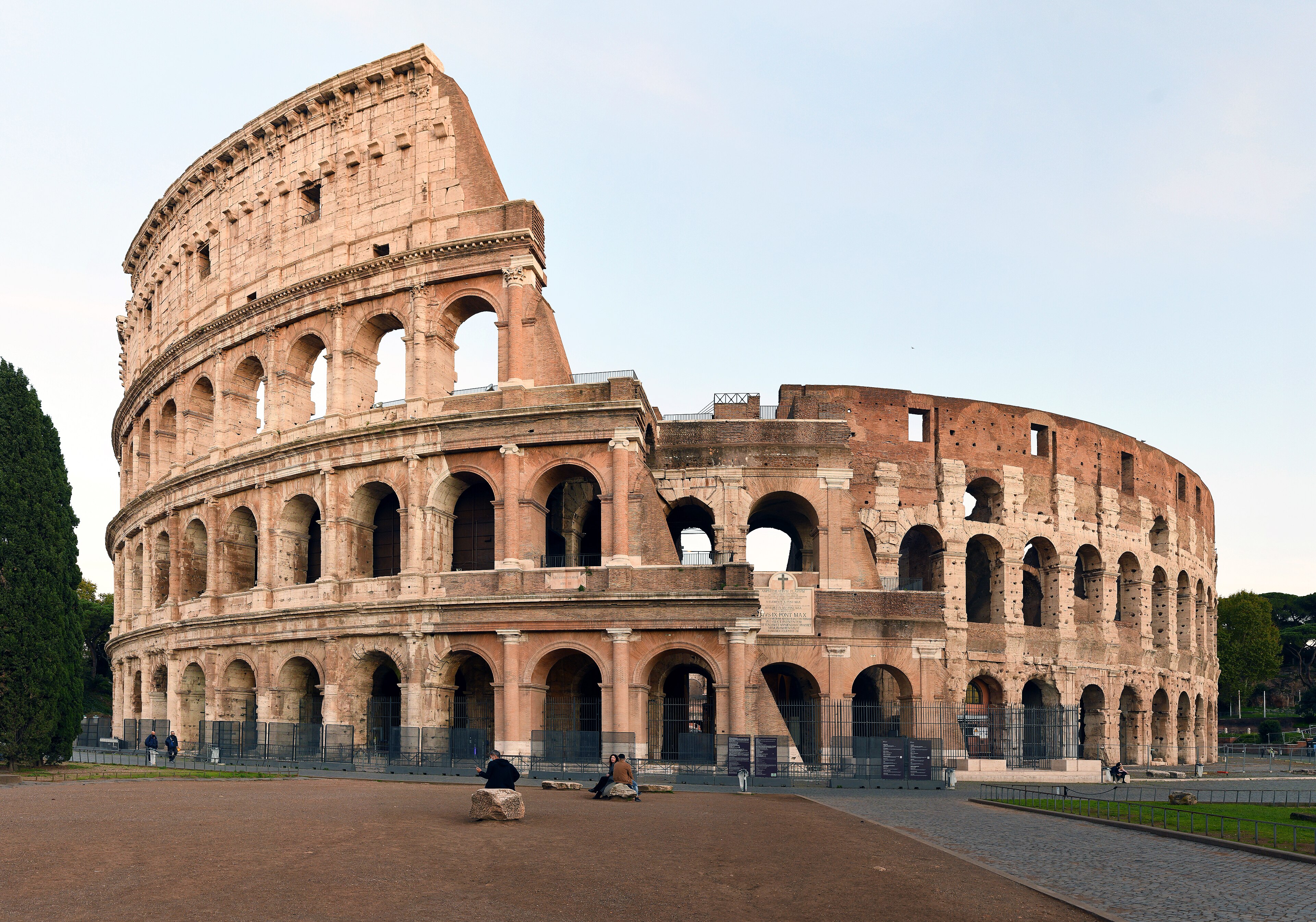
Colosseum
📍 About this place
The largest surviving Roman amphitheatre, built between 72–80 AD. Once hosted gladiatorial contests and public spectacles for up to 50,000 spectators. Its engineering—arches, vaults, and travertine blocks—shaped Western architecture for centuries.
📖 The story
The first thing you notice is the scale — not just height, but mass. Nearly two thousand years of weather have stripped the marble cladding and left the travertine skeleton exposed, honey-coloured stone stacked in four tiers of arches. Stand close to the outer wall and you can see the pockmarks where medieval scavengers pried out the bronze clamps that once held each block in place. The stone itself feels warm under your palm, even on cool mornings.
This is the Flavian Amphitheatre, though the world knows it by its medieval nickname — the Colosseum, likely after a colossal statue of Nero that once stood nearby. The emperor Vespasian commissioned it in AD 72, shortly after the civil war that followed Nero's suicide. He built it on the drained lake of Nero's sprawling Golden House, a pointed gesture — giving back to the Roman people the land Nero had seized for private pleasure. His son Titus opened the arena in AD 80 with one hundred days of games. Fifty thousand spectators filled the seats.
The engineering still astonishes. Eighty ground-level entrances, each numbered, funnelled crowds to their designated sections in minutes — senators on marble seats near the sand, commoners in wooden bleachers at the top. Beneath the arena floor, which no longer exists, you would have found a labyrinth of tunnels and cages, trap doors and hand-cranked lifts. Stagehands hauled exotic animals up through the floor mid-performance — lions from North Africa, bears from the forests of Germania, elephants shipped across the Mediterranean. The sand soaked up blood and was raked clean between events.
The games themselves were brutal spectacle. Gladiators fought in the mornings, often condemned criminals or prisoners of war, though some were free men who volunteered for the fame and prize money. Afternoons brought animal hunts — venationes — where trained bestiarii faced down leopards and wild boar with spears. Executions filled the midday lull, sometimes staged as mythological tableaux. The crowd expected variety, and emperors competed to outdo their predecessors. When the Colosseum opened, Titus flooded the arena for a mock naval battle, though historians still debate how he managed the hydraulics.
The games ended in the sixth century as Rome's power fractured and Christian emperors turned away from public bloodsport. The building fell into neglect. Earthquakes in 847 and 1349 brought down the southern outer wall — the side you see missing today. For centuries the Colosseum served as a quarry. Builders stripped its marble and travertine to construct Renaissance palaces and churches across the city, including St Peter's Basilica. Weeds and wildflowers took root in the ruins. Botanists catalogued over four hundred species growing here in the nineteenth century, seeds carried in the fur of those long-dead African lions or blown in from across the empire.
Restoration began in earnest in the 1990s, cleaning centuries of soot from the stone and shoring up the structure with steel braces. You can walk the perimeter in about fifteen minutes, though most visitors spend an hour inside, moving through the tunnels and climbing to the upper tiers. The view from the second level gives you the full sweep of the arena floor and the underground chambers, now exposed to daylight. On summer evenings the stone glows amber in the low sun, and swifts nest in the upper arches, their calls echoing through the vaults.
The Colosseum sits at the eastern end of the Roman Forum, with the Arch of Constantine just outside and the Palatine Hill rising to the south. In the mornings before the tour groups arrive, you can hear the city waking — espresso machines hissing in nearby cafés, delivery trucks rattling over cobblestones. By midday the plaza fills with tourists and vendors selling bottled water and sun hats. The best light for photographs comes in the first hour after sunrise or the last hour before sunset, when the stone takes on a deeper warmth and the shadows stretch long across the arches.
Inside, the air smells faintly of old stone and dust, cooler than the street even in August. The acoustics are strange — voices carry across the arena in unexpected ways, a reminder that this was a building designed for sound as much as sight. Fifty thousand people cheering, the roar of animals, the clash of swords on shields. Now it is mostly quiet, except for the shuffle of feet and the occasional tour guide's amplified voice bouncing off the walls.
Every year lightning strikes the structure, usually hitting the metal supports installed during restoration. The stone itself has survived worse — earthquakes, fires, centuries of plunder, two world wars. It remains the largest amphitheatre the Romans ever built, and the template for every stadium that came after. The oval plan, the tiered seating, the numbered entrances — walk into any modern sports arena and you are walking into a descendant of this building.
Stand at the western entrance, where the emperors once entered, and look east across the arena floor toward the rising sun. The stone is uneven underfoot, worn smooth in places by centuries of footsteps. Somewhere beneath your feet are the foundations of Nero's lake, and beneath that, traces of earlier settlements stretching back to Rome's founding. The city has always built on top of itself, layer upon layer. The Colosseum is just one stratum, monumental and ruined and still standing, a stone record of what Romans believed was worth building.
As you leave, glance up at the highest remaining arches. Swifts nest there in the spring, and on quiet mornings you can watch them dive and wheel above the arena, tracing lines through the same air that once carried the roar of the crowd. The stone will outlast us all, pocked and patched and still holding its shape, a shell of empire under the Roman sky.
💡 Key facts
👀 What to look for
🎒 Practical tips
❓ Common questions
- How long do you need at Colosseum?
- Plan around 1-2 hours on site. The free Lokali audio guide (~9 min) tells the story as you explore.
- Is there a free audio guide to Colosseum?
- Yes. The Lokali app narrates Colosseum for free in your own language — history, what to look for and practical tips, right at the site.
- What should you know before visiting Colosseum?
- Arrive at sunrise or late afternoon for the best light and smallest crowds Climb to the second level for the full view of the arena floor Bring water — the plaza has little shade in summer.
🗺️ On the map
Opens directions to Colosseum from your location.