
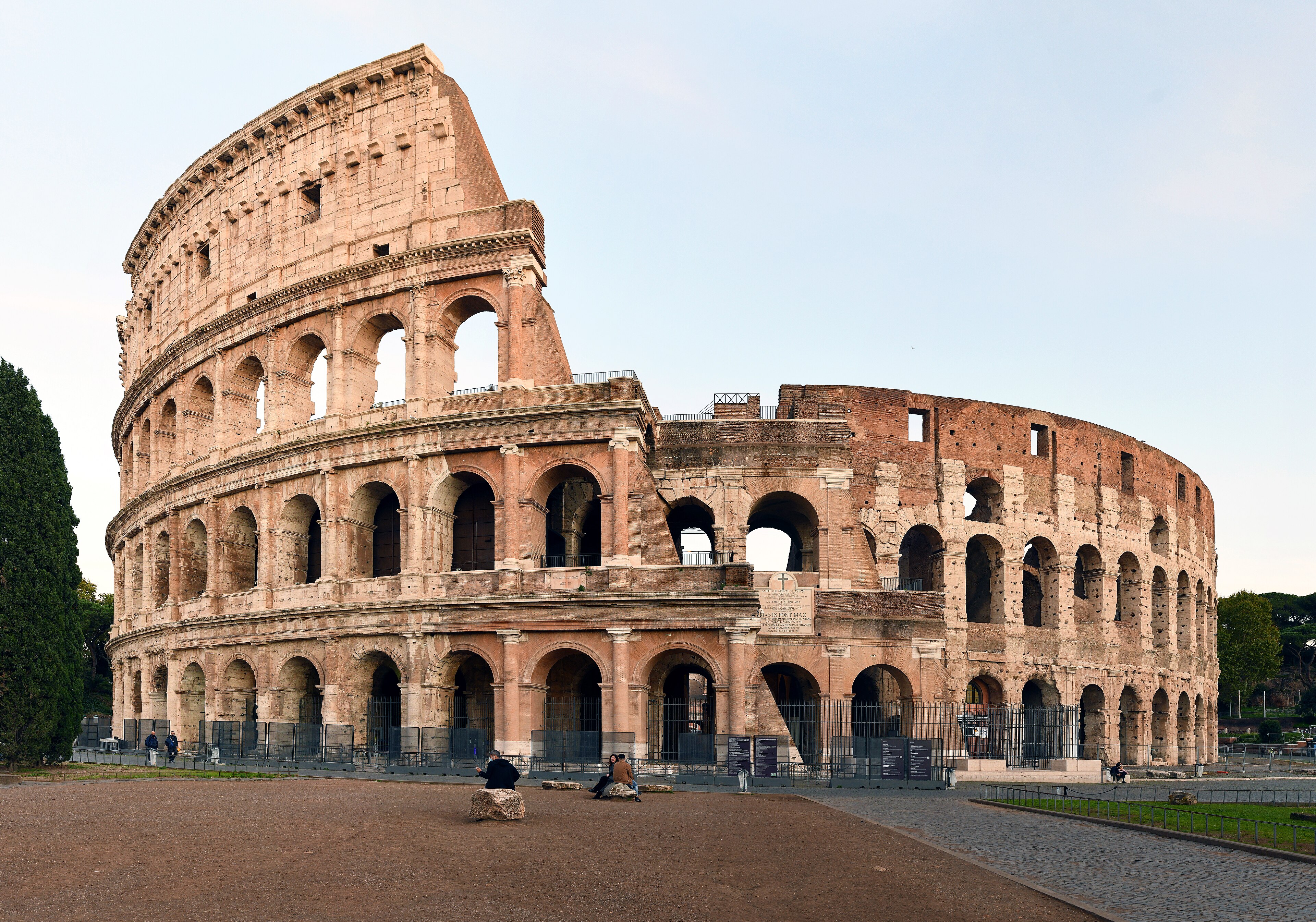
Photo: Rabax63 · CC BY-SA 4.0 · Wikimedia Commons
Domus Aurea is a domus, palace of Roman emperor Nero, "Golden house". It is in Rome, Italy. Nero began building after the great fire of 64. The free Lokali audio guide runs 7 minutes.
✓ Published October 2026 · how we write these guides
Visitor facts
| Lokali audio guide | 7 min · free |
|---|---|
| Type | Archaeological Site |
| Location | Rome, Italy |
| Coordinates | 41.8914, 12.4953 |
| Official website | parcocolosseo.it |
| Languages | 50+, in the Lokali app |
The story
Step inside, and the air changes at once. It is cool, damp, and still, even on the hottest Roman afternoon. Water drips somewhere in the dark. Your footsteps sound soft against packed earth, and the walls around you rise into vaults you can barely see. You are standing inside a palace that was buried on purpose... and that is part of what makes it so strange to visit today.
This is the Domus Aurea, the Golden House of the emperor Nero. Above your head is the Oppian Hill, one of the green slopes that look down toward the Colosseum. Today, people walk dogs and sit on benches up there. Most of them have no idea that a vast imperial residence lies under the grass and the gravel paths.
The story begins with a disaster. In the year 64, a great fire swept through Rome and burned for days. Large parts of the city were destroyed. When the ashes cooled, Nero took a huge area of land in the heart of the city. Here he built a palace on a scale Rome had never seen. Roman writers tell us the architects were two men named Severus and Celer. They designed buildings, gardens, and landscape as one connected whole.
Imagine the scene in its first years. The palace was not one single building. It was a sprawling estate of pavilions, colonnades, vineyards, pastures, and woodland — a country villa placed right in the middle of a crowded capital. In the valley below sat an artificial lake. The historian Suetonius describes a vestibule large enough to hold a colossal bronze statue of Nero himself. He also writes that ceilings were finished in gold and ivory, and that walls were decorated with precious stones.
Suetonius records one famous line. When the palace was finished, Nero is said to have remarked that at last he could begin to live like a human being. Whether he said it with a smile or with total seriousness, we cannot know. But the remark tells you a lot about how far an emperor's idea of normal life could drift from everyone else's.
Now look at the walls around you. Much of the colour has faded, but traces remain — reds, ochres, soft greens, and pale backgrounds. The Roman writer Pliny the Elder names a painter who worked here, often called Fabullus. Pliny says he painted with great seriousness, even wearing a toga while he worked on scaffolding. Under the right light, you can still pick out fine lines, small figures, garlands, and imaginary architecture floating on plaster.
Here is the first surprise. Nero did not get to enjoy any of this for long. He died in the year 68, only a few years after construction began. The emperors who followed had little reason to honour his memory. The Flavian dynasty drained the lake in the valley and built the great amphitheatre we now call the Colosseum on that spot. In a sense, the most famous monument in Rome stands on top of Nero's private landscape.
Later, the emperor Trajan built enormous public baths over this part of the palace. His engineers filled the rooms with earth and rubble to create a solid foundation. That is why you are underground right now. The rooms were not built as cellars. They were sunlit halls that opened onto gardens. Burial turned them into the cool, dark spaces you are walking through today — and it also protected the paintings for centuries.
The second surprise comes much later, in the late fifteenth century. People on the hill began to find holes that dropped into painted chambers below. Renaissance artists heard about them and came to look. They were lowered on ropes into the dark, holding lamps, and studied the strange, playful designs. Because these rooms looked like caves, Italians called them grotte. The decoration became known as grottesche — and that is where our word grotesque comes from.
The painter Raphael and his circle were among the artists who studied these walls. The light, fantastical style they found here spread into palaces and churches across Europe. Some visitors also left their own mark. Names scratched into the plaster by early explorers can still be found on certain ceilings. It is graffiti, but it is also a record of the moment the ancient world was rediscovered.
One space deserves your full attention: the Octagonal Room. Eight sides support a concrete dome with a round opening at the top. Light falls through that opening and moves across the floor as the day passes. Smaller rooms branch off around it. Roman builders were experimenting here with poured concrete and curved space. Many historians see this room as an important step toward later domed buildings, including the Pantheon across the city.
Ancient sources also mention a dining room that turned constantly, day and night, like the heavens. Exactly how it worked, and where it stood, remains a subject of debate among archaeologists. It is a good reminder that this palace is still being studied. Restoration work continues, and each season of research adds new questions as well as answers. The site is fragile. Moisture from the garden above seeps down, and keeping the paintings stable is a constant task.
As you move through the corridors, notice the scale of the brick and concrete around you. These walls are thick, heavy, and practical. Yet they once carried the most delicate painting in Rome. That contrast — raw structure and refined decoration — is easier to see here than in almost any other ancient building, because time has stripped away the gold and left the bones.
Before you climb back into the daylight, pause for a moment. Listen to the drip of water and feel the cold on your skin. When you step out onto the Oppian Hill, look down toward the Colosseum and picture a lake there instead. Then look at the grass beneath your feet. Somewhere under it, the painted rooms are waiting in the dark, just as they did for more than a thousand years.
Key facts
What to look for
Practical tips
Common questions
Is there a free audio guide to Domus Aurea?
Yes — the Lokali app narrates Domus Aurea free of charge in 50+ languages. The guide runs about 7 minutes, covers the history, what to look for on site and practical tips, and works offline once downloaded.
Where is Domus Aurea?
Domus Aurea is in Rome, Italy, at 41.8914, 12.4953. Tap the map link on this page for directions from where you are.
What is Domus Aurea known for?
Nero began building after the great fire of 64. Roman sources name Severus and Celer as architects.
What should you look for at Domus Aurea?
Daylight falling through the oculus of the Octagonal Room. Faded red and ochre fresco fragments on vaulted ceilings. Names scratched into plaster by Renaissance-era explorers.
What should you know before visiting Domus Aurea?
Book a guided visit in advance; reservations are required. Bring a light jacket because the tunnels stay cool.
On the map
Opens directions to Domus Aurea from your location.
More to see in Rome


Hear Domus Aurea in your language
The full story, narrated, in 50+ languages. Download it before you go and it plays offline, at your own pace, with no ticket and no tour group.