
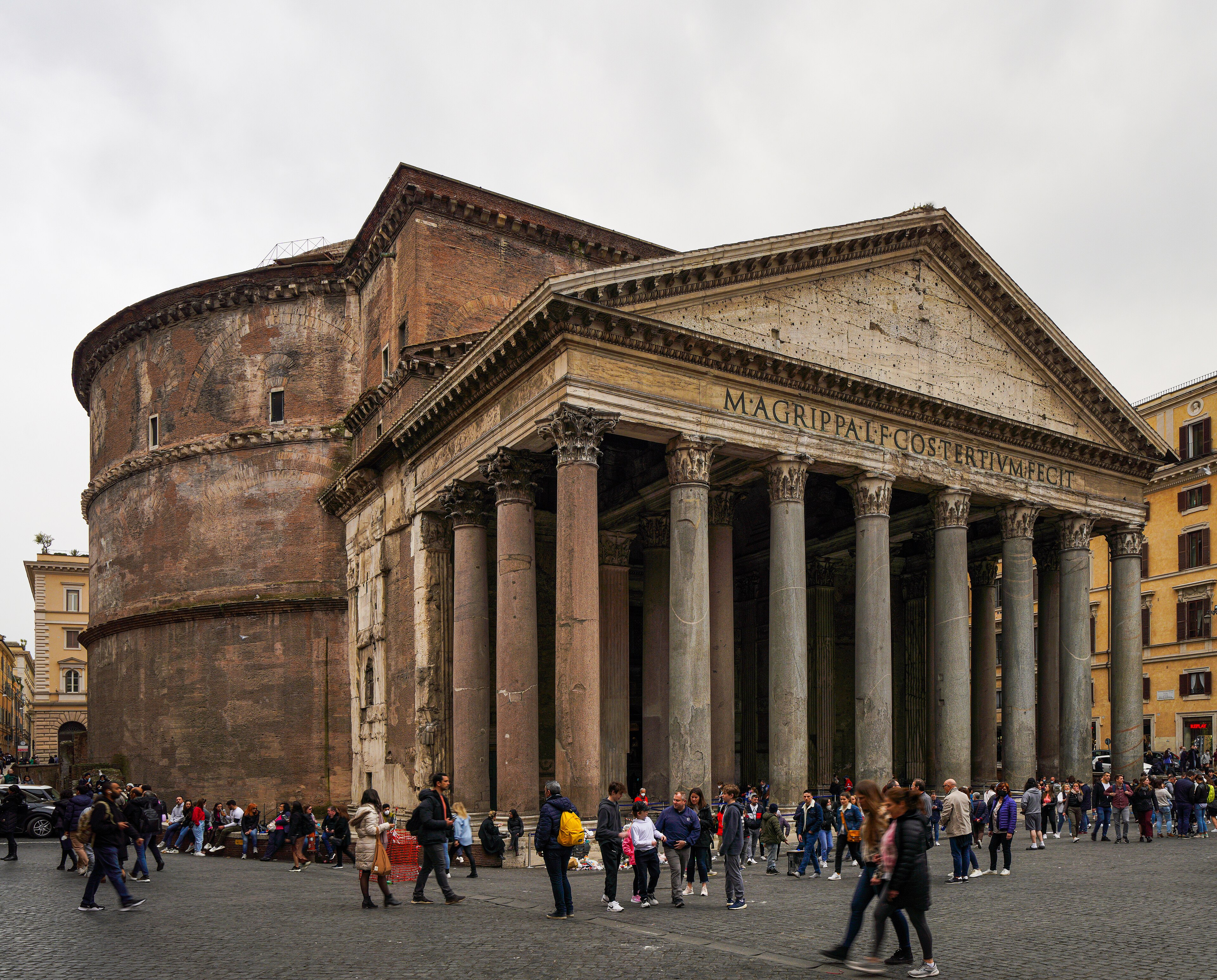
Photo: Wilfredor · CC0 · Wikimedia Commons
Santa Maria Maddalena is a church building in Colonna, Rome Italy. Facade is one of Rome's rare Rococo church fronts. The free Lokali audio guide runs 7 minutes.
✓ Published October 2026 · how we write these guides
Visitor facts
| Lokali audio guide | 7 min · free |
|---|---|
| Type | Church |
| Location | Rome, Italy |
| Coordinates | 41.9001, 12.4767 |
| Official website | camilliani.org |
| Languages | 50+, in the Lokali app |
The story
Walk a few steps north from the Pantheon, and the street narrows. The light changes too. It drops from the wide, open square into a small piazza, where cobblestones shine with the polish of many feet. Then a facade appears in front of you. It does not stand flat. It curves inward, soft and pale, like a sheet of paper pressed gently in the middle. This is Santa Maria Maddalena, the Church of Mary Magdalene. Many people walk straight past it on their way to gelato or the Pantheon. That is a mistake... and you are about to see why.
Look first at that curve. Most Roman church fronts are serious and heavy. They are Baroque, or classical, built to impress with weight and order. This facade is different. It is Rococo, a lighter, more playful style from the eighteenth century. Rococo loves shells, ribbons, swirling stucco and soft curves. In France and Germany this style filled palaces. In Rome, it is rare. This small church gives you one of the clearest Rococo church fronts in the whole city. The design is usually credited to the architect Giuseppe Sardi, and it dates from the first half of the eighteenth century.
Not everyone loved it. Later critics, who preferred strict classical lines, found this facade too decorative, almost frivolous. To them, a church should look calm and noble, not frothy like a cake. Today, that judgement feels unfair. Stand back and follow the lines with your eye. The niches hold statues. The stucco frames move up and around them. The whole surface seems to breathe in and out. For a few minutes, it is worth looking at this front as its makers hoped — as something joyful.
Now, a surprise. This church is not only about Mary Magdalene. It is the home of a religious order with a very practical mission — caring for the sick. They are known as the Camillians, after their founder, Saint Camillus de Lellis. You may notice their symbol around the church: a simple red cross. Members of the order wore it on their black habits. Some historians point out that this was long before the modern Red Cross used a similar sign. The coincidence surprises many visitors.
Camillus himself had an unlikely life for a saint. He was born in the sixteenth century in central Italy. As a young man he was a soldier and a mercenary. He was also, by his own later admission, a heavy gambler. Records of his life describe him losing money, and even his possessions, at cards and dice. He had a painful wound on his leg that never fully healed. That wound brought him into Roman hospitals, first as a patient, then as a worker.
In those hospitals, Camillus saw terrible conditions. Patients were often neglected, and care was rough and careless. After a religious conversion, he decided to change this. He gathered companions who promised to serve the sick with real tenderness, as if each patient were Christ himself. That group became his order. They nursed people in hospitals, in homes, and later on battlefields and during outbreaks of plague. Camillus spent his last years in the house next to this church. He died there in 1614.
Camillus is now honoured as a patron saint of the sick, of hospitals, and of nurses. His remains rest inside this church, in a chapel on the right side. Visitors still come to pray there for people who are ill. You may see small notes, flowers, or candles left by families. It is a quiet, human corner of a very decorated building. Pause there for a moment, even if you are not religious. The prayers left here are about the most ordinary fears we all share.
According to a well-loved tradition, a crucifix in this church once spoke to Camillus. The story says that, at a moment of doubt, the figure of Christ on the cross encouraged him to continue his work. This is a devotional account, not documented history. But the crucifix linked to the story is still venerated here, and it explains why many pilgrims go looking for it. For them, it is the emotional centre of the church.
Inside, your eyes will need a moment to adjust. After the bright piazza, the interior feels warm and golden. The plan is compact, with a central space and chapels opening off the sides. There is gilding almost everywhere — on the frames, the cornices, the ornate organ case high above the entrance. Marble in deep reds, greens and creams covers the walls. Painted ceilings and side altars add colour. It can feel crowded at first. Try to look at one chapel at a time.
Here is a detail many visitors miss. The sacristy, the room where priests prepare for services, is considered one of the finest Rococo rooms in Rome. Its carved wooden cabinets and decorated surfaces keep the full eighteenth-century spirit. It is not always open to the public. If you find a door open, or a member of the community nearby, it is polite to ask whether a short look is possible. Even a glimpse through the doorway tells you how complete this style once was.
Listen for a moment. This church sits in one of the busiest walking areas of central Rome. Outside, there are voices in many languages, scooters, café cups, and street musicians near the Pantheon. Inside, those sounds fade to a soft hum. You may hear the creak of a wooden pew, coins dropping into a candle box, or quiet prayer. That contrast is part of the experience. It reminds you that this is still a working church, not only a monument.
Back outside, take in the piazza itself. It is small and irregular, framed by old ochre and rust-coloured buildings with green shutters. Café tables spill out over the stones. In the evening, the facade catches warm lamplight and the curves look even softer. In the morning, sunlight comes in at a low angle and picks out every stucco shell and ribbon. Either way, the church feels like a stage set for daily Roman life, not a distant monument behind a fence.
Before you move on, turn around once more and look at that pale, curving front. Think of the gambler-soldier who became a nurse, and of the many hands that cared for strangers here. Then notice the people around you right now — tourists with maps, locals with shopping bags, someone lighting a candle in the doorway. As you walk back toward the Pantheon, listen to the city rise again around you... and keep a little of that quiet with you.
Key facts
What to look for
Practical tips
Common questions
Is there a free audio guide to Santa Maria Maddalena?
Yes — the Lokali app narrates Santa Maria Maddalena free of charge in 50+ languages. The guide runs about 7 minutes, covers the history, what to look for on site and practical tips, and works offline once downloaded.
Where is Santa Maria Maddalena?
Santa Maria Maddalena is in Rome, Italy, at 41.9001, 12.4767. Tap the map link on this page for directions from where you are.
What is Santa Maria Maddalena known for?
Facade is one of Rome's rare Rococo church fronts. Facade design is usually credited to architect Giuseppe Sardi.
What should you look for at Santa Maria Maddalena?
The facade's inward curve, like pressed paper. Red cross emblem of the Camillian order. Chapel holding Saint Camillus's remains on the right side.
What should you know before visiting Santa Maria Maddalena?
Combine your visit with the Pantheon, a short walk south. Dress modestly with covered shoulders and knees inside.
When is the best time to visit Santa Maria Maddalena?
Return in evening lamplight to see the facade softer.
On the map
Opens directions to Santa Maria Maddalena from your location.
More to see in Rome


Hear Santa Maria Maddalena in your language
The full story, narrated, in 50+ languages. Download it before you go and it plays offline, at your own pace, with no ticket and no tour group.